Thailand has long depended on imports of feed corn from neighbouring countries to bridge the gap between domestic demand and insufficient local production. However, a proposal to import feed corn from the US has sparked a debate over its potential impact on agricultural industries.
The Explainer examines the key issues at the centre of this controversy and explores potential strategies to improve domestic corn production.
Why does Thailand need to import feed corn?
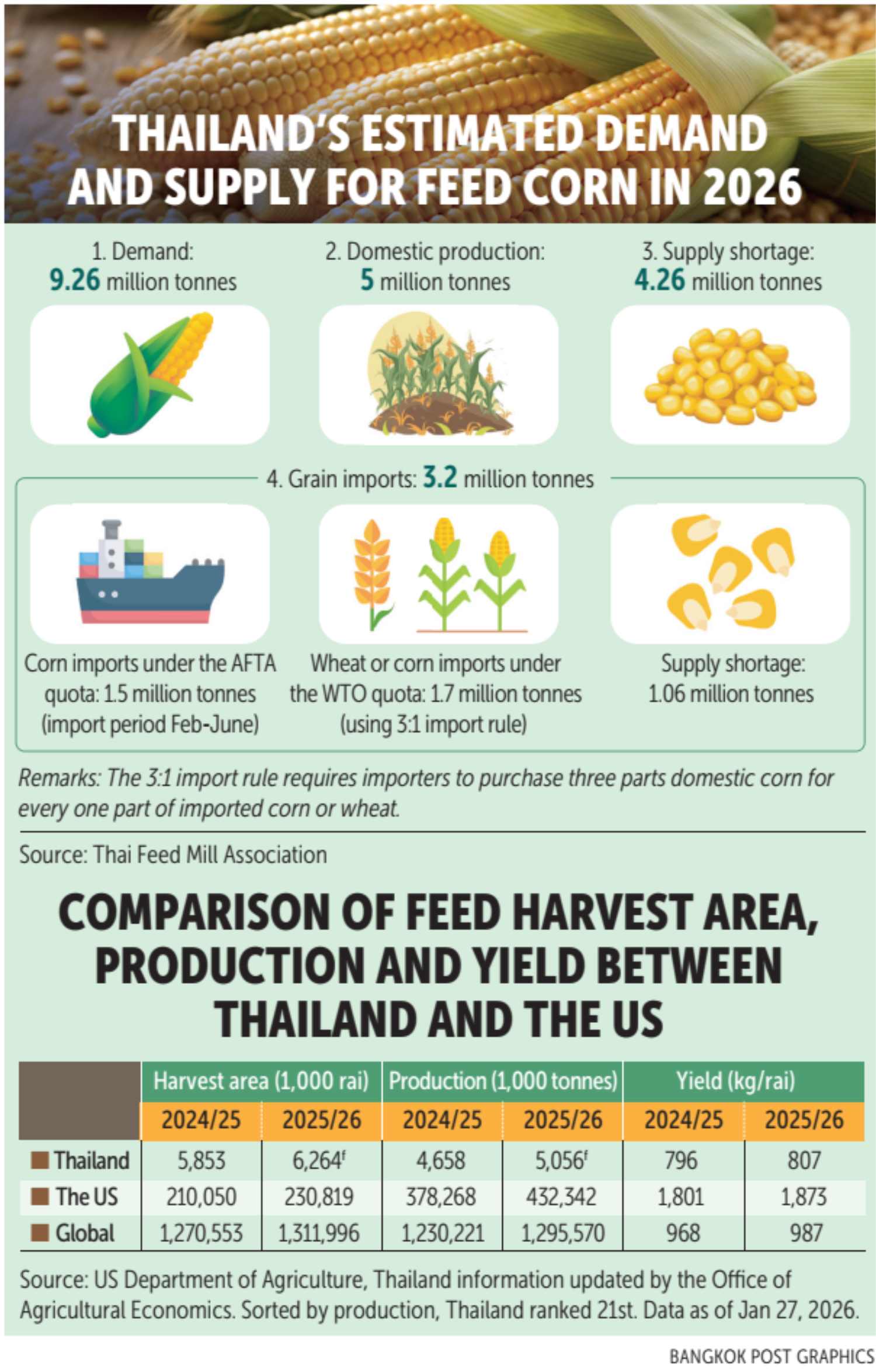
Thailand uses about 9 million tonnes of feed corn annually, but produces only 5 million tonnes, a shortfall of 4 million tonnes.
Each year, roughly 3.2 million tonnes are imported, including 1.5 million tonnes of corn from neighbouring countries and 1.7 million tonnes of wheat, leaving a deficit of about 800,000 tonnes.
Pornsil Patcharintanakul, president of the Thai Feed Mill Association (TFMA) and secretary-general of the Federation of Livestock and Aquaculture, said Thailand requires burn-free certification for all feed corn and wheat imports to curb cross-border air pollution. As a result, corn imports from Myanmar are expected to fall to 1.1 million tonnes this year.
Why is Thailand importing feed corn from the US?
The government decided Thailand would import 1 million tonnes of corn from the US in 2026. On Nov 11, 2025, the cabinet approved an expansion of Thailand's World Trade Organization (WTO) corn import quota from 54,700 tonnes to 1 million tonnes. The in-quota tariff is reduced from 20% to 0%, while the out-of-quota tariff remains at 73%, together with a fee of 180 baht per tonne.
Thailand has a trade surplus with the US of more than US$35 billion. As part of ongoing trade negotiations, Thailand is required to provide market access for certain US products, with feed corn among those under consideration.
According to the TFMA, importing US feed corn reduces the risk of higher tariffs being imposed on Thai exports to the US, potentially supporting the broader economy.
During certain periods, US corn is cheaper than wheat, making it a cost-effective alternative that can reduce feed production costs and livestock farming expenses.
Mr Pornsil said US corn imports align with emerging trade trends that value environmentally sustainable production. US corn is cultivated using sustainable agricultural practices that generally result in a lower carbon footprint.
How do these planned imports affect local corn farmers?
A representative from the Crops Grower & Merchandise Association told local media that US corn imports will negatively affect Thai corn in the future because of lower prices for the imports.
Allowing imports without clearly defined periods may overlap with domestic harvests, complicating raw material management and potentially resulting in a glut, said the agent.
The TFMA argued that importers need to purchase all available Thai corn before importing corn under the WTO quota. Importers must comply with the 3:1 import regulation, which requires importers to purchase three parts domestic corn for every one part of imported corn or wheat.
The association said US corn imports are not intended to replace Thai corn, but to serve as an alternative to wheat imports.
Why don't feed mills use domestic alternative raw materials instead of imported corn?
The TFMA said animal feed formulation requires a balance of nutritional value, animal growth performance, and cost efficiency. Alternative ingredients such as broken rice, cassava chips and rice bran can be used when their nutritional value and cost are comparable to or more competitive than corn.
However, their use is often limited by availability and technical constraints, noted the association. For example, paddy rice contains high levels of fibre, limiting its inclusion rate in feed formulations. Paddy rice also requires digestive enzymes, which increase production costs, and it lacks the pigmentation of corn, has a higher moisture content that shortens its shelf life, and it contains a hard husk that may lead to rapid deterioration of machinery.
Cassava also contains high levels of fibre, limiting its usage in feed. Cassava may be contaminated with Clostridium perfringens from soil, which can cause digestive diseases in animals.
In addition, excessive use of cassava can impair pork carcass quality by producing harder fat with a dull appearance that is less preferred in the market.
Moreover, rice and cassava are primarily export-oriented crops. Increasing their use in feed production generally occurs during periods of weak export demand. When export markets recover, supplies available for feed use become limited.
Will genetically modified organism (GMO) corn from the US affect Thai meat exports?
The TFMA said GMO crops are widely used around the world. Thailand has used GMO soybeans in food and feed production for more than 30 years without a negative impact.
The use of GMO feed ingredients has not affected Thailand's meat exports, noted the association.
Regarding concerns about contamination, the Department of Agriculture has repeatedly reviewed the issue and consistently confirmed that GMO crops are safe.
How can Thailand improve its corn production?
Prof Chaiyapoom Bunchasak, a nutritionist at the Department of Animal Science at Kasetsart University, told the Bangkok Post government policy plays a crucial role in improving corn production in the country.
However, Thai administrations have not sufficiently prioritised the application of science and technology to increase productivity and reduce production costs, enabling farmers to reach the break-even point, he noted.
"The current conditions for corn production set by the government, involving regulations on seed varieties, fertiliser use and farm management practices, prevent farmers from achieving the break-even point," said Prof Chaiyapoom.
Farmers will be unable to adapt unless the government undertakes a comprehensive review and revision of cultivation requirements, which includes reconsidering policies on GMO crops, the use of herbicides and insecticides, and productivity standards such as yield per rai, he said.