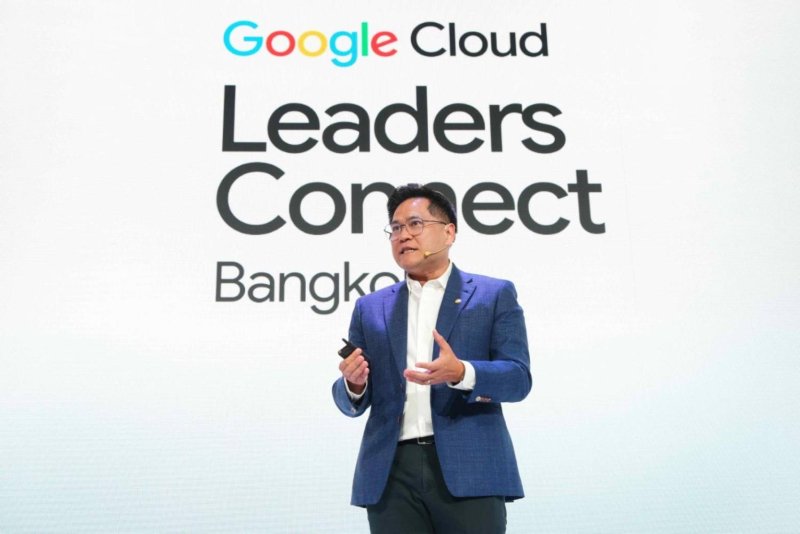
Adopting artificial intelligence (AI) at an enterprise level has the potential to generate 1.4 trillion baht in economic value for Thailand over five years, says Google Cloud Thailand.
"Rather than focusing on standalone AI tools, companies need to embed AI into core business operations to improve efficiency, automate routine tasks and support data-driven decision-making," said Saruj Thipsena, country manager of Google Cloud Thailand.
Many organisations remain in the "individual AI" stage, where employees independently use public AI applications without enterprise governance, he said.
To unlock greater business value, companies need to transition to what Google calls "institutional AI", integrating AI across organisations under common governance, workflows and data management.
This requires standardised AI policies across departments, collaboration between business functions, AI embedded into workflows, secure access to enterprise data, and organisation-wide integration rather than isolated pilot projects, noted Mr Saruj.
"If executed properly, AI could contribute 1.4 trillion baht in economic value to Thailand over five years, creating numerous jobs and professions," he said.
Successful enterprise AI depends on three factors: seamless integration into employees' daily work, secure access to internal corporate data without risking information leakage, and measurable business outcomes.
To support enterprise adoption, Google Cloud offers Gemini Enterprise, which lets organisations use AI while ensuring proprietary corporate information remains within the company's environment.
The company also provides the Gemini Enterprise Agent Platform, allowing businesses to develop and manage multiple AI agents for specialised functions, such as customer service or inventory management, while enabling them to work together without extensive manual programming.
Google Cloud is also emphasising its vertically integrated AI infrastructure, spanning custom chips, cloud infrastructure, AI models, analytics and applications.
As organisations transition from pilots to full production, managing the economics and predictability of running complex AI workloads becomes a critical differentiator.
TOKENOMICS
Mr Saruj said a key advantage is what Google calls "tokenomics", which allocates simpler tasks to smaller, lower-cost AI models while reserving larger, more advanced models for complex requests, helping organisations optimise AI spending.
Widespread enterprise adoption will depend not only on access to AI technology, but also on organisations redesigning business processes, strengthening governance and investing in human capital to ensure AI delivers measurable business value, he said.
"AI has dramatically shifted the threat landscape, and attacks that used to take weeks to carry out can now happen in mere minutes or hours," said Steve Ledzian, chief of technology for Google Cloud Security and Mandiant, Japan and Asia-Pacific.
To defend against this range of threats, organisations need more than one model or agent -- they need a collection of models for multiple passes, and a solution that can analyse their systems, prioritise the most significant threats, and patch vulnerabilities quickly, while continuously monitoring for new attacks, he said.
Vulnerabilities tripled from about 20,000 in 2020 to 60,000 this year, while the time needed to weaponise them has fallen sharply, said Mr Ledzian.
Fixing flaws during coding can take seconds, compared with up to 40 hours after deployment.
"My focus is partnering with my team and our partners to bring the full power of our open, end-to-end AI stack to Thai enterprises, helping them translate AI potential into tangible economic value," Mr Saruj told the Bangkok Post.
"Google Cloud's DNA includes delivering open and integrated solutions, alongside its investments in local infrastructure enabling support for customers in uncertain times and rapid AI developments."
Regarding criticism of data centres' massive natural resource consumption, he said that Google's data centres rank among the top globally for energy efficiency, achieving 83% greater efficiency compared with standard data centres.