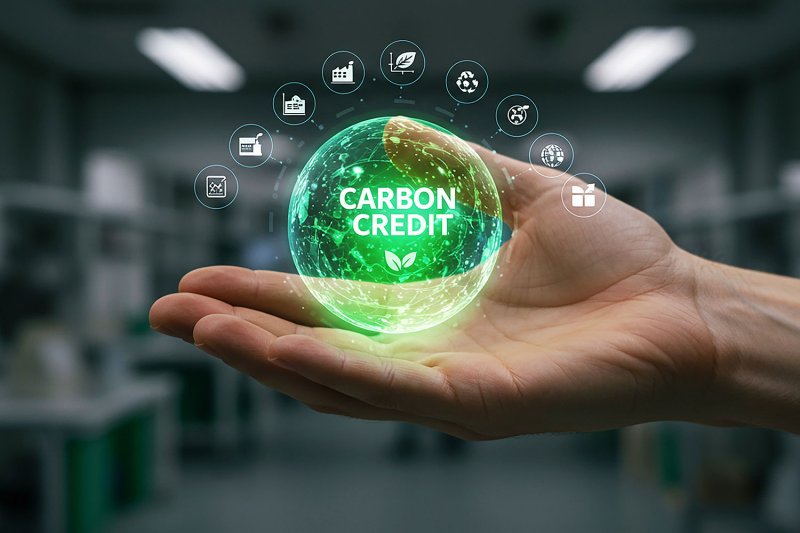
A new set of trade rules is sweeping through the business world. This time, it is not about price or quality. It is about carbon reduction. The big question is whether companies can keep up with this particular "green" goal.
Environmental pressures are rocking global trade and its supply chains to the core. Businesses are expected to take responsibility for their environmental impact, not as a choice, but as a condition of market access.
This is not only about large corporations, but also about small and medium-sized enterprises as trade and investment trends shift.
As carbon rules tighten amid the climate crisis, SMEs cannot afford to stand still. In a low-carbon economy, green transition has become a business imperative.
For Thai SMEs, the journey begins with recognising the shift in global trade rules -- and the need to change how they do business. To avoid being left behind by new pressures in global trade, they need to understand what the transition requires and the benefits they will receive in return: lower costs, greater efficiency, and better access to future markets.
From awareness comes action
The first step is to assess where their business stands. How "green" is it already? The government has developed self-assessment tools such as the Green SME Index and the Green Enterprise Index to help answer that question.
Then comes planning. SMEs must identify what needs to change, set priorities, and design green projects or activities. These plans lead to implementation and investments to make operations more environmentally friendly.
And finally, monitoring and evaluation. The steps are clear. But the path is not easy.
Most SMEs are still preoccupied with basic survival: cash flow, costs, and market uncertainty. Environmental concerns often feel distant, secondary.
There is also a common misunderstanding. Many believe the green transition requires large-scale change and heavy investment. In reality, some green actions are simple and already adopted by SMEs to improve efficiency.
Using energy-efficient machinery, installing solar panels, and switching to electric vehicles. These are practical measures already in place but not recognised as part of a wider green transition.
Still, obstacles remain.
Many SMEs lack the capacity to plan and carry out green initiatives. They then depend on external expertise, which adds cost and complexity. Access to funding is another barrier. True, Thailand's green finance market is growing, but for SMEs, it remains hard to reach and even harder to use.
Green finance to support this transition includes financial tools such as green deposits, green loans, green bonds, and sustainability-linked bonds. For SMEs, green loans are the most relevant.
Government-backed schemes offer a starting point. For example, the Bank of Thailand's Financing the Transition programme and the SME Green Productivity programme from the Office of Small and Medium Enterprises Promotion (OSMEP).
These schemes not only have lower interest rates but also longer repayment periods and credit guarantees from the Thai Credit Guarantee Corporation.
Meanwhile, banks are expanding green finance services to meet growing demand and build their own portfolios.
Unfortunately, the progress remains slow.
According to a 2023 Bank of Thailand report, green loans account for only 1.4% of total outstanding loans. And most of them go to large companies.
Why are SMEs left behind?
Part of the answer lies in familiar constraints. Being small, they have limited business capacity, raising banks' concerns about their ability to repay.
In practice, the criteria for green loans are not much different from conventional loans. Financial institutions still focus on business readiness and the ability to repay.
But there is an added layer of hurdles.
SMEs must present clear plans for green projects or activities. This often becomes a burden. Documentation takes time and resources. But most SMEs lack proper data systems. Without reliable data, banks cannot assess their business risks and approve loans.
For SMEs to help Thailand reach its Net Zero target by 2050, the government has a key role to play.
First and foremost, it must make SMEs believe that transitioning is not difficult and that they will benefit from it.
Tax incentives can be a game-changer. Incentives include tax benefits for green activities, subsidies for adopting green technologies, and advantages in green procurement processes. A good example is the United Kingdom, which is effectively using tax incentives to encourage high-emission businesses to adjust.
Coordination within the state bureaucracy is just as important.
Government agencies need to work together to make the transition less complicated.
Tools such as the Green SME Index and the Green Enterprise Index should not stand alone. Their results should link directly to state support, such as advisory services in assessment and planning for green transition, access to technology, and financing.
There is also a need for simpler systems.
SMEs need practical ways to report sustainability and carbon reduction. They do not want complex frameworks but tools they can actually use. Better data would improve their chances of securing green loans and allow for proper monitoring of progress.
Malaysia's Greening Value Chain programme is also taking this approach by combining green financing with technical training and access to software to track greenhouse gas emissions.
For Thailand's new government, the starting point is clarity. It must set a clear direction for the transition, starting with identifying target industries -- those with high emissions or those most exposed to future pressure.
It should also focus on low-risk green activities that can reduce business costs. These are the easiest entry points. They build confidence and deliver results.
If policy direction is clear and state support is accessible, the green transition will no longer feel like a burden for small businesses. Instead, it will be an opportunity to cut costs, improve efficiency, and stay competitive in a market that prioritises the environment.
At that point, Thai SMEs will not simply be adapting. They will be positioning themselves within emerging green supply chains, both at home and abroad.
And the question will no longer be whether they can afford to change, but whether they can afford not to.
Urairat Jantarasiri is a researcher at the Thailand Development and Research Institute (TDRI). Their policy analyses appear in the Bangkok Post on alternate Wednesdays.