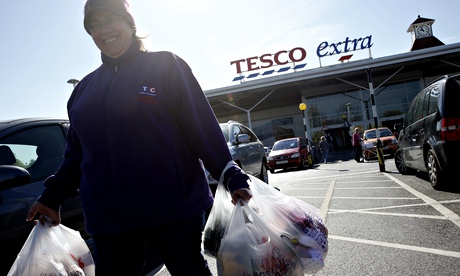
Tesco has made a loss of £6.38bn. That’s not much less than Nicaragua’s annual GDP. It’s more dosh than most sub-Saharan African countries can dream of. It is “the official end of the Tesco era,” according to the retail analyst, John Ibbotson. “With this huge loss, the decadent retail dynasty of Tesco has come to an end.”
Decadent. That’s a big word, meaning a state of moral or cultural decline. To some of us, Tesco has always felt decadent, a rapacious giant that ruined high streets, hollowed out town centres and fuelled an economy built on extreme downward pressure on costs at one end in order to sell deceptively cheaply at the other.
But you don’t build a £50bn business that employs half a million people unless you have something to offer, and Tesco always has. Good value to the customer, fresh quality produce, and lots of low-skilled, part-time jobs. Tesco has come to stand for a particular way of doing business. It represents the ultimate triumph of the dividend over every other measure of a successful business. It is retail as an extractive industry.
The business model is the bottom line. It is the only morality. Chief executives live and die on price/earnings ratios. The ones who build hugely profitable businesses that can pay big dividends year after year are masters of the universe. This is what success looks like. It became a way of seeing that seeped into every aspect of public life.
Tesco’s glory years almost exactly match the dominance of Thatcherism. They go hand in hand with the attritional war against the idea of collective and communal values, or of doing the right thing rather than just the cheapest thing. Tesco provided the heroes to people the periphery of Margaret Thatcher’s political world: the chain’s founder, Jack Cohen (motto: you can’t do business sitting on your arse); his daughter, the controversial leader of Westminster council, Shirley Porter, under whose rule the political advantages of shrinking the number of council tenants in the borough was first appreciated; and Tesco’s first megaboss Lord MacLaurin. These were the archetypes of Thatcher’s new world order.
The East End market stall that grew into a global colossus by giving customers what they wanted before they realised they wanted it, and always at a price Tesco as well as the customer could afford: this was a model that Thatcher set about incorporating into government. The bottom line was measured in public spending. The dividend was re-election.
Tesco grew. And grew. And grew. It bought up its rivals. It cut its costs. It drove down high street prices. It created a whole new way of doing business that relied on squeezing suppliers, who in turn squeezed their suppliers, who then squeezed their workers. That’s why food processing is now Britain’s biggest manufacturing sector and also its lowest paid, one of the biggest magnets for workers from the poorer parts of Europe.
As Tesco’s rivals began to wear away at its market share, profitability began to shrink. It is now becoming clear that some of Tesco’s business practices began to fall below what even the incurious minds of the City would find acceptable. In the past year, eight executives have been suspended in the wake of the discovery of questionable financial reporting tactics that appeared designed to inflate profit expectations.
But that wasn’t all. Last month, the new chief executive, Dave Lewis, announced he was simplifying the way Tesco dealt with suppliers. His announcement revealed what insiders had known for a long time. Tesco had long since stopped been primarily interested in selling stuff to customers. It made its real money out of charging its suppliers to sell their products to Tesco customers. It was actually selling its customers to its suppliers.
There is an eerie parallel between this and successive governments’ privatisation of public services. We the voters are being parcelled up and sold to G4S and Serco.
But before anyone starts to incant funeral rites over one of the biggest success stories of 20th century British business, remember this: Tesco is still the place where almost £1 in every £3 is spent in supermarkets. It is still 10 percentage points bigger than its nearest rival. It is still a £50bn business.
So, in the same way that it is beguiling to imagine that the current strength of challenger parties in the political world means an end to the corset of the two-party system, it would be lovely to imagine that Tesco is sinking and a new world of independent, value-based shopping is opening up ahead. But it isn’t. It may stop flogging us, the customers, to its suppliers instead of the other way round. But the City seems confident it will find another way to do business. Just look at its share price.