Fruit bats fell from the sky and died after their homes -- giant trees that had stood for generations in a temple compound -- were cut down on the abbot's orders. Public anger was swift and justified.
Traditionally, temples are regarded as khet aphai than -- sanctuaries where life is protected. For centuries, temple grounds have provided refuge not only for people but also for trees, birds, bats and countless other living creatures. In many communities, old temple compounds preserved pockets of nature long after they had disappeared elsewhere.
That is why the deaths of the khang khao mae gai (Lyle's flying foxes) at Pikul Kaew Temple in Nakhon Nayok struck such a nerve. They died in a place where they should have been safest.
The deputy abbot of Wat Pikul Kaew said a vendor's car had been damaged by a falling branch from one of the temple's Yang Na trees. To ensure public safety and allow the area to continue operating as a temple market, he said tree cutting was necessary.
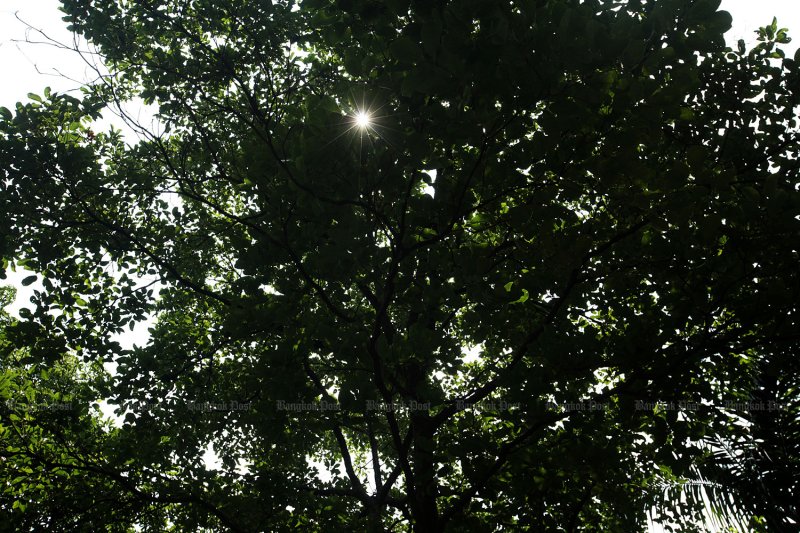
Curiously, the tree in question reportedly remained standing. Instead, four giant Yang Na trees were felled. Among the largest and oldest on the temple grounds, they were more than a century old, with trunks measuring more than 1.5 metres in diametre.
In viral video clips, villagers expressed shock and sadness at the sight of the fallen giants. The trees had long been part of both the landscape and the community's collective memory. For decades, flying foxes had roosted in their branches. Their grief only deepened when they saw fruit bats lying dead beneath the fallen trees or desperately clinging to what remained of their shattered habitat.
Public outrage intensified further when residents learned that the timber had reportedly been handed over to the logging contractor free of charge. Many asked why they had never been consulted.
Images of the fallen trees and dead bats spread rapidly across social media, provoking anger far beyond Nakhon Nayok.
The tragedy at Wat Pikul Kaew was more than a single abbot's mistake. It highlighted a broader lack of environmental awareness within parts of the clergy and exposed a system that allows abbots to make major decisions with little community oversight.
It also raises questions about monastic education. At a time when even schoolchildren are taught about climate change and biodiversity, how can those entrusted with managing temple grounds fail to recognise the value of century-old trees and the wildlife they support?
Old trees are not merely large plants. They are ecosystems, providing habitat, regulating temperature, absorbing carbon and sustaining biodiversity. Likewise, a colony of fruit bats is not a nuisance but part of a healthy natural environment.
At present, abbots wield near-absolute authority over temple assets, with decisions that can have lasting environmental consequences. The same applies to cultural heritage.
Thailand has witnessed repeated cases in which historic structures have been demolished in the name of temple development. The most notorious example is Wat Kalayanamit in Bangkok, where registered historic buildings, ancient pavilions and old monastic residences were torn down to make way for new construction.
When material development becomes a criterion for advancement within the ecclesiastical hierarchy, many abbots are encouraged to replace the old with the new. Heritage comes to be viewed as a burden rather than a treasure.
The same mindset helps explain why ancient trees are removed to make way for commercial facilities. Nature and history are treated not as assets worth preserving but as obstacles to schemes presented as progress.
Temples are not private property. They are public institutions sustained by generations of faith, donations and community support. Monks should consult local communities and relevant experts before making decisions with irreversible consequences.
Environmental education matters, as does heritage education. The clergy should do far more to equip monks with a better understanding of conservation and cultural preservation.
Yet education alone is not enough. Even the most enlightened abbot should not exercise unchecked authority over assets that belong not only to a temple but also to future generations.
Most importantly, the Sangha Act should be revised to bring greater transparency and accountability to temple management.
The bats at Wat Pikul Kaew had no voice. Neither did the century-old trees. Villagers, however, do have a voice, yet clerical authorities appear unwilling to listen. That may be the most troubling aspect of all.