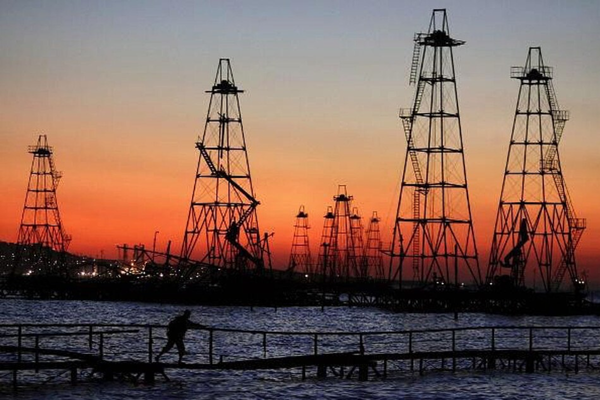

Asian shares mostly retreated on Wednesday after a sell-off in technology stocks on Wall Street, while oil prices climbed following fresh US airstrikes against Iran.
The US military launched attacks after US President Donald Trump vowed to retaliate, accusing Iran of bringing down an Apache helicopter that crashed near the Strait of Hormuz on Tuesday morning.
Tehran vowed to respond, saying it "will leave no attack or threat unanswered".
The latest escalation has raised doubts about prospects for a lasting end to a conflict that has now lasted more than three months, unsettling markets already rattled by volatility in artificial intelligence-linked stocks.
However, despite the uncertainty over the full reopening of the Strait of Hormuz, oil prices were slightly lower in early trading on Tuesday.
The front month contract for Brent crude, the international benchmark, and the US benchmark crude, WTI, both fell roughly 0.3% at the time of writing, trading at $91.20 and $87.90 per barrel respectively.
"The situation remains highly volatile," ING commodities strategists Warren Patterson and Ewa Manthey wrote in a note.
"This once again demonstrates the difficulty Iran and the US face in working towards a sustainable ceasefire that allows for the free flow of vessels through the Strait of Hormuz," the analysts added.
They added that seasonal demand remains strong, contributing to the overall upward pressure on prices.
Wall Street sell-off spreads to global markets
Key European markets had a mixed reaction at the open on Tuesday morning.
The Euro Stoxx 50 traded 0.3% lower but the broader pan-European Stoxx 600 rose around 0.3% in early trading.
Germany's Dax was up 0.25%, France's CAC 40 was lower by 0.3%, while the UK's FTSE 100 declined 0.5%. Meanwhile, Italy's FTSE MIB rose by 0.4%.
In other stock markets, technology shares led the decline as investors worried that possible higher interest rates could hurt growth companies, which often rely on borrowing and future earnings expectations.
Traders are closely watching US inflation data due on Wednesday, with economists expecting consumer prices to rise at their fastest annual pace in more than three years.
Strong US jobs data released last week increased speculation that the Federal Reserve might raise interest rates to combat inflation.
Markets have also become nervous after a strong AI-driven rally since March, with some investors questioning whether tech valuations have become too high as SpaceX prepares to IPO on Friday.
US futures edged lower after losses among chipmakers on Wall Street, including Micron Technology, Advanced Micro Devices (AMD) and Marvell Technology.
In Asia, South Korea's Kospi fell 4.7% to 7,720.59 after a sharp rally a day earlier. Samsung Electronics, which makes memory and logic chips and is the country's most valuable company, dropped 5.8%. Shares of chipmaker SK Hynix lost 6.3%.
Japan's Nikkei 225 declined 1.4% to 64,524.84 after data showed producer prices rose 6.3% in May from a year earlier, marking the fastest increase in more than three years.
Shares of multinational investment holding firm SoftBank Group, which has significant exposure to AI-related investments, fell 8.9%. But chipmaker Tokyo Electron advanced 5.3%.
Hong Kong's Hang Seng Index lost 1.1% to 24,296.62, while mainland China's Shanghai Composite slipped 0.7% to 3,980.24. Official data showed Chinese producer prices rose 3.9% in May, their fastest pace in nearly four years.
Australia's S&P/ASX 200 edged up 0.2% to 8,624.50. Taiwan's Taiex fell 1.6%, while India's Sensex gained 0.6%.
On Wall Street, the S&P 500 fell 0.3% to 7,386.65 on Tuesday. The Dow Jones Industrial Average rose 0.2% to 50,872.11, while the technology-heavy Nasdaq composite fell 1%.
US chipmaker Micron Technology went from an early 4% gain to a 10% drop before closing 1.4% lower. Marvell Technology fell 7.6%, and AMD lost 3%.
Investors are also watching key US inflation data due later this week, as higher energy prices linked to the Iran war raise concerns about inflationary pressures.
In currency markets, the US dollar was little changed at 160.36 yen, while the euro edged up to $1.1550 from $1.1543.
Gold fell 2% to $4,197.60 an ounce in early European trading.
In bond markets, yields on major European 10-year government bonds edged lower on Wednesday, while the benchmark US 10-year Treasury yield rose 2.3 basis points to 4.545%.