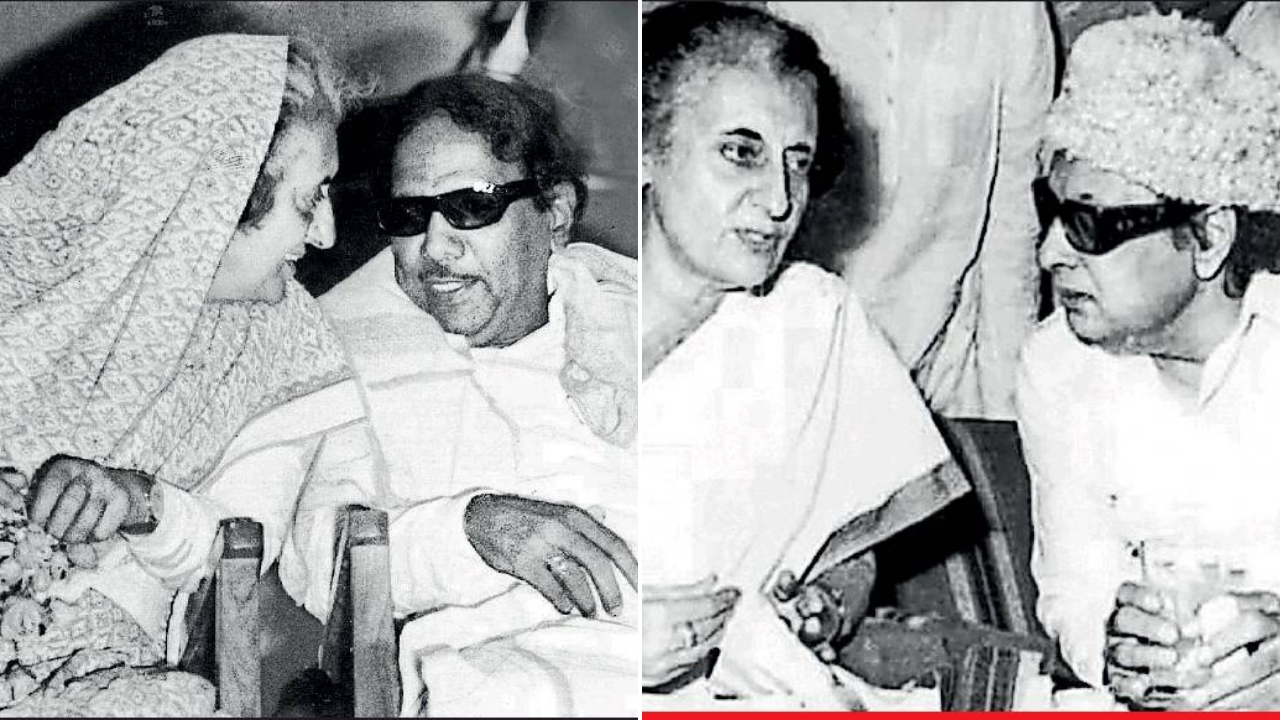
Fifty years ago, the unthinkable happened — despite diametrically opposite political standings, the DMK formed an alliance with the Indira Gandhi-led Congress faction for the elections to the Lok Sabha and the Tamil Nadu assembly held between March 1 to 7, 1971.
This development led to a new equation — the political arithmetic in TN became geometrical — two sides of a triangle were greater than the third. However big the third side, it faced defeat if the other two joined hands.
An alliance with the Congress for either the DMK or the AIADMK would end in a sweep. This trend continued for 25 years barring the 1980 assembly polls.
The Congress, which ruled the state from 1947 to 1967, has remained a junior partner in these 50 years.
Another development in 1971 was the beginning of the cracks in the relationship between M Karunanidhi and M G Ramachandran, changing the political landscape in the state, as the DMK and MGR’s AIADMK continue to battle it out for supremacy today.
The first watershed moment in 1971 came when the Indira-led Congress, called INC(R), decided to go for early elections to the Lok Sabha to overcome the problems due to the split in the party.
The DMK’s 25 Lok Sabha MPs had supported the Indira-Congress government after the split in 1969, leading to bonhomie between the two parties. However, an alliance was not easy given the conflicting ambitions of the two parties.
It was when Karunanidhi felt that the forthcoming alliance between K Kamaraj-led Congress(O) and Rajaji’s Swatantra party could knock the DMK out of power, that he decided to dissolve the state assembly and encash the Indira image to see his party through.
The DMK decided to include parties like the CPI, Praja Socialist Party, Tamizharasu Kazhagam, Muslim League and Forward Bloc as its allies. But the DMK was prepared to provide only about five seats for the Lok Sabha elections and 10 to 15 seats for the state assembly.
As the INC(R) was unhappy with the offer, relations between the parties were strained. In a compromise, the DMK increased the LS seats from five to 10. That sealed the deal as Indira Gandhi was keen on a victory at the Centre.
The decision of the INC(R) to forfeit assembly seats was considered a disastrous move by the TN unit. Years later, this folly was realised as the deal was tantamount to giving up its attempt at a comeback in the state after losing power in 1967, and yielding primacy of place to the DMK.
The INC(R) was happy that it won nine of the 10 seats including Puducherry as it enabled Indira Gandhi to be back in power with a big majority.
The DMK won 24 of the 25 seats it contested, losing only the Nagercoil seat to Kamaraj. In the state assembly, the DMK triumphed with a bigger majority than the 1967 mandate, winning 183 seats.
The second watershed moment of 1971 was now developing. Soon after declaration of results for the assembly polls, MGR, it is said, congratulated Karunanidhi on the victory and asked to be made the health minister.
To his shock, he was told that a cabinet berth would come at the cost of his film career. MGR seconded the resolution to make Karunanidhi leader of the legislature party again but remained disgruntled. Reports of the skirmish reached the Congress.
A senior intelligence department official, writing a series of articles in a Tamil magazine, revealed two decades later that senior Congress leaders worked on a plan to split and weaken the DMK MGR’s name was shortlisted as he was a popular actor.
MGR was subjected to intensive questioning by the income tax and enforcement directorate authorities over his income, properties and foreign funds for his films.
This official claimed he was then deputed to talk to MGR. He advised MGR to meet Indira Gandhi. The official claimed that MGR went to Delhi, accompanied by a lawyer and chartered accountant and came back happy.
MGR began to revolt against DMK leadership over issues like suspension of prohibition, and after his expulsion formed the AIADMK.
Socialist Leader George Fernandes had also stated in the early 1970s the Indira-led Congress was working on a plan to break the DMK.
The Union government also announced the National Award for MGR for the film ‘Richshawkaaran’ in 1971. Many felt the Congress was wooing MGR. Moves were afoot to boost the film career of Karunanidhi’s son Mu Ka Muthu as a rival to MGR, further driving a wedge between MGR and Karunanidhi.
For the LS polls in 1977, the AIADMK, Congress and CPI formed an electoral front and swept the elections. In the ensuing assembly polls, differences surfaced between the AIADMK and the Congress over seat-sharing, and the Congress decided to make an attempt to return to power in the state when G K Moopanar, as its state chief, approved of the Congress plan to go it alone.
Although Congress failed in the bid, it did gain a decent number of seats and vote share, which would have risen had the party pursued this line of action.
The Congress made another attempt, again with G K Moopanar as the state chief in 1989, to avoid alliances with the DMK and AIADMK groups, with the approval of Rajiv Gandhi, but yet fell short of the target.
However, the Congress did achieve a performance close to that of the AIADMK (Jayalalithaa group). Here again, the Congress abandoned the agenda of strengthening itself and went in for alliances with either the DMK or the AIADMK for the sake of a few seats in Parliament or state assembly.
What began in 1971, could not be undone by Indira or Rajiv Gandhi. The Congress was pushed to the background, and the Kazhagams came to dominate the state political scene.
The split in the Congress, with the formation of the Tamil Maanila Congress in 1996, turned out to be the proverbial last straw on the camel’s back.
As for the DMK and the AIADMK, they went in for opportunistic alliances with the Congress, despite differences over policy issues, thus diluting the Dravidian plank.
(The writer is a senior journalist)