A decade after Congress first allowed federal funding to support clean needle programs, the Trump administration is backing off that policy, potentially risking progress made against hepatitis C, a deadly but curable virus mostly spread by people who inject drugs.
The administration now says funding can no longer support programs such as paying the people who distribute syringes, framing it as “enabling” drug use.
The change is part of the administration’s broader rejection of a public health approach aimed at reducing the harms of drug use through measures like syringe services, test strips, as well as efforts to connect people with food, housing and medical care.
What could follow is a spike in preventable infectious diseases like hepatitis C, which countries like England are on the way to eliminating as a public health threat by 2030 — in part by expanding access to testing and clean needles for people who inject drugs, public health advocates say.
“Limiting access to test strips, as well as clean syringes, puts American lives at risk,” a group of senators led by Sen. Edward J. Markey, D-Mass., said in a letter to the Substance Abuse and Mental Health Services Administration in response to the change.
While Congress first banned the use of federal funds to purchase syringes in the 1980s, it loosened that restriction in 2016 to allow funding for syringe services programs — such as staffing facilities and other operating costs — but not for buying needles themselves.
The administration’s actions prohibiting federal funding for those services “flies in the face of Congressional intent, undermining the programs designed to prevent outbreaks in the communities most vulnerable to them,” the lawmakers said.
The shift comes despite a Trump administration vow to eliminate hepatitis C as part of its goal of “ending chronic disease,” the strongest endorsement yet of a goal the United States signed onto in 2016.
Hepatitis C still kills more than 11,000 people a year in the U.S., despite the availability of a cure that has been on the market for more than 10 years.
The administration committed to reducing cases of the disease as recently this month as it sought public comment on programs to battle addiction, while noting within the same document it was “ending support for harm reduction, including syringe services.”
“Syringe services will have to make some hard choices,” like reducing services or hours, said Regina LaBelle, director of the Addiction and Public Policy Initiative Georgetown University and former acting director of the White House Office of National Drug Control Policy under the Biden administration. “I’m very, very concerned about more outbreaks because we know that syringe service programs are effective in reducing blood borne diseases. It could potentially have a devastating impact in areas of the country.”
Research has shown syringe services reduce infectious diseases like hepatitis C and HIV by 50 percent while also increasing the likelihood someone will get treatment for substance use disorder.
But federal support for syringe services has long run hot and cold.
‘Strictly prohibited’
Recent communications from SAMHSA, the primary behavioral health grant-making agency, states that grantees are “strictly prohibited” from using federal funds, directly or indirectly, to support harm reduction efforts that “facilitate illegal drug use.” That includes purchasing, distributing or supporting the “provision of drug paraphernalia.”
The result is a landscape of confusion, where states and programs remain unclear about how they can spend any federal funding they get. Some organizations now are trying to find separate funding to pay for staff to distribute syringes, according to people familiar with the situation.
An agency spokesperson did not respond to questions about whether grantees could still pay for services with separate funding.
“They’re really wondering how it is they’re going to be able to keep their doors open,” said Drew Gibson, director of advocacy at AIDS United, a nonprofit organization that works to end the HIV epidemic. “I think a lot of harm reduction organizations are starting to reevaluate how they pursue federal funding in terms of what they’re able to do with the money if they get it and whether the juice is worth the squeeze.”
Additionally, the Trump administration’s new political review of discretionary grants has slowed funding to states for substance use response and disease prevention, leaving harm reduction groups and others working to prevent HIV and hepatitis C facing delays and funding uncertainty.
In a recent notice to harm reduction grantees obtained by CQ Roll Call, the Minnesota Department of Health said it does not currently have the funds to continue supporting syringe service programs while it awaits funding decisions from the federal government.
Meanwhile, Centers for Disease Control and Prevention staff said in emails that funding “may not support harm reduction efforts that a reasonable person might conclude primarily serve to facilitate or promote illegal drug use” while highlighting things the administration supports including naloxone, which reverses opioid overdoses.
It’s part of a misunderstanding of what syringe programs do, said Paul LaKosky, executive director of the Dave Purchase Project, the North American Syringe Exchange Network and the Tacoma Needle Exchange.
“While syringe exchange is the basis of what we do, it’s the least of what good syringe exchange does,” he said.
Many programs are staffed with people who’ve experienced drug addiction and work to build trust in a community of people who may be suspicious of the health care system. Syringe services can help bridge the gap to other services, including hepatitis C testing and drug treatment.
The World Health Organization, which established the 2030 elimination goal, says syringe services are a key part to eliminating hepatitis C as a public health threat. It recommends countries make available 300 syringes per drug user per year.
“You need to have that alongside any implementation plan,” said Stuart Smith, director of community services for the England-based Hepatitis C Trust, a nonprofit helping move the country toward ending the virus as a public health threat by 2030. “You need to be giving them clean equipment so they’re not just perpetuating the cycle.”
In England, free syringes can be found at pharmacies, at most drug treatment centers and can be ordered by mail. “Peer workers” who have had hepatitis C also deliver syringes.
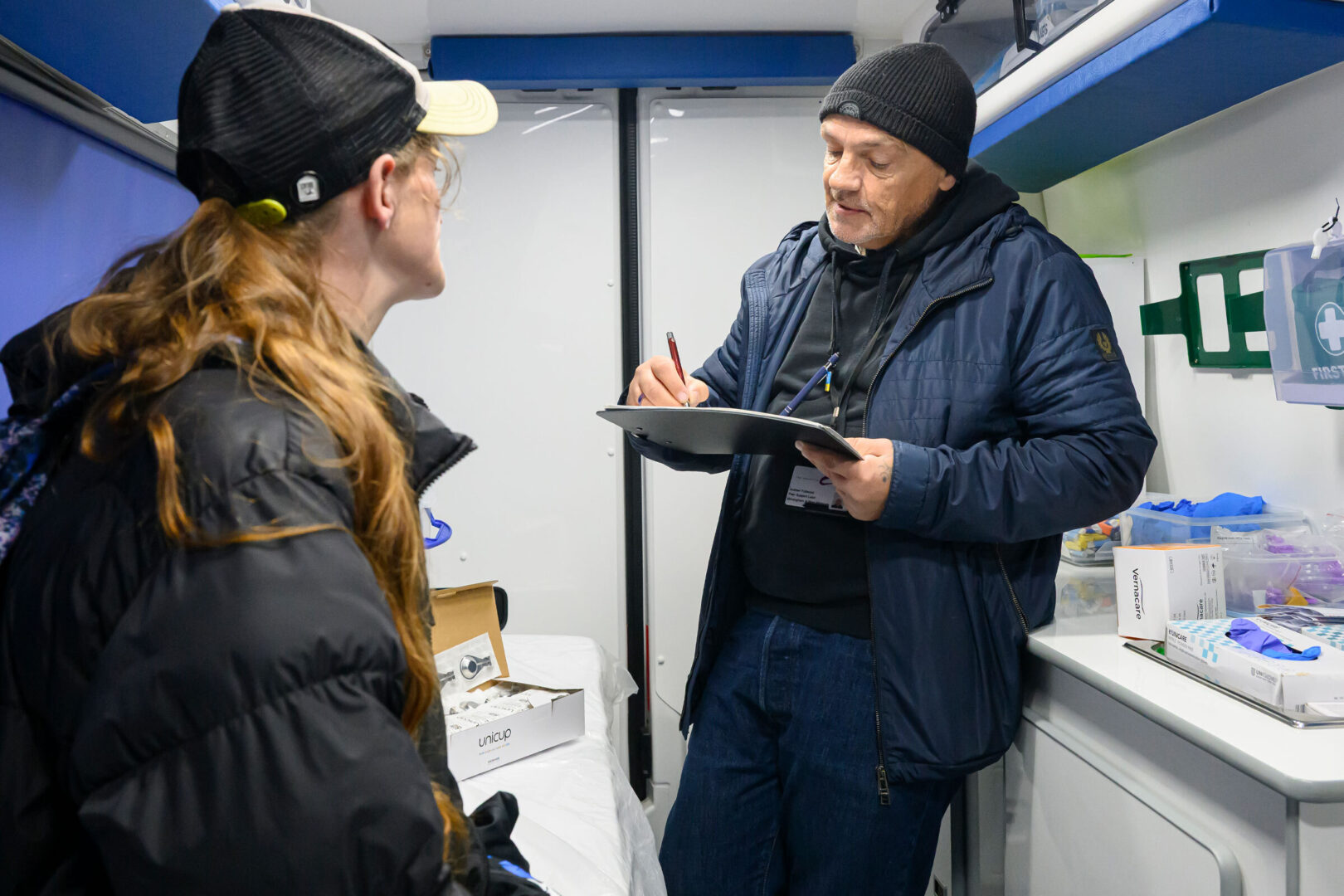
Still, access is a concern even in England, mainly due to funding issues. In downtown Birmingham, hepatitis C cases and reinfections spiked when the two biggest pharmacies shut down their syringe programs. The city council then contracted with the Hepatitis C Trust to deliver syringes and other harm reduction supplies out of a van at a downtown park, homeless shelters and other places people who use drugs hang out.
These efforts also involve testing for hepatitis C using Cepheid rapid point-of-care machines, which get results within an hour, and connecting people to treatment quickly.
“We’ve got to try and fill that gap. People are going to use drugs. You need to make sure they do it safely,” said Paul Huggett, a manager with The Hepatitis C Trust in Birmingham.
Testing lag
Federal government investment in syringe programs has been scarce in the United States, where many operate on shoestring budgets and acquiring equipment like a Cepheid machine is often out of reach.
Instead, many programs rely on antibody tests, which can show whether someone has ever been exposed to hepatitis C but cannot determine if the infection is active.
Others use dried blood spot tests, which can detect active infections but often take several days to get results from a lab.
That lag can make it harder to move people into care, said Jack Martin, a founder of Southside Harm Reduction Services in Minneapolis. The organization runs a syringe program, offers antibody hepatitis C testing, connects people to treatment, and provides basic services such as food and clothing.
“It just creates a lot of work to be able to get people into treatment, or be able to do follow-up testing,” Martin said. “It’s kind of a hard position to be in. Getting the message that you may have hepatitis C is difficult to navigate, especially when it’s as common as it is.”
A Cepheid machine would allow the program to test people and connect them to treatment during the same visit.
“It just seems like such a great solution,” he said. “It’s so much better than the hepatitis C testing flow we have now.”
In 2021, Congress under Democratic control authorized $30 million for harm reduction programs, including syringe services. That funding expired at the end of 2024.
House Republicans in the fiscal 2027 Labor-HHS funding bill committee report said the measure would not fund any “harm reduction activities” and commended the Trump administration’s “shift away from harm reduction activities that facilitate illicit drug use.”
But the same bill includes a long-standing policy allowing funds to support a syringe program if the CDC determines a state or community is at increased risk for the spread of HIV or hepatitis due to injection drug use. The rider still prohibits federal fund for direct purchase of syringes.
Advocates have come close to getting that ban removed from spending legislation, said Chad Sabora, a harm reduction expert. But it fell through amid attacks on harm reduction and syringe services.
“Getting people to accept something so simple and accepted in every other sovereign nation — like syringe service — will take years. It’s absurd how hard we have to fight for these services,” Sabora said. “It may not be the avenue they chose, but it gives them the results they’re looking for, like less disease and more treatment.”
This report is part of a series made possible by a reporting fellowship sponsored by the Association of Health Care Journalists and supported by The Commonwealth Fund.