Tony Abbott, the Australian prime minister, has said his national security team needed to look into why a self-styled Islamist activist with a troubled history was allowed to be at large, as witnesses paid tribute to the two hostages who died in the Sydney cafe siege.
He said officials were seeking answers to questions on the minds of all Australians.
“How can someone who has had such a long and chequered history not be on the appropriate watch lists and how can someone like that be entirely at large in the community?” Abbott told reporters in Sydney. “These are questions that we need to look at carefully and calmly and methodically, to learn the right lessons, and to act upon them.”
Abbott said security agencies and the government had been responding effectively since terrorists began threatening acts of random violence against Australians. But had the “sick and disturbed” individual behind the siege been on a watchlist it was still possible the incident could have occurred.
“The level of control that would be necessary to prevent people from going about their daily life, would be very, very high indeed,” said Abbott, who described Man Haron Monis, the 50-year-old gunman, as a “deeply disturbed individual” who sought to associate himself with the “Isil death cult”.
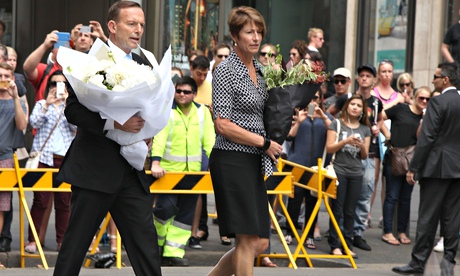
Abbott and the leader of the opposition,Bill Shorten, laid flowers at a makeshift memorial in Martin Place on Tuesday. Shorten joined the prime minister in expressing the condolences of the nation.
“There is still a lot to learn about why this happened and indeed what happened. We need to also learn how we can ensure that this doesn’t happen again,” he said.
The two hostages who died have been named as cafe manager Tori Johnson, and barrister Katrina Dawson.
A statement released on behalf of Johnson’s brother read: “We are so proud of our beautiful boy Tori, gone from this earth but forever in our memories as the most amazing life partner, son and brother we could ever wish for.”
Peter Manettas, from Nicks Restaurant and Bar group, where Johnson worked for more than six years, told Guardian Australia he “always put everyone else first”.
“He was a leader. He was a very selfless person, he always put his staff before anything else,” said Manettas, adding that Johnson was close to his family, and maintained close ties with many of his former co-workers when he left to work for Lindt.
Dawson, a 38-year-old mother of three, was buying a coffee with fellow barrister Julie Taylor in the Lindt cafe when the gunman attacked. They practised in the nearby Eight Selborne chambers. It is believed Taylor was forced to appear in one of the propaganda videos made by the gunman during the siege. The videos were released on to social media early on Tuesday.
Dawson was a highly regarded commercial barrister whose areas of practice included banking and insolvency law, commercial competition and consumer law, corporations law, equity and property. She was the sister of prominent media barrister Sandy Dawson, and the daughter of McKinsey executive and a sculptor. Sandy Dawson recently represented Fairfax Media in its defamation case against the treasurer, Joe Hockey.
She was married to Paul Smith, a partner at Mallesons, whom she met while completing her clerkship at the firm.
A friend of Dawson told the Australian Financial Review: “I can’t even believe it is her. Just that face, the dimples, the eyes – she was just unforgettable really. I remember thinking how capable she always seemed, balancing a career and her kids.”
Family members and friends of several of the hostages told Guardian Australia of a terrifying and unpredictable 17-hour ordeal as Monis forced hostages to film videos outlining his demands, and pressganged cafe staff to act as his sentries, escorting customers to the toilet and back to the shop floor.
As the siege wore on, Mounis, realising his message was not getting out, grew suddenly more angry. He saw that his dictated phone calls to media outlets were not being played live to air as he insisted, the videos he had forced his hostages to shoot were not being broadcast and his demands weren’t being heard. He turned his fury upon those he held captive.
Monis forced the cafe staff to act as his emissaries. He demanded they call newsrooms across Sydney, at 2GB, Nine, Seven and the ABC, to relay his demands. The journalists who took the calls have reported being able to hear his commands barked in the background.
Monis had three demands. Based on the number of people standing before him, he had created a bartering system he felt would ensure outside acquiescence. In exchange for an on-air live broadcast phone call with Tony Abbott, Monis was prepared to release five hostages. In exchange for a public declaration from the government that his was an act of terror committed on behalf of Islamic State, he was prepared to release two more. And for a black Islamic State flag he was prepared to release a final prisoner.
None of Monis’s demands was met. Monis then forced his captives to appear in brief videos, designed for the widespread public dissemination of his demands. The videos were posted online by several news websites and on YouTube but were removed at 12.30am.
The bloody end to the siege happened shortly after 2am local time when a loud bang was heard from the Lindt Cafe and a group of about six hostages fled the building. Moments later stun grenades and gunfire erupted as officers from the tactical operations unit carrying assault rifles and wearing body armour stormed in.
Details on the final minutes are confused and hazy, and police are still conducting interviews to piece together exactly what happened. It has been reported that, as Monis grew weary, one or more of his hostages attempted to wrestle the gun from his control.
Police will only confirm they heard gunshots fired inside the building shortly after 2am, and immediately burst in through the doors. Officers threw volley after volley of flash-bangs into the building, filling the cafe with disorienting light and smoke. Throughout, augmenting the noise, was the unmistakable pop of gunfire. Monis was pronounced dead on arrival at hospital after being shot during the gunfight.
Monis was released from custody despite facing more than 40 offences. Monis, 50, first gained notoriety when he wrote a series of offensive letters to grieving families of several soldiers killed in Afghanistan. He was placed on a two-year good behaviour bond for this in 2013. But within a year he had been charged with being an accessory to his ex-wife’s murder and more than 40 sex offences against several women.
Noleen Hayson Pal, 30, was stabbed to death and set alight in April 2013 in Werrington in western Sydney.
Monis’s then partner, Amirah Droudis, 34, has been charged with her murder. Monis had been released on bail in December last year on the accessory charge. Magistrate William Pierce said at the time the crown’s case was weak and that the pair did not represent a threat to the public.