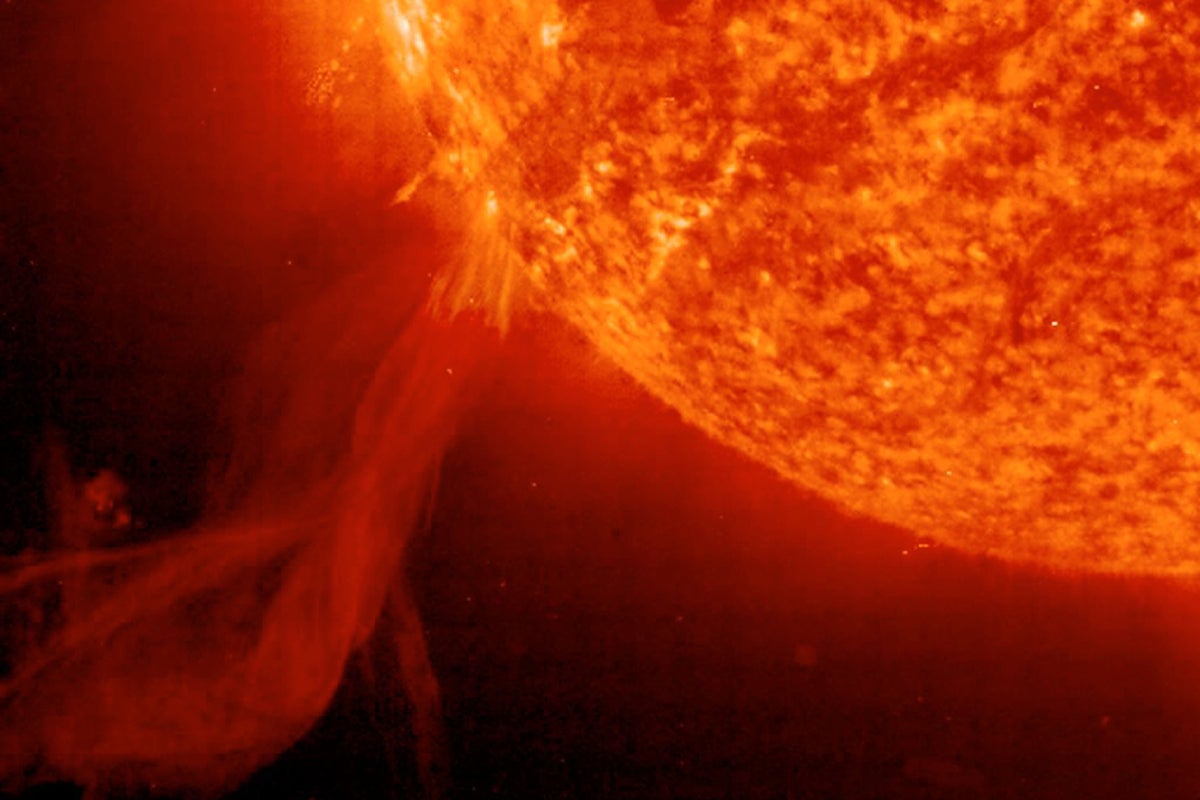
The Sun has released a massive solar flare, causing radio blackouts in some parts of the world, as well as forecasts for Northern Lights tonight.
The solar flare erupted from a sunspot region known as AR4436 on Sunday, which is actively rotating to face Earth.
Classified as an M5.8-class flare, it is powerful enough to cause noticeable space weather events.
The initial burst of electromagnetic radiation, which travels at the speed of light, triggered a moderate radio blackout over the Atlantic Ocean and parts of eastern Africa, according to the US National Oceanic and Atmospheric Administration (NOAA).
This caused a temporary disruption of high-frequency radio communications, mostly impacting aviators and mariners.
The solar flare also blew a hole in the Sun’s outer atmosphere, something known as a coronal mass ejection (CME), launching a cloud of magnetized solar plasma into space.
Travelling at around 650 kilometres per second, this CME is expected to shoot past Earth on Tuesday night, with parts of the plume glancing the atmosphere to create aurora displays.
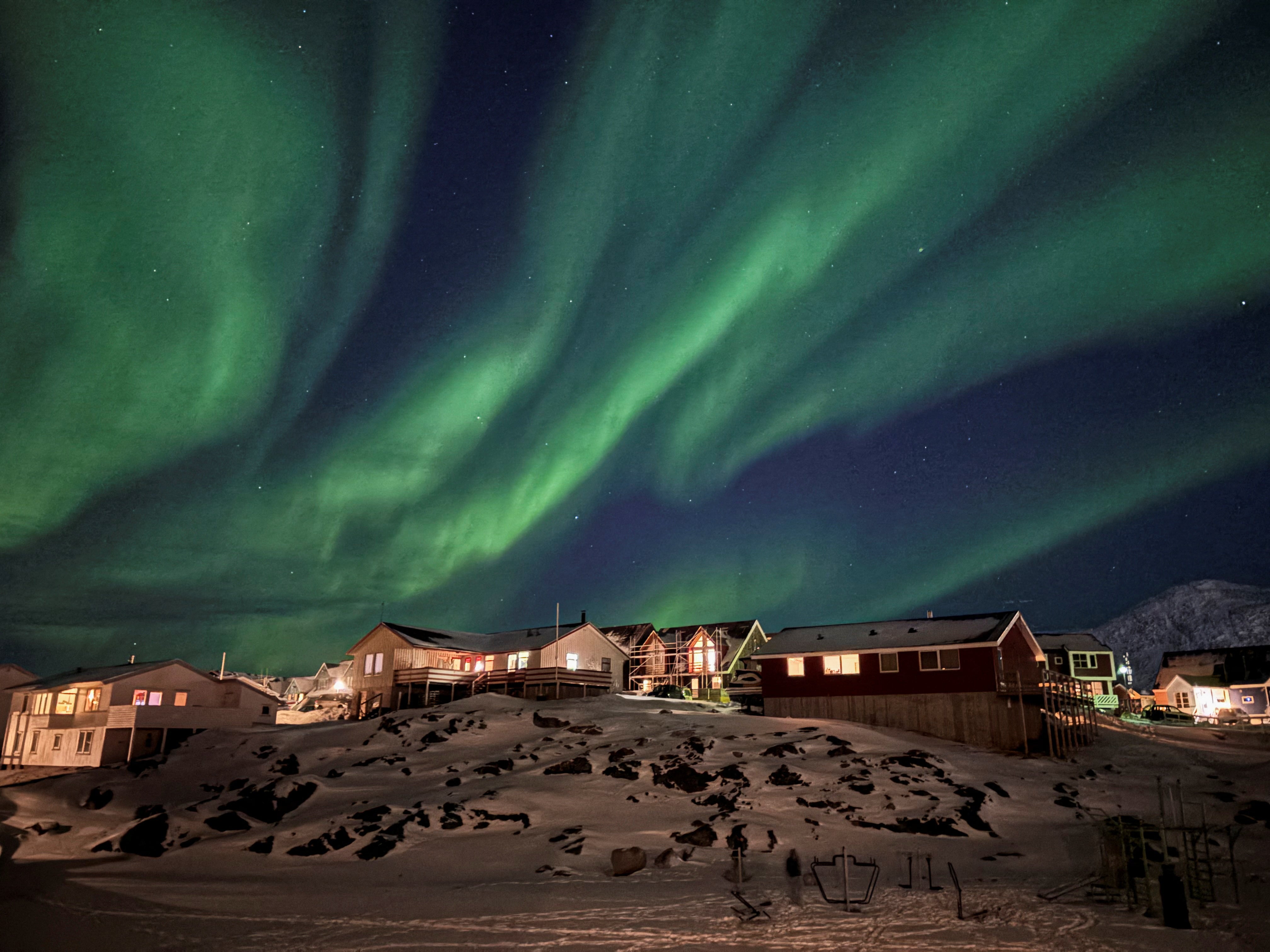
Weather permitting, Northern Lights could be visible at more southerly latitudes, including parts of the UK and northerly parts of the US.
“There is the potential for a glancing CME arriving into early UTC on 13 May,” the Met Office’s latest aurora forecast stated.
“This may bring an enhancement to the auroral oval perhaps allowing sightings across northern Scotland and similar geomagnetic latitudes, where skies are clear.”
There will be patchy cloud over parts of the UK on Tuesday night, according to the latest forecast from the Met Office, though clear skies are expected in some locations.
NOAA’s Space Weather Prediction Center said it was monitoring the arrival of the CME on Tuesday.
“Modeling of the resulting CME indicates that a bulk of the material should pass well behind Earth's orbit.” the agency said.
“That being said, a glancing blow and or shock arrival by late on 12 May into the early portions of the 13th UTC-day can not be ruled out.”
China unveils humanoid robot for Moon mission
‘Whatever Russia is testing, it’s sophisticated’: Satellites perform 3-metre flyby
Explosion at SpaceX launch site, days before critical rocket mission
NASA testing telescope that could help astronomers detect city-killing asteroids
Stargazing in May: Once in a blue moon...
New shortcut found to Mars that could cut travel time by half