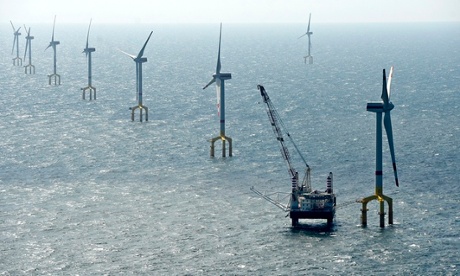
This has been a landmark year for the UK offshore wind industry.
We have seen significant milestones hit, such as 4GW of capacity now in operation – enough to meet the electricity demands of nearly 3.2m UK households. Substantial investment announcements have included those from Siemens and AB Ports - for manufacturing facilities on the Humber - and from the Green Investment Bank to support the construction of two major projects and the establishment of a £1bn Offshore Wind Fund.
With the government financial support that has been issued by the Department for Energy and Climate Change for further offshore wind development, this is now an annual multi-billion pound market that is poised for double-digit growth at least until 2020.
As a result, the UK continues to be the most attractive place to invest in offshore wind globally, with fantastic natural resources and a project pipeline that comfortably meets the most demanding government scenarios; in fact, we estimate that offshore wind will be meeting around 10% of the UK’s electricity demand by 2020.
Yet this growth is not without its critics, and it is only right that we ask whether these billions will help address the pressing energy issues of our time: energy security; climate changing CO₂ emissions; and the affordability of basic human needs. These are three components of what is often called the “energy trilemma”, so how does offshore wind score in these areas?
In a globalised world where long-term access to energy resources is increasingly politicised, the certainty of access to our wind energy resources should place wind power squarely in the middle of any UK energy policy. Of course, fortunately for British summer the wind doesn’t always blow and that’s why wind power will always require some form of backup supply, which is precisely what the power grid is capable of. In fact, the existing energy system when taken as a whole is robust enough to accommodate a large amount of wind without expensive backup (PDF).
As further supported by the stark evidence in the concluding instalment of the Fifth Assessment Report from the IPCC last weekend, climate change threatens irreversible and dangerous change. With the power sector responsible for around a third of our national carbon dioxide emissions, any climate change programme will have decarbonisation of the power sector as one of its core components. Here too, offshore wind scores well, as the energy that is used in manufacturing and installing an offshore wind farm can be generated by running that wind farm for a 6 to 9 month period. Given the typical wind farm lifetime of 20 years or more, the “energy payback time” of offshore wind is therefore very small indeed.
However, we have to be honest and acknowledge that the same cannot be said for the economic payback time, as the costs of wind power are still much higher than those for competing sources of power generation. The technology is still young and relatively costly, and in a world of technology competition and consumer price concerns it is imperative that costs continue to come down.
As a result, the offshore wind sector is working to very challenging cost reduction targets, and progress is being made not only in the UK but across Europe. As part of this drive, we are seeing industry increasingly working together to tackle common cost barriers where appropriate, a kind of ‘cooperative competition’.
What is required alongside this is concerted action by the government and industry to ensure that the steady build-out of offshore wind will continue beyond 2020. This will drive technological and industrial innovation, which will continue to drive down costs and improve the competitiveness of offshore wind in relation to competing generating technologies.
With a general election approaching fast, the ball is now in industry’s court to demonstrate that it is up for the challenge to deliver the large-scale projects being developed off our shores at competitive price levels. They’ll need to turn ambition and vision into contracts; build the supply chain that will continue to deliver local jobs and economic opportunities; and perhaps most importantly of all, gaining consumer and political confidence by enhanced transparency about performance and the contribution to our energy supplies.
What better way to achieve this than for the government to take industry at its word, and open up the vast offshore project opportunities to price competition. The recently completed Electricity Market Reform offers the framework for this. At The Crown Estate we will continue to work with the market to ensure this natural resource benefits the nation in the long-term.
Huub den Rooijen is head of offshore wind at The Crown Estate, which manages the UK seabed, assesses the case for offshore wind in turbulent times and calls for greater transparency in debating our energy future.
Content on this page is paid for and provided by The Crown Estate, one of the sponsors of the Big Energy Debate