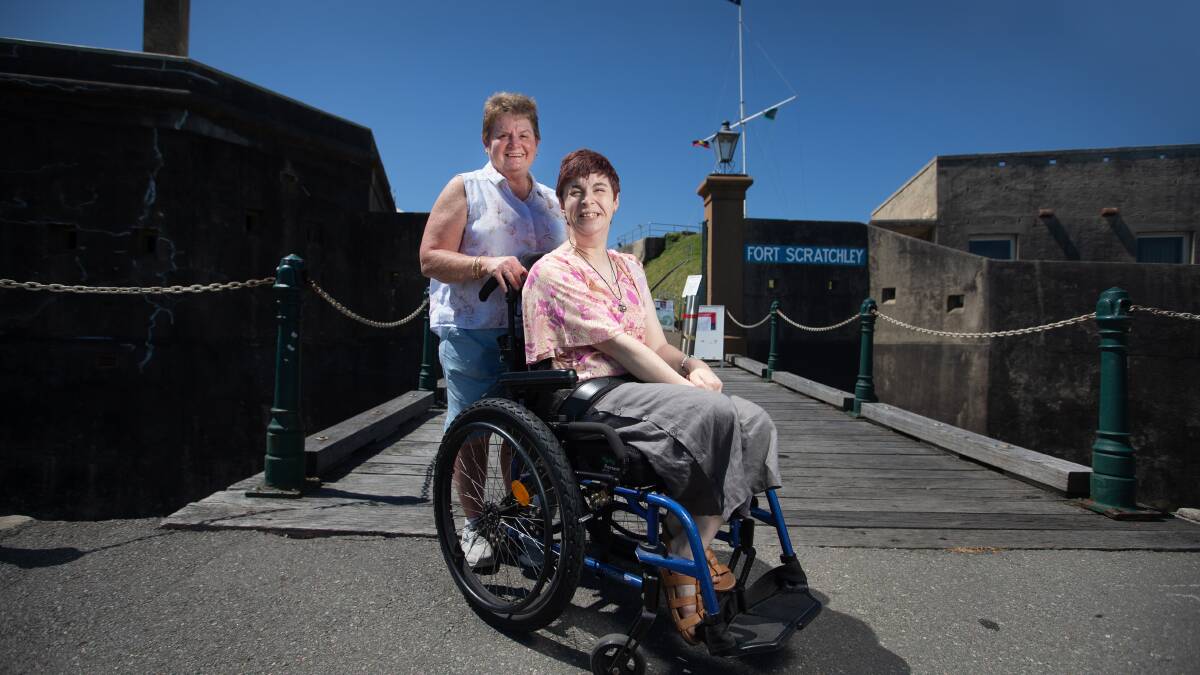
When Kaitlin Lawrence watched the 75th anniversary of the shelling of Newcastle from her wheelchair on Nobbys Beach in 2017 she dreamed of one day exploring Fort Scratchley's wartime tunnels.
While her wheelchair is able to make it into the fort, the awkward entrance to the tunnels means they are only accessible to able-bodied individuals.
Kaitlin, who has has cerebral palsy, has set the City of Newcastle's Sustainnovation Challenge participants the goal of helping her gain entry.
Students from across Newcastle have been asked to 'walk in the shoes' of those who are not able to access parts of the city that most people take for granted.
"Kaitlin is passionate about history. She believes it is important to preserve history so we understand how our lives have been shaped," her mother Helen said.
"She would dearly love to access the tunnels at Fort Scratchley but she knows that when it was built back in the 1800s it was not thought that in 2021 the fort would be open to tourists let alone people in a wheelchair so it is expected that the tunnels would be inaccessible to those who are physically impaired. But this doesn't stop her wanting to experience the smells, the sounds and atmosphere of the tunnels."
Kaitlin has also identified Nobbys Lighthouse as a location she would like to visit.
The Sustainnovation Challenge, which was launched last month, brings together education, industry, community and city leaders who are volunteering their expertise to help students develop workable solutions to issues relevant to their community.
Students from 10 secondary schools including Newcastle High, Lambton High, Hunter School of the Performing Arts, West Wallsend High, Merewether High, St. Philip's Christian College, Bishop Tyrrell Anglican College and Big Picture Education Cooks Hill Campus attended a two-day workshop this week.
Students were guided through applied innovation, system engineering, and other analysis and development tools and principles.
Community Disability Advocacy Hunter's community organiser David Belcher said the program was a timely opportunity to develop greater understanding around real change.
"We need to be aware that better accessibility to workplaces, shops, restaurants, venues and public amenities benefits everybody - not just those with a disability. Whether people are living, working in or visiting Newcastle, future planning needs to focus on limiting barriers and increasing inclusion for all," he said.
Supporting organisations include Business Hunter, Australian Industry Group, NSW Department of Education the University of Newcastle, Castle Personnel Services and Community Disability Alliance Hunter.