
One of the most cheering aspects of Scotland’s knife-edge independence referendum in September was the enthusiastic involvement of teenagers. With the franchise extended to 16- and 17-year-olds, many were casting their first vote, and the existential, one-off nature of the decision inspired fervent debate.
As my colleague Alberto Nardelli has pointed out, that enthusiasm looks set to carry Scottish youngsters back to the polls on 7 May. Almost two-thirds of Scottish 18- and 19-year-olds plan to vote in the general election, against 34% of their English counterparts. For 20- to 24-year-olds, the figures are 57% for Scotland, 38% for England.
Young people south of the border may not have had a once-in-a-lifetime political awakening, but the economic obstacles they’ve faced over the past five years should have made them furious enough to storm the polling booths and send the government packing.
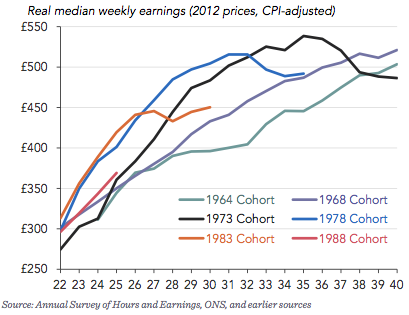
As a new collection of essays published by the Resolution Foundation last week makes clear, they are also at particularly high risk of being stuck on what labour market expert John Philpott calls the “low road” – of poor job conditions, stingy pay and lack of career progression. Bath University’s Paul Gregg calculates that workers born in 1988 have missed out on 15 years’ worth of pay progression compared with those born in 1973.
“Lower starting salaries, as young people take jobs below their skill level, are made worse by fewer promotion opportunities during a recession, reducing their chance of rising up the ladder,” he says.
Yet while David Cameron laid out his wares to pensioners last week (not without heckles), few politicians on either side have a coherent plan for ensuring that today’s school- and college-leavers can make their way in the world – what Ed Miliband calls “making Britain work for working people”.
The top-down, “human capital” approach targets what economists call the long tail of low-skilled workers in the UK, by improving vocational education, for example, and boosting the number of apprenticeships. The jobs are there, the story goes – we just need to make young people fit for them.
A second approach is for policymakers to cross their fingers and hope for a revival in productivity. Output per worker has been shockingly weak since the end of the recession. Economists are divided about this “productivity puzzle”, but one school of thought has it that this will evaporate as demand picks up, and as firms can produce more from the same workforce, wages, including for those at the bottom of the scale, will inevitably rise.
Yet there is evidence of something deeper and more worrying than a short-term skills mismatch, or a temporary pause in productivity growth. Economic growth and wages had begun to diverge in the UK and in the US long before the crisis, leaving younger generations facing far lower lifetime earnings potential than their parents.
Jared Bernstein, a former adviser to Barack Obama, argues in his contribution to the Resolution Foundation book that in the US, debate is now starting to shift from skills shortages to the “deep and persistent deficit in bargaining power”, which has left workers impotent in the face of shareholders and bosses. Since 1979, the average pay of the bottom 90% of US earners has risen just 15%; the top 1% of earners have banked a 140% increase. Profits, and boardroom pay, have swallowed up an increasing share of economic output.
In the UK too, as LSE’s Steve Machin argues, “productivity improvements may be insufficient to raise wages if the benefits are mainly appropriated by shareholders or pensioners”.
Labour’s most headline-grabbing response to the cost-of-living crisis has been to promise a cap on household energy bills, tapping into consumers’ powerlessness in the face of the giant energy corporations. But there’s a more fundamental way in which many Britons, particularly the young, feel impossibly outgunned by big capital – when it comes to seizing a fair share of what Karl Marx would have called the “fruits of their labour”.
There are many explanations for this – technological change, rapid inward migration, the tendency for women and the over-60s to step into the labour market on modest pay when jobs become available — and several of them were rehearsed by Bank of England chief economist Andy Haldane in an important recent speech. Another is the deliberate dismantling of workers’ bargaining power since the 1980s.
Ignoring the plight of the young won’t just mean a generation struggling to get by; it will undermine long-term economic growth by depressing demand, and stoke social resentment.
The balance could be redressed by boosting workers’ representation in corporate decision-making; using regulation to constrain zero-hours contracts and other shady employment practices; shifting incentives for directors from short-term returns to longer-term investment; and even rewriting the aims of monetary policy. Not all of these are even on the political agenda; but as Miliband’s performance in Thursday night’s non-debate showed, at least Labour has set itself the task of reconnecting economic growth and workers’ living standards. The best the Tories can offer is a Help to Buy Isa. England’s youngsters should get mad as hell, follow their Scottish cousins’ example, and get out and vote.