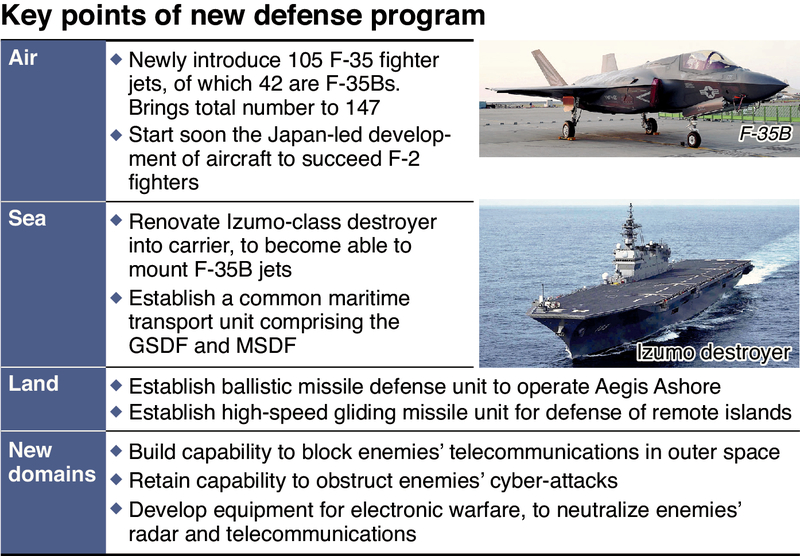
The government adopted revised National Defense Program Guidelines and the Mid-Term Defense Program (fiscal 2019-fiscal 2023) on Tuesday, stipulating the introduction of top-of-the-line F-35B stealth fighter jets, with the Maritime Self-Defense Force's Izumo-class destroyer to be effectively used as an aircraft carrier.
The defense guidelines were adopted at a Cabinet meeting held in the morning. They also spell out the boosting of self-defense capabilities in such new domains as outer space and cyberspace.
Incorporated in the Mid-Term Defense Program is a policy of renovating the deck of the Izumo-class destroyer to enable the takeoff and landing of F-35B fighter jets. Taking into account the fact that Chinese aircraft carriers and bombers have been advancing into the Pacific Ocean in recent years, the use of the destroyer as a carrier is aimed at enhancing the SDF's operational capability in areas around the Nansei Islands and on the Pacific side of Japan, where there are few runways where fighter jets can take off and land.
As the SDFs are banned from possessing offensive-type aircraft carriers, due to the government's exclusively defense-oriented policy, the government plans to set limits on the use of the Izumo-class destroyer and F-35B fighter jets.
Stipulated in the mid-term program as acceptable uses of the Izumo-class destroyer are: 1) Dealing with aerial assaults in the event of contingencies; 2) Surveillance activities; 3) Drills; and 4) Dealing with natural disasters and the like.
These were worked out at the request of Komeito, which has called for clarifying the use of the destroyer and F-35B jets.
In tandem with the formulation of the new guidelines, the government approved at the Tuesday Cabinet meeting a policy of introducing 105 top-of-the-line F-35 stealth fighter jets to replace about 100 F-15 main fighter jets that are now in service but deemed difficult to modify. The scale of the related budget is estimated to be in excess of 1 trillion yen.
When combined with the 42 F-35A fighter jets that are being introduced, the number of F-35 fighter jets will rise to 147.
Of the aircraft to be additionally introduced, there will be 63 F-35A jets, which use regular runways, and 42 F-35B jets, which are capable of short-field takeoffs and vertical landings, and can be mounted aboard the Izumo-class destroyer. Eighteen F-35B jets are scheduled to be introduced under the latest mid-term program.
Under the new guidelines, the basic concept of "building a multidimensional, joint tactical defense capability" has been adopted, as the Chinese and Russian forces are enhancing their offensive capabilities in new domains of outer space, cyberspace and electromagnetic waves.
By combining the capabilities of the ground, maritime and air defense forces with those in new domains, the government aims to cope with new threats. The guidelines state that with the cross-domain operations, the nation's inferiority in strength will be overcome, thus implementing national defense.
The total budget for the mid-term defense program will reach about 27.47 trillion yen, setting a new record, as the cost of introducing such costly defense equipment as F-35 fighter jets will add up. About 2 trillion yen will be eked out through "procurement reforms," by reviewing the purchase prices of such equipment as fighter jets.
Read more from The Japan News at https://japannews.yomiuri.co.jp/