Moroccan authorities are facing mounting criticism from Spanish cavers over the slow pace of their rescue operations, after two potholers who were trapped for days in a ravine in Morocco’s High Atlas mountains died while waiting to be saved.
The third trapped caver, Juan Bolívar, 27, was rescued on Sunday from a ravine near Ouarzazate in southern Morocco. His two companions, Gustavo Virués, a 41-year-old lawyer from Cádiz, and José Antonio Martínez, a 41-year-old member of the national police force from Granada, died in the 400-metre-deep ravine.
The three cavers had broken off from their nine-member group days before to explore a different set of caves. After the experienced mountaineers failed to meet up again with the rest of the group, they were reported missing on Tuesday.
The three were spotted alive at the bottom of the ravine on Saturday. But by Sunday night, as rescuers scrambled to pull them out of the ravine, two of the men had died.
As news broke of the deaths, many in Spain’s caving community took aim at Morocco authorities for an allegedly sluggish rescue response and stubborn refusal to allow Spanish authorities and specialists to help in the rescue.
However, a Moroccan official said the mountaineers had taken a huge risk by setting off without a professional guide and “without tools to allow for their detection”. The area the cavers were exploring is rugged terrain that includes peaks of about 4,000 metres still covered with snow from winter.
As soon as the three were reported missing, the Andalusian Cavers’ Federation began putting together a team of 16 specialists to travel to the rugged mountain area and help with the rescue, said José Enrique Sánchez, federation secretary.
“Technical knowledge, adequate material and qualified people is what you need for a rescue. The Moroccan authorities didn’t have the necessary resources,” Sánchez told El Mundo.
With the help of Spain’s interior ministry, the team approached the Moroccan government as well as the Spanish embassy in the north African country but were refused the necessary authorisation to help.
Spain’s civil guard also put together a team to help with the rescue, but were initially told that Moroccan authorities had the situation under control. On Sunday – after the three Spaniards had spent days trapped at the bottom of the ravine – Spanish authorities were granted permission to fly in to help with the rescue.
The rest of the cavers in the group, meanwhile, were becoming increasingly frustrated, said Juan Rengel, one of the people who had travelled to Morocco with the missing three. “Everything was really slow. If they had sent out a helicopter the day we had sounded the alarm, the outcome might have been different.”
He and the other members of the team took matters into their own hands, Rengel said, hiring a guide and renting a vehicle to carry out the search themselves. After more than four hours of walking through the snow, he said, “we were the first to access the mouth of the ravine and the first to spot our companions”.
When Moroccan authorities arrived to carry out the rescue, Rengel said they asked the Spaniards for a 200-metre rope so they could descend into the ravine. “If they didn’t have the necessary material, they should have let in the Spanish experts who had the right resources,” he said.
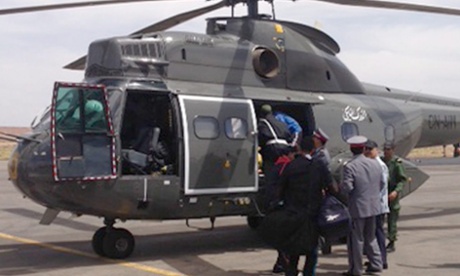
However, Zubeir Bouhout, director of tourism for Ouarzazate, said the Moroccan authorities began the rescue operation as soon as the three Spaniards were reported missing. The remote location of the Spaniards complicated the rescue, he said, with rescuers forced to land the helicopter 45 minutes by foot from the ravine where the cavers were trapped.
“The mountaineers took an enormous risk by seeking adventure in that area without a professional guide and without tools to allow for their detection,” he added.
Spain’s prime minister, Mariano Rajoy, also defended the Moroccan authorities on Monday, pointing out that the rescue had taken place in an area where access was tremendously complicated. Speaking to the state broadcaster Radio Nacional de España, Rajoy said they had put in a “great effort” in rescuing the Spanish cavers and showed “goodwill and a spirit of cooperation”. The Moroccans had initially thought they could carry out the operation without need of further resources, he said.
Bolívar, the sole survivor of the rescue operation, remains in stable condition in a clinic in Ouarzazate.