
On June 30, 2026, Gov. Henry McMaster (R) signed H 3021, making South Carolina the third state this year to enact a REINS-style law, and the fifth to prohibit judicial deference. The bill included other provisions related to executive agency procedure and oversight.
H 3021 requires legislative approval for all executive agency regulations with estimated costs exceeding $1 million over five years. Ballotpedia defines a REINS-style policy as one that requires legislative review or approval for executive agency regulations with expected costs to exceed a certain monetary threshold.
The bill also prohibits courts and administrative law judges from deferring to the agency's interpretation of a statute or regulation, and instead requires them to interpret them de novo. Read the other provisions of the bill here.
On March 6, the South Carolina House of Representatives passed H 3021 108-0, with six Democrats and four Republicans not voting and one Democrat and three Republicans absent. Twenty-seven Democrats joined 81 Republicans in support of the bill.
On May 6, the South Carolina Senate passed H 3021 40-0, with two Democrats and three Republicans absent. Ten Democrats joined 30 Republicans in supporting the bill.
The General Assembly reconciled amendments between the chambers and ratified the bill on June 29, sending it to McMaster. South Carolina has a Republican trifecta, meaning Republicans control the governorship and have majorities in both legislative chambers.
REINS-style laws
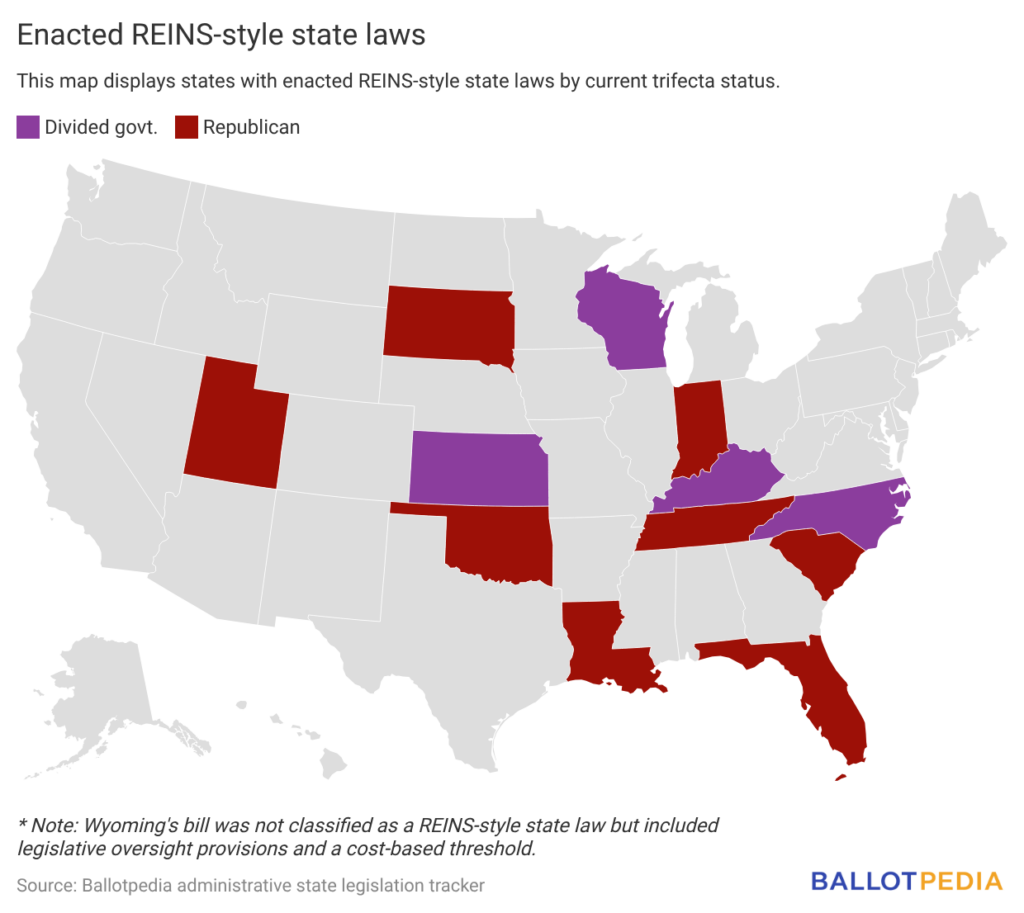
South Carolina is the 12th state to adopt a REINS-style state law since 2010, and the third this year, behind South Dakota and Tennessee. Indiana amended its REINS-style state law in the 2026 legislative session. Five states enacted REINS-style bills in 2025.
Eight of the 12 states had Republican trifectas when they enacted the laws, and the other four had divided governments.
Ballotpedia defines a REINS-style state law as one that requires legislative approval of a proposed rule exceeding a certain cost threshold before the regulation can take effect. These laws are modeled after a federal legislative proposal called the Regulations from the Executive in Need of Scrutiny Act (REINS Act).
REINS-style state laws are one of several other types of policy proposals designed to increase legislative oversight of agency regulations. REINS-style state laws provide state legislatures with more direct control over major agency regulations with significant economic impacts by granting lawmakers the preemptive authority to review and halt the enactment of certain regulations. They address the separation of powers between state legislatures and state executive branches in administrative rulemaking by undelegating executive branch authority.
Judicial deference
South Carolina is the fifth state to limit or prohibit judicial deference this year. Four of the states — Georgia, Alabama, South Carolina, and South Dakota — had a Republican trifecta, and one — Kansas — had a divided government. In 2025, seven states – six with a Republican trifecta and one with a divided government — limited or prohibited judicial deference through legislation or court decisions.
In 2024, the U.S. Supreme Court overturned Chevron deference in its Loper Bright Enterprises v. Raimondo decision, and three states ended deference at the state level through legislation.
Judicial deference is an administrative law principle under which courts yield to an executive agency’s interpretation of a statute, regulation, or policy when certain conditions are met. There are different types of judicial deference doctrines at both the federal and state levels. When courts do not apply a deference doctrine, they read the statute, regulation, or policy de novo, deciding the meaning without deferring to any other authority. Judicial deference is central to many debates about the administrative state and the balance of power between executive branch agencies and the courts.
Click here for more information on REINS-style state laws, and here to check out Ballotpedia's Administrative State Legislation Tracker for more state and federal legislation regarding the executive branch agencies.