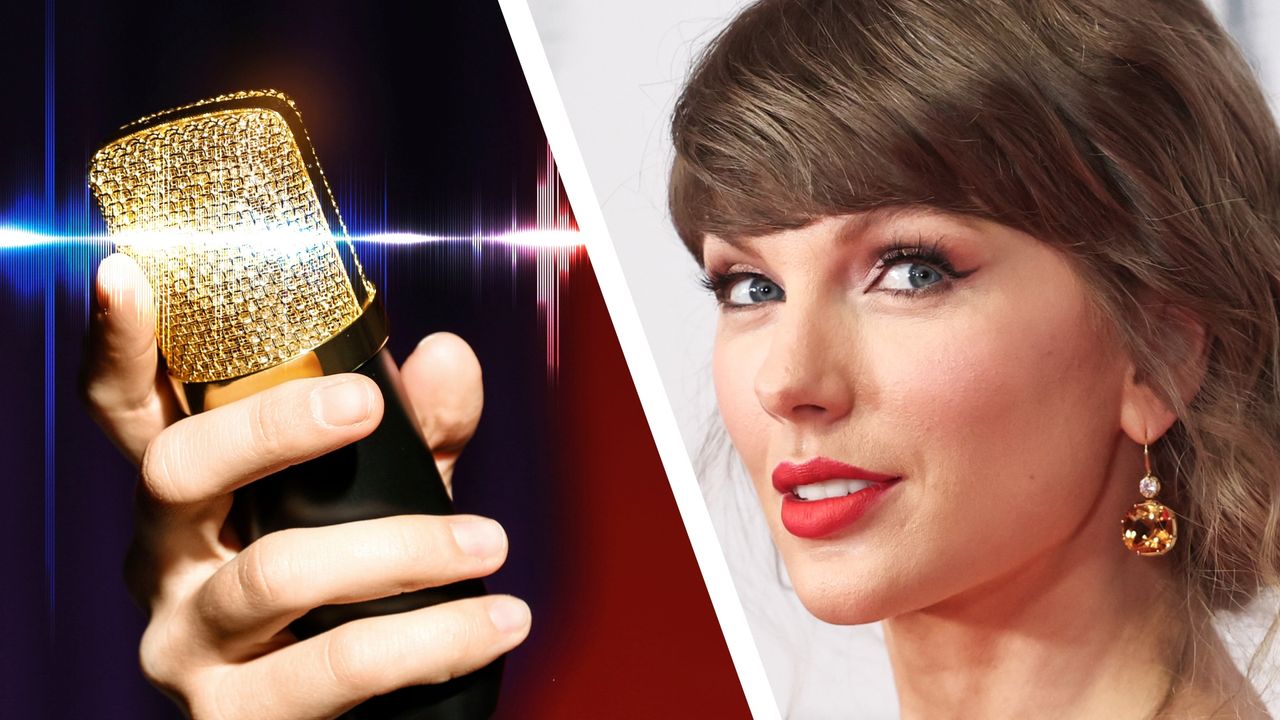
Earlier this year, Taylor Swift filed trademark applications covering the phrases "Hey, it's Taylor" and "Hey, it's Taylor Swift" — two recordings closely associated with her voice and personal brand. Around the same time, actor Matthew McConaughey sought trademark protection for some of his most recognizable catchphrases.
These cases highlight an important question in the AI era, what rights do people actually have over their voice?
And this isn’t a theoretical issue. People tend to focus on the image and video generation capabilities of AI, but AI voice cloning tools can now recreate a person's voice from just a few minutes of audio. While platforms like ElevenLabs and Suno have helped make synthetic voices and AI-generated audio more accessible than ever.
For celebrities, the stakes are really clear. A distinctive voice can be a valuable part of a personal brand and a source of income. But this technology doesn't just affect public figures anymore. Now, anyone with audio recordings online could potentially have their voice copied, cloned or imitated.
The problem is one we’ve touched on repeatedly in our reporting on AI. Which is that the law hasn’t caught up to the tech yet. Existing laws around copyright, trademarks, privacy and publicity rights were largely created before AI-generated voices became possible at scale.
As a result, many of today's biggest questions don't have straightforward answers, and the rules vary significantly depending on where you live too.
So where do we stand right now? What protections do ordinary people actually have if their voice is cloned or used without permission? And are lawmakers beginning to adapt to a world where a voice can be replicated in minutes? To find out, I spoke to legal experts specializing in technology, intellectual property and AI law.
What does the law say?
Dr Edina Harbinja is an Associate Professor in Law at the University of Birmingham, specializing in digital rights and the regulation of emerging technologies. I asked her if I can ever really “own” my voice and she says there’s not a simple answer.
“A recording of a voice can be protected by copyright and related rights, and a performance may attract performers’ rights,” she explains. “But the voice itself is usually not ‘owned’ in the same way as a song, a sound recording, or a written work.”
Professor Andres Guadamuz, an expert in intellectual property and technology law at the University of Sussex, largely agrees.
"In the UK the answer is no, you don't own your own voice," he tells me. "There are several possible ways to try to get around this, but the real answer is that there is no good legal recourse if someone uses your voice to train an AI, particularly if they have legal access to the voice."
Harbinja tells me that ownership isn’t necessarily the most useful way to think about the issue. “The harder issue is whether an AI-generated voice that sounds like a person appropriates their identity, falsely implies endorsement, or misleads the public,” she says.
In other words, the legal question may be less about ownership and more about whether a cloned voice causes harm, deception or misrepresentation. But even then, what happens next depends heavily on where you live.
“In the US, this is often framed through the right of publicity, false endorsement, and impersonation-style claims,” Harbinja says. She points to the case of Midler v. Ford Motor Co. In which singer Bette Midler successfully objected to Ford using a soundalike singer in an advert.
There are also newer US initiatives, including the proposed NO FAKES Act, move more directly towards protecting voice and likeness against unauthorized digital replies.
But the UK takes a different approach. “In the UK, there is no general right to own one’s voice, image, or persona,” she tells me. “The most relevant routes are passing off performers’ rights, misuse of private information, data protection, defamation, contract, and sometimes trade marks. But these are patchwork protections.”
One possible route is passing off, which protects businesses and individuals from misrepresentation that could damage their reputation or falsely suggest commercial endorsement.
Guadamuz points to passing off as one of the few existing legal routes available in some circumstances.
"If a person has a reputation, they could use passing-off, which is a way to stop people from profiting from your image," he says. However, he notes that its application is limited and has historically been used more often for images than voices.
Harbinja says that the challenge here is that AI voice cloning doesn’t fit nearly into a single legal category.
“AI voice imitation can be a form of impersonation, but the legal label depends on the jurisdiction and context: false endorsement, personality infringement, data processing, unfair competition, performers’ rights, or consumer deception,” she says.
The legal framework also varies depending on whether the person is a celebrity or performer.
“So, you may own the recording, the song, or the mark, but you do not necessarily 'own' the sound of yourself in a simple copyright sense,” she says. “AI voice imitation exposes the gap between laws protecting works and laws protecting persons.”
AI presents unique problems
Harbinja explains AI complicates things because there are two major enforcement problems to consider.
The first is a training problem. “Models may be trained on vast collections of online recordings, songs, interviews, performances, and videos. Rights holders often do not know whether their material was used, where training occurred, or whether a legally relevant copy was made in a jurisdiction where they can sue,” Harbinja tells me.
The second problem is output. “If an AI output sounds like Taylor Swift but does not reproduce a substantial part of a protected recording or song, copyright may not be the best route,” she says. “That is why the debate is shifting from copyright alone to voice, likeness, personality, publicity, consent, transparency, and digital replica regulation.”
She says this is why the Taylor Swift example is proving to be so interesting. Because although trade mark and brand protection strategies can work in commercial contexts, they don’t solve the bigger issue of unauthorized AI imitation.
Guadamuz says enforcement remains one of the biggest practical obstacles. "There is no protection in the UK, some in other countries, but it is almost impossible to enforce at the moment. Only the most egregious examples of cloning could be actioned,” he tells me.
The future of the law
Is the law changing to accommodate new technologies? Yes, but slowly.
“AI transparency laws are emerging,” Harbinja tells me. “The EU AI Act does not create a property right in one’s voice, but Article 50 imposes transparency obligations for certain AI interactions and deepfakes/synthetic content, including synthetic audio.”
Guadamuz believes new legislation will ultimately be needed. "For the most part we need new legislation that specifically protects voices," he says.
He notes that UK policymakers have already discussed protections against deepfakes and digital replicas, which could eventually extend to AI-generated voice clones.
However, Harbinja argues that the debate here shouldn’t focus exclusively on ownership.
“The deeper theoretical and moral question is whether voice, likeness and persona should be governed primarily as property, or instead through concepts of dignity, personhood, identity and autonomy,” she says. “My own view is that the latter provides the more appropriate starting point, especially where AI systems do not merely copy a marketable asset but simulate a person.”
What Harbinja got me thinking about is how often we treat AI as just another technology to regulate. Another tool, another platform, another legal problem to solve.
But the rise of AI voice cloning suggests something more complicated is happening. These aren't just questions about copyright, trademarks or data protection. They're questions about identity, authenticity and personhood.
After all, a voice isn't just a piece of data. It's one of the ways we recognize each other. It's tied to our relationships, our memories and our sense of self.
As AI becomes increasingly capable of imitating not just what we create but who we are, the challenge for lawmakers goes beyond deciding what can be owned and becomes about whether we should ever treat parts of a person as property in the first place.