Confronting footage raises questions that a dolphin expert says need investigation. David Williams reports
Dolphins should be tested for potentially harmful nutrients, an expert says, after viewing footage of dolphins in a marine mammal sanctuary swimming in soupy waters.
Canterbury’s Te Waihora/Lake Ellesmere, one of the country’s most polluted lakes, is hemmed in by Kaitōrete Spit, and is periodically opened to stop flooding of the surrounding land, much of it farmland, and to allow fish passage.
Regional council ECan and Te Rūnanga o Ngāi Tahu hold consents for lake openings, controlled by a water conservation order.
The resulting churn of green, soupy water flows into the Pacific Ocean.
Dolphin expert Gemma McGrath, a Southlander who’s a scientific advisor to environmental group Sea Shepherd New Zealand, doesn’t know if dolphins have been specifically tested for agricultural contaminants, such as nitrates and phosphorus, but she says: “It’s high time they were.”
Hector’s dolphins feed close to shore, mostly around river mouths, and have a narrow, long-shore range of between 30km and 50km. If contaminants are flowing from the land to the waterways, and then out to sea, they’re generally arriving in the “turf” of Hector’s, McGrath says.
“I really think that the freshwater impacts and the state of our rivers need to be further investigated, with the Hector’s dolphins in particular,” she says.

The Department of Conservation confirms the lake exits into a marine mammal sanctuary, which is important habitat for nationally vulnerable Hector’s dolphins.
“If there are any potential effects on protected species, they are likely to be indirect,” says DoC’s eastern South Island operations director Nicola Toki. DoC administers the Marine Mammals Protection Act, which doesn’t consider indirect effects.
McGrath, the dolphin expert, says studies have found anthropogenic pollutants – such as polychlorinated biphenyls (PCBs), and the pesticide DDT (dichlorodiphenyltrichloroethane), as well as trace elements of heavy metals – in the blubber or vital organs of dead Hector’s.
The process of environmental contaminants travelling up the food chain to top predators is called bioaccumulation. That is an indirect effect, DoC’s Toki says. “This would be difficult to measure and attribute back to a specific source.”
ECan, the regional council, points to a 2012 study by Crown research institute NIWA, which said plumes from the lake add little to nutrient concentrations, entrained faecal indicator bacteria or toxic cyanobacteria in Banks Peninsula’s coastal waters.
Science team leader Shirley Hayward says consent conditions manage the risk of adverse effects on the environment, including risks to marine life, and the lake and marine waters are monitored.
“This monitoring shows elevated nutrient and chlorophyll concentrations within the plume area during the discharge, and sometimes elevated nutrient levels beyond the visible plume zone, but these effects are short duration (during and immediately after the discharge).”
She adds: “We acknowledge that at the time of the discharge, the visible plume of turbid waters from the lake may impact recreational activities in the marine environment.”

Environmental lobby group Greenpeace, meanwhile, is quick to draw a direct line between intensive dairying up the lake’s catchment to the dolphin habitat.
Senior agricultural campaigner Christine Rose says the Waihora footage shows the visible impacts of intensive dairying on river systems and the marine environment.
“This should provoke an outrage among New Zealanders because it’s so graphic – both in terms of the lack of water clarity and quality, both seen and unseen.”
(Concerns about the potential health effects of high concentrations of nitrate, a chemical made of nitrogen and oxygen, in private drinking water supplies prompted Greenpeace to run community testing days around Canterbury.)
In 2010, while co-leader of the Green Party, Russel Norman kayaked Lake Ellesmere on his national “dirty rivers” tour, warning Christchurch people to wake up to the threat of intensive agriculture.
Now, as Greenpeace’s executive director, Norman says not only is the lake being “destroyed” by pollution from intensive agriculture, but that same pollution is entering a protected area where endangered dolphins are swimming.
“I don’t know what the health impact of that disgusting pollution is on those dolphins but they are mammals and any other mammal, such as a human, we know you’ve got to stay out of Te Waihora – it’s dangerous.”
Les Wanhalla, of Te Taumutu rūnanga, one of six rūnanga with Waihora in its rohe, is co-chair of the Selwyn Waihora water zone committee, a joint committee of the district, city and regional councils, with appointed iwi representatives.
He says while the lake’s nutrient-rich waters entering the ocean is a major problem, he isn’t concerned about dolphins feeding on fish from Waihora, as Māori eat them, too. Also, sea water dilutes the effect of contaminated lake water. “It’s not a very nice environment for them to be swimming through, or the high nitrates.”
Environmentalist Matt Coffey, who grew up at Selwyn Huts, on the banks of the Selwyn/Waikirikiri River which flows into the lake, shot the footage before lockdown. (The lake has been opened again in recent weeks.)
He’s observed the lake’s decline. “We’re not seeing the change. The pollution’s still going in there, they need to change it. It’s not only affecting the rivers, the lakes, it’s also affecting the sea.”
The idea of taking the footage was to document dolphins swimming in the nutrient-rich muck pouring from the lake, Coffey says.
“Every time they open the lake that green plume goes out to the sea and goes all the way round – the currents are going north it goes all the way round Banks Peninsula.”
Dr Jenny Webster-Brown, who has a PhD in geochemistry, is a former director of University of Canterbury’s Waterways Centre for Freshwater Management. She now heads the Our Land and Water National Science Challenge – which last month released research showing excess nutrients from farms take less than five years to reach rivers.
She says Te Waihora’s green colour comes from cyanobacterial blooms, which won’t have a huge impact on the coastal environment. Actually, nutrients are important for the coastal system, she says.
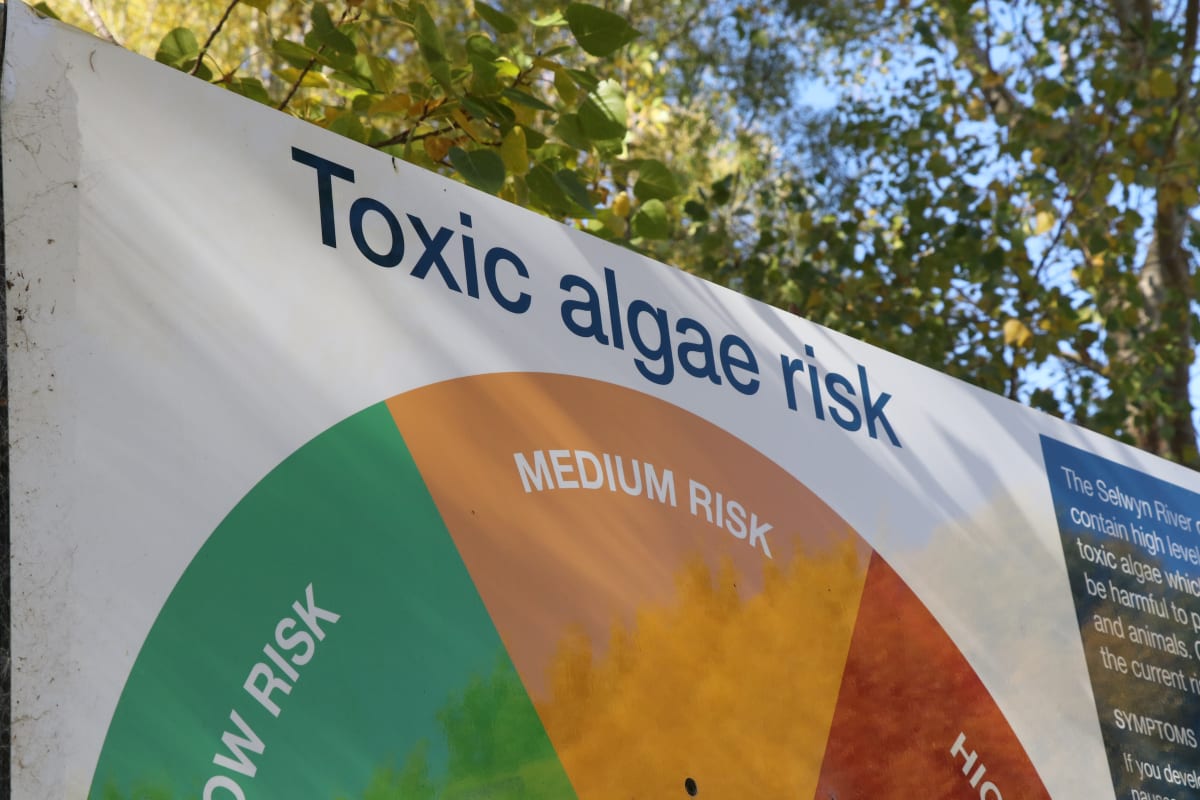
“Obviously if there are toxic algal blooms within Ellesmere then that is a different story,” she says.
John Donkers is a shareholder and director of several dairy farming companies in Canterbury, and has been involved in Central Plains Water (CPW), the South Island’s largest irrigation scheme, since its inception. He’s a CPW director, a former Irrigation NZ board member, and a former member of the Canterbury Water Management Strategy’s regional committee.
Donkers flinches at criticism of farmers. “Most farmers are concerned about the level of nutrients flowing into the lake,” he says.
Every irrigated farmer in the Selwyn Waihora catchment above the lake has a farm environment plan, and under zone regulations they have to achieve nitrate reductions. Waterways are being fenced off, which has led to huge improvements. CPW shareholders have reduced stocking rates, improved fertiliser efficiency, and upgraded irrigation systems to meet nutrient loss requirements.
While improvements are made to existing farms, part of the problem is legacy pollution, Donkers says.
“Everybody wants this to be better tomorrow, and I’d like it to be like that too, but it doesn’t work like that. There’s a lot of stuff we’ve done over the last 100 years that is perhaps still having an impact on the lake.”
Farmers are involved in plenty of environmental work, Donkers says, and they’ll do more.
“But there’s very little recognition of that. I keep hearing this: that farmers think they’ve got a licence to pollute and they don’t care. Well, that’s certainly not the discussions we have at our board table at CPW.
“The environment is our highest priority. We are well organised, we’ve got people that work for us within the organisation that help farmers achieve a higher standard.”
To be fair, there is plenty happening.
About 900 farmers need a land-use consent to farm, including a farm environment plan. The Selwyn Waihora zone committee has been involved in many biodiversity projects, enhancing ecological and cultural restoration, including weed control and riparian planting, as well as river recharge to pump more water into the system.
A particular standout is the Whakaora Te Ahuriri project, building a wetland at Ahuriri Lagoon, between Tai Tapu and Motukarara.
But Donkers’ other comments need to be challenged.
It’s fair to assume that if environmental costs cut farm profits too deeply they won’t be the top priority; at least not for every farm. And while there may be a reduction of nutrient losses from existing farms, more nitrogen is predicted to enter the catchment.
Hayward, ECan’s science team leader, says the nitrogen load “ready to enter the lake from land use” was calculated as 1970 tonnes per year in 2015.
“The nitrogen load calculated to enter the lake after the Selwyn Te Waihora plan requirements are implemented is 2310 tonnes N/year. The difference between these two figures is due to farming that was already consented at the time of the plan development. But it is important to note that this would have been higher without the plan: about 2700 tonnes N/year.”
Increased nitrogen pollution is an environmental blow for an ecologically important lake – it has the most diverse bird habitat in the country, and is a wetland of international importance.
It also neglects the lake’s cultural importance. The lake, once rich with fish and waterfowl, has been an important focus for Māori activity for about 1000 years.
Wanhalla says: “It’s one of the most important lakes in the whole of the South Island for collecting kai, and it always has been.”
(It was also rich in introduced fish species. Fish & Game once recorded 65,000 trout on a spawning run from Waihora into the Selwyn River. By 2005, however, the count was down to 87, according to the 2009 book Canterbury’s Wicked Water.)
Cultural and environmental issues overlapped last year when Te Rūnanga o Ngāi Tahu served a High Court claim on the Crown regarding rangatiratanga (authority) over wai māori (freshwater) in the takiwā (region), to ensure responsible management of water in the South Island.
Colonisation is central to the lake’s degradation.

Waihora, a former saltwater estuary, was impounded by the Kaitōrete beach barrier about 3000 years ago, according to the 1994 book Waihora/Lake Ellesmere: Past-Present-Future. (About 20,000 years ago, sea level in Canterbury was 130m lower, and the coast was 50km east of where it is now.)
The lake, rich with fish and waterfowl, has been an important focus for Māori activity for about 1000 years. Waihora means “water spread out”. Another name for the lake is Te Kete Ika o Rākaihautū, “the fish basket of Rākaihautū”, after a revered ancestor who was reputed to have helped form the landscape as we know it today.
Rather than spreading out, however, Waihora’s water has been suppressed by the regular openings to the ocean, and contaminated by pollution, much of it agricultural. While Māori did open the lake to the ocean to ensure their land wasn’t flooded, the frequency increased under Pākehā management.
Gone are the days when the lake, twice the size in pre-European times as it is now, teemed with eels in their millions. Webster-Brown, the scientist, says: “If we could allow it to be higher, its water quality would almost certainly be better.”
Today’s environmental problems in Waihora can be traced back to the controversial 1848 deed of sale with Ngāi Tahu.
Known as “Kemp’s purchase”, after Crown commissioner Henry Tacy Kemp who negotiated on behalf of Governor George Grey, it has been labelled a “swindle” as it relied on a false translation to break promises to Māori they could keep areas for food gathering (mahinga kai) and their dwellings (kainga nohoanga), as well as substantial additional land.
A second Crown commissioner, Walter Mantell, eventually set aside just 6359 acres for Māori out of 20 million acres. That’s 2573 hectares out of 8.1 million hectares.
Ngāi Tahu, the previous owners of land spanning almost a third of the country, were virtually landless, and forced into small, uneconomic ghettos on which it was a struggle to survive.
As Waitangi Tribunal found in its report Wai 27, from 1991, Ngāi Tahu’s lands had been reduced to a “pitiful remnant of their previous vast territory”. Also, the Crown paid a pittance – just £2000.
Instead of being partners, developing land on an equal basis with European settlers, Māori were reduced to witnesses, as their taonga lake, rich in tuna (eel), pātiki (flounder), piharau (lamprey), aua (mullet), inanga (whitebait) and shellfish, was denied to them, and farming by settlers proliferated on its drained margins.
Ngāi Tahu told Mantell they wanted unimpeded access to Waihora and Kaitōrete Spit for mahinga kai. The Crown’s failure to comply was a “serious breach of Treaty principles”, the tribunal found. (Beyond the very convenient misinterpretation of the deed, other grievances included the vast extent of the sold area, and the phantom promise of schools and hospitals, dangled as an inducement.)
This dispossession and injustice led to the Crown apology in the $170 million Ngāi Tahu settlement in 1997. The Crown acknowledged “grave injustices which significantly impaired Ngāi Tahu’s economic, social and cultural development”.
Since then, hopes for environmental gains at Waihora have been largely dashed on the rocks of economic progress, with nutrients like nitrogen, phosphorus and sediment piling into the lake.
(Lakes are complex, of course. A turning point for Waihora was the 1968 ‘Wahine’ storm, which helped destroy aquatic plants in the lake known as macrophytes. Another reason for a reduced tuna population is over-fishing in the 1970s and 1980s.)
Calls for unity, for all parties to work together for the greater good, have seen the playing field tilted towards agricultural intensification.

After the Ngāi Tahu settlement, milestones followed.
In 2005, the Te Waihora joint management plan – the first statutory joint land management plan between Crown and iwi – was signed. Five years later, as part of the Canterbury Water Management Strategy, the Selwyn Waihora zone committee was set up. (At the same time, the Government sacked ECan councillors and appointed commissioners, in what many saw as a water grab.)
The zone’s implementation programme was adopted in 2011.
That same year, the Government, ECan, Fonterra and Ngāi Tahu committed $12 million to clean up the lake, gathering at the tiny Ngāti Moki Marae near Waihora’s edge – home to Taumutu Rūnanga. Hopes were high but the then Environment Minister Nick Smith acknowledged it would be the country’s most difficult clean-up.
So it has proved.
Wanhalla, of Taumutu, says the lake is “quite polluted” and there has not been a massive improvement since the 2011 hui at Ngāti Moki. “In fact, it could have got even a bit worse.”
ECan’s science director Dr Tim Davie says nutrient concentrations in Te Waihora are at “very high concentrations” and consequently water quality is poor. However monitoring data from the middle of the lake, for the likes of total nitrogen, total phosphorus, algae, and water clarity, show some promise.
“Trend analysis over a short timeframe like five years can be influenced by climate so this represents guarded optimism, but it is better to see the trend in this direction than the other.”
An ECan technical report for the zone committee from last December said most targets from the implementation programme haven’t been met. “This is because of the large geographical and temporal scale of the issues.”
Despite the pollution, Wanhalla describes Waihora as a vibrant lake. “Mahinga kai in there, the pātiki (flounder) and the tuna (eels), the inanga (whitebait), they’re really still good to eat – I eat them all the time.”
Donkers, the dairy company owner and director, says Ellesmere is not an alpine lake and will never be pristine. “There’s got to be some balance here.”
He points to a discussion in 2017 about improving the lake’s water quality. The discussion centred on achieving a trophic level index (TLI) of 5.
(A TLI of 0 means the lake is pristine, while a score of 6 means the lake is hypertrophic.)
The zone implementation plan aimed for a score of 6.6 at the mid-lake monitoring site, but last December’s technical report said that is exceeded most years.
In 2017, ECan told the Ministry for the Environment achieving a TLI of 5 would be economically catastrophic, basically wiping out the local dairy industry, at a cost of roughly $300 million a year.
Donkers says: “The farming in the zone to achieve that sort of outcome would have had to roll back to the 1880s – extensive sheep farming, essentially, no irrigation.
“That’s not good for farmers but it’s not good for the local economy either.”
Balance, you see. What is achievable, Donkers says, is water quality that is “much, much, much better”.
“People want hospitals and schools and they want to be able to buy imported goods and what have you. We need an economy.”
Donkers is hopeful of improvements – he calls them “green shoots” – within 10 or 15 years. “If there is a country that can do it, it’s New Zealand. We can have a thriving economy and a good environment.”
Calls from farming interests for balance might cause some to gag. They might look at the past 150 years of economic progress – particularly in the past 30 years, with the rise of dairying in the Selwyn district – and wonder if there is any significant environmental balance.
Wanhalla, of Taumutu, isn’t optimistic about any quick improvement. “Not in my lifetime,” the 74-year-old says. “After 50 years you might see Te Waihora improve.”
He’s also realistic about the influence of zone committees. Wanhalla sits on three – he’s been on the Christchurch-West Melton for nine years, Selwyn Waihora for eight, and Ashburton for six. “None of the zones are doing it properly.”
Back in the 1960s and 1970s, Wanhalla fished the lake with his father, a commercial fisherman. They’d flick the guts of pātiki over the side.
“And we used to see a line of tuna following the boat in. You could see the bottom of the lake as a metre-plus deep.”
How things have changed.
“You could see the bottom of the lake and tuna following the boat in. But now you go out there and put your hand a foot under the water, or less than a foot under the water, and you can’t see it.”