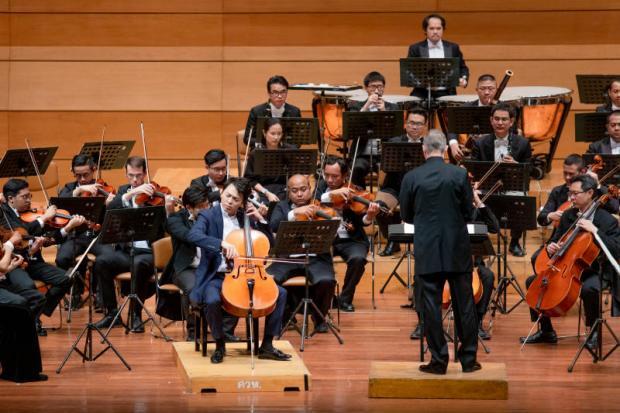
British-born conductor Douglas Bostock made a hugely positive impression on the entire ensemble of the Royal Bangkok Symphony Orchestra instrumentalists when he conducted them for the first time in 2018, and his return visit this year for "Li-Wei Qin Plays Shostakovich" at the Thailand Cultural Centre last month was no less inspiring.
The troubled Russian composer's monumental Cello Concerto No.1 In E-flat Major -- the centrepiece of a musically weighty programme, which featured a truly stellar Chinese cello virtuoso of the highest rank -- is a thoroughly meaty work, so organically conceived that it rivals many of his 15 symphonies in terms of pure musical reasoning.
Indeed, it was made perfectly clear by Bostock's genial introduction of what was, quite possibly, the Thailand debut of Sibelius' ebullient Symphony No.3 In C Major in the second half, that "symphonic greatness" was the intended overriding theme of this concert. He asserted with an unambiguous conviction that Beethoven, Shostakovich, and Sibelius represent an ultimate triumvirate of symphonic giants. Leonore Overture No.3 is "a complete drama in itself" according to the wisdom of Richard Wagner (who himself certainly knew a thing or two about vast vistas of soundscape), and it seems that Beethoven here was all-but incapable of finalising an effective introduction to his only opera Fidelio that wouldn't dwarf all that follows onstage in terms of musical storytelling. Without going into too much detail, opera houses simply still don't quite know how to handle this beautiful behemoth in theatrical context -- apart from admire it, of course.
Which is why most of us enjoy it rather more easily as part of the regular concert-hall going experience. The RBSO delivered a reasonably confident, fairly competent rendition overall, in a context where weak playing has absolutely no hiding place. The most delicate and reflective opening adagio displayed some passages of nicely controlled phrasing and, for the most part, quite well centred intonation in what is quite transparently a totally unforgiving, exposed chord spacing context. The ensuing explosive allegro was most pleasing for its clear differentiation between true pianissimo and fortissimo dynamics (an acid Beethovenian test), with the ever-present temptation to crescendo prematurely thankfully avoided. Principal trumpet Vanich Potavanich was on this rare occasion "heard but not seen" as he provided the offstage fanfares that signify prisoner Florestan's liberation. Likewise, special mention must be made of the front two desks of first violins -- fronted by rock solid concertmaster Bing Han -- who were clearly selected in rehearsal to articulate (convincingly) a truly notorious transitional moment for orchestral violin pros worldwide, of any vintage or calibre -- bravissimo!
Virtuosity of genuine order was then seemingly defined anew by Li-Wei Qin as he appeared stage-right to dazzle the expectant audience. Shostakovich's first cello concerto was written for mega-legend Mstislav Rostropovich in 1959, who famously memorised the highly complex creation in, or even under, four days. To this day it is rightly regarded as one of the instrument's biggest challenges, and not just technically. The gargantuan five-minute cadenza workout alone, arguably the mother-of-all-cadenzas, demands an emotional outpouring commensurate with the profound existential message communicated by Shostakovich at his most earnest. The TCC was privileged to witness this committed interpretation by Qin, while expert accompanying by Bostock and the RBSO complemented a spellbinding performance that will remain long in the memory. The significant solo interjections throughout by principal horn Supreeti Ansvananda were of the very highest order, and were duly acknowledged by Qin himself.
Li-Wei Qin then rewarded adulatory applause with a perfectly charming verbal introduction to not just one, but two absolutely entrancing encores. His gorgeous 1780 Joseph Guadagnini cello made Bach's Prelude From Suite No.1 In G Major BWV 1007 sing and sound like the most divine manna from heaven, while his mesmerising performance of music by contemporary Italian composer Giovanni Sollima featured virtuosity of the most impressive variety -- certainly introducing this fascinating contemporary composer to a Thai audience for the very first time.
Sibelius' Symphony No.3 has the most exquisite C-major symmetry at its very heart. Bostock captured its relatively understated and subtle essence from the outset, with the cellos, then violas, entering in turn with the exact crystalline clarity, which the composer had envisaged. The metronomically exacting semiquaver scale patterns that pass through the string sections were mostly neat and tidy, albeit with a measure of instability in the viola section as it struggled with awkward chromatic passages. The climax of the first movement was a reminder of how much composers such as Sibelius have influenced the arena of film music in the 20th century -- Howard Shore's heroic theme for the The Lord Of The Rings series borrows heavily, and very obviously, from this original source.
But nothing detracts from the original greatness of Sibelius' own conception, and the audience showed full appreciation for the opportunity to hear this great symphony live for the first time in Bangkok.