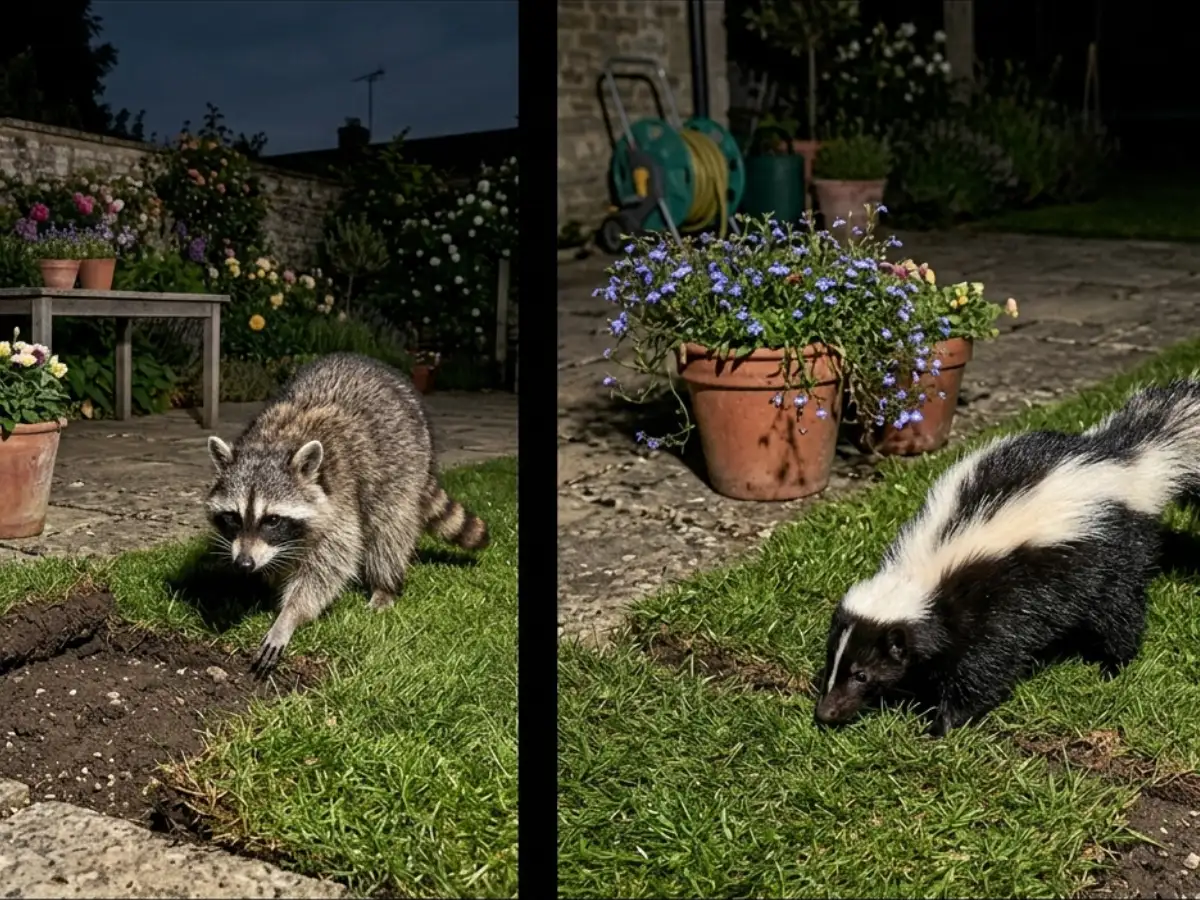
A lush green lawn that appears to be healthy in the evening might appear to be totally devastated the following morning. The presence of small holes all over the grass or sod that has been lifted out can lead to questions about whether or not any wildlife has entered the property overnight. As per the University of Maryland Extension, one only needs to look into the pattern of damage that has occurred.
According to the wildlife experts, skunks and raccoons are two of the most frequent species responsible for damage to lawns in the evenings. These two animals like to tear apart the turf as they dig up worms and grubs hidden underground. Since they are looking for the same kind of prey, both types of damage look alike. However, one can differentiate between the two on the basis of the surface pattern left behind.
Why the lawn damage can look confusing
Initially, it might appear that uprooted grass is disorganized. Skunks and raccoons make their marks differently when people pay closer attention to their lawn damage, as stated by the University of Maryland Extension.
For example, skunks usually dig several tiny cone-shaped holes in their yards. These holes can be relatively shallow due to the fact that skunks dig using their front paws while looking for bugs in the soil. Meanwhile, raccoons are known to either tear out bigger portions of the grass or pull turf in chunks.
As Iowa State University Extension and Outreach states, the presence of many tiny holes in the grass indicates that skunks are the ones damaging the lawn, while broad areas where turf was torn out suggest that raccoons are the culprits. Despite seeming too obvious, this approach is considered one of the quickest to distinguish between them by specialists.
What the hole shape actually reveals
A number of extension services use the size and shape of holes as vital hints in making their determination. As per the North Carolina Cooperative Extension, any hole in the size range of 6 to 10 inches with no sign of soil pile-up signifies activity by either skunks or raccoons.
According to the University of Georgia Extension, large holes that are dispersed in turf grass are an indication of mammalian activity, not insect activity. Often, people do not even get to observe the animal since much of this activity occurs at night. This is why the lawn itself becomes crucial evidence.
Wildlife experts stress that what matters more is the whole pattern rather than a single hole. While a lawn full of cone-shaped holes depicts a certain pattern of activity, sod being stripped off from a lawn represents yet another pattern.
Why are skunks often blamed first?
The connection between skunks and lawn digging at night comes primarily from their feeding habits. The Penn State Extension indicates that skunks frequently dig through good lawns when looking for insects below the surface.
According to the University of Nebraska-Lincoln Extension, another sign of skunks is cone-shaped holes, which are among the most common indications of skunk feeding. Instead of uprooting large patches of grass, skunks typically make numerous small disturbances while walking through the lawn. Since this is how skunks naturally hunt, extension services highlight the fact that this type of damage is not random destruction.
Why raccoons leave a different pattern
Raccoons might create similar issues as well, albeit they tend to employ a different method altogether. The University of Maryland extension suggests that raccoons are very versatile omnivores who usually scavenge suburban lawns for bugs and grubs.
Unlike skunks, raccoons tend to make use of their highly developed front legs to turn up the sod when they are hunting for food. In consequence, one might wake up to find an entire section of their lawn turned over in the morning rather than having multiple holes.
As stated in a scientific paper published in PubMed, raccoons often move around at night in order to forage. Raccoons have been described in this paper as very adaptable nocturnal hunters that thrive in suburban environments.
Why grub problems should still be confirmed
Despite the fact that grubs attract both skunks and raccoons, extension specialists advise property owners not to jump to conclusions regarding lawn damage being caused by an excessive number of grubs in the area.
As explained by University of Maryland Extension specialists, people are encouraged to check several spots on the lawn prior to applying any grub controls or pesticides. Digging by wildlife can take place even at lower levels of grub population.
It is suggested to treat the lawn as if it were a crime scene investigation. The first step includes analyzing the appearance and arrangement of lawn damage. It then becomes necessary to verify that insects are indeed found underneath the grass.
In all extension guides for Maryland, Iowa, Georgia, Nebraska, and North Carolina, there is one common piece of advice. The arrangement of the holes often reveals the culprit rather than their number. Cone-shaped holes indicate that the perpetrator was a skunk. On the other hand, rolled or lifted turf areas are often the sign of raccoon activity.