
Welcome to the Monday, July 6, 2026, Brew.
By: Briana Ryan
Here’s what’s in store for you as you start your day:
- Since 2016, nine former U.S. representatives have run in Florida — four of them are running this year
- South Carolina adopts REINS-style state law, prohibits judicial deference
- President Donald Trump issued six executive orders in June, the fourth-lowest monthly total in his second term
Since 2016, nine former U.S. representatives have run in Florida — four of them are running this year
Twenty-two former members of the U.S. House of Representatives — 13 Democrats and nine Republicans — have announced candidacies for a non-consecutive term in the 2026 election cycle — the most since 2016.
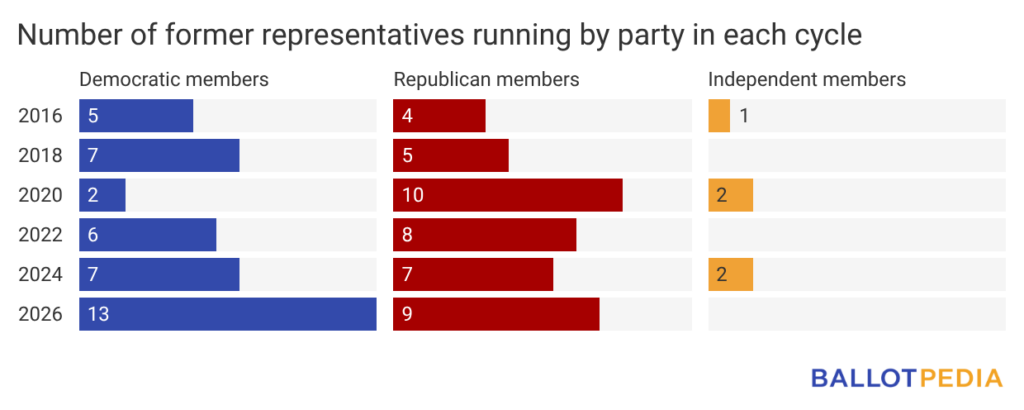
Four of those former members are running in Florida — one of 10 states that underwent mid-decade redistricting ahead of the midterm elections — for non-consecutive terms this year. As a result, a total of nine former members have run for non-consecutive terms in Florida since 2016 — the most of any state.
Florida also ties with Texas for the state with the most former members running for non-consecutive terms this year, at four each.
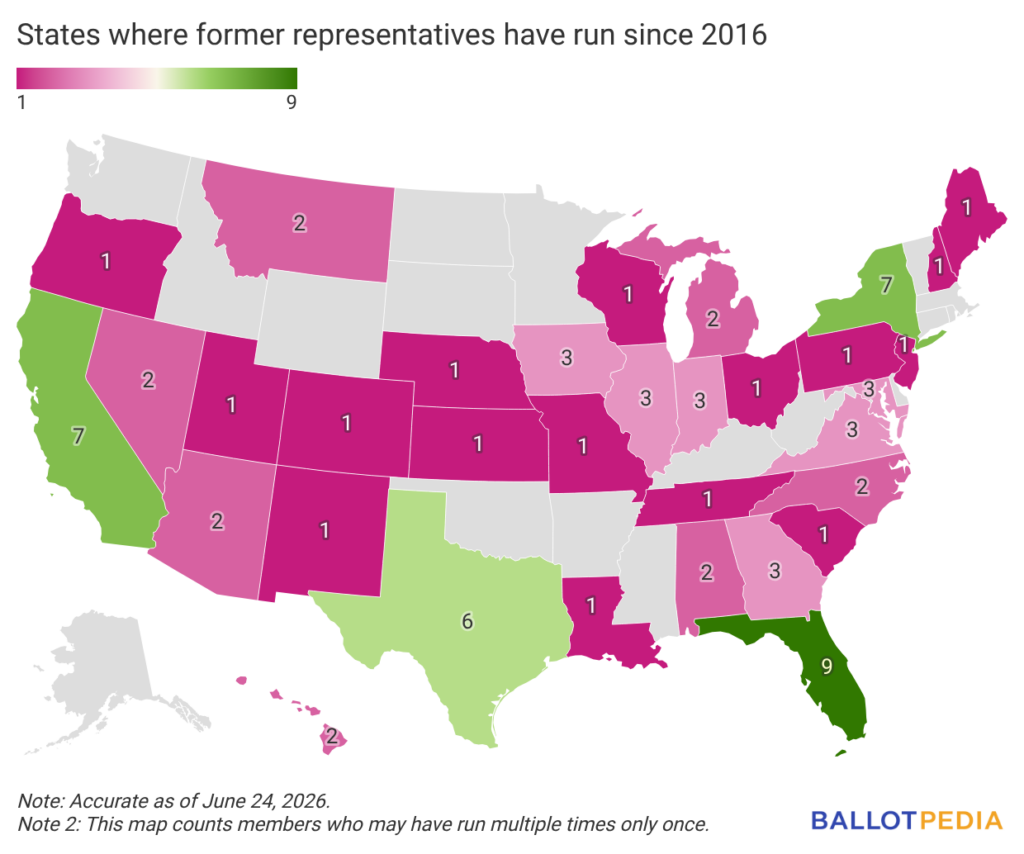
The four former members are running for non-consecutive terms in three congressional districts in Florida this year: the 7th Congressional District, the 19th Congressional District, and the 20th Congressional District. As a result of redistricting, all three of those congressional districts became more Republican based on the 2024 presidential election results in the state.
Here’s a closer look at the four former members who are running in Florida this year for non-consecutive terms:
- Sheila Cherfilus-McCormick (D) is running in the Democratic primary for the 20th Congressional District after resigning in April 2026. The August primary will occur just under four months after her resignation.
- Madison Cawthorn (R), formerly of North Carolina's 11th Congressional District , and Chris Collins (R), formerly of New York's 27th Congressional District , are running in the Republican primary for the 19th Congressional District.
- Alan Grayson (D) is running in the Democratic primary for the 7th Congressional District.
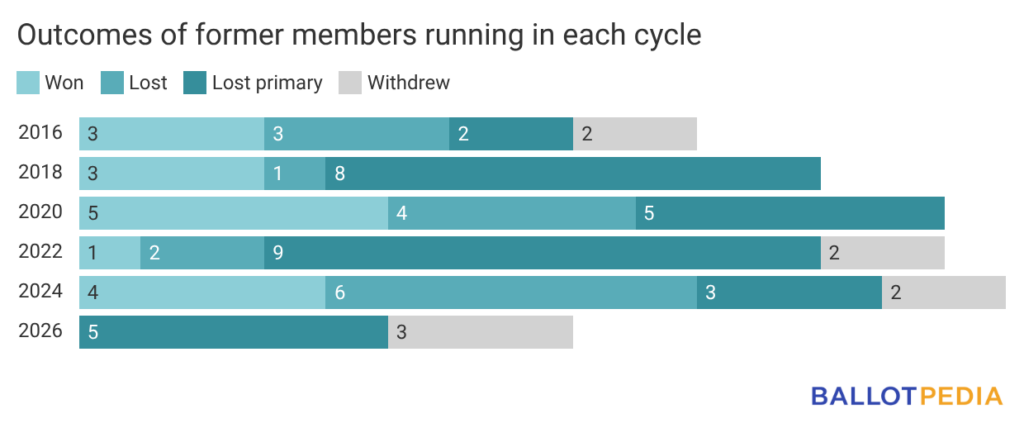
Six of the 22 former members running for a non-consecutive term this year have lost primaries, four advanced from primaries, and nine are running in primaries that have not yet occurred. The remaining three former members withdrew from the primaries.
In every election cycle from 2016 to 2024, former members were largely unsuccessful in running for non-consecutive terms. During that period, 49 candidates, or 55.7%, lost in either a primary or a general election. The most successful election cycle for former members was 2020, when five former members won non-consecutive terms. The least successful election cycle was 2022, when one former member — Ryan Zinke (R) of Montana’s 1st Congressional District — won a non-consecutive term.
This year, among all members running for non-consecutive terms, the average time between leaving office and running again is 7.5 years, or almost four full U.S. House terms.
Some members ran soon after leaving office, while others have run again after a longer absence. The member with the longest gap between leaving office and the date of election was Elizabeth Holtzman (D), who ran for New York’s 10th Congressional District in 2022 — approximately 42 years after leaving office in 1981.
Click here to read about former members of the U.S. Congress who ran for non-consecutive terms.
South Carolina becomes the third state to enact a REINS-style law and the fifth to prohibit judicial deference this year
On June 30, Gov. Henry McMaster (R) signed H 3021, making South Carolina the third state this year to enact a REINS-style law, and the fifth to prohibit judicial deference. The bill included other provisions related to executive agency procedure and oversight.
H 3021 requires legislative approval for all executive agency regulations with estimated costs exceeding $1 million over five years. Ballotpedia defines a REINS-style policy as one that requires legislative review or approval for executive agency regulations with expected costs to exceed a certain monetary threshold.
The bill also prohibits courts and administrative law judges from deferring to the agency's interpretation of a statute or regulation, and instead requires them to interpret them de novo. Read the other provisions of the bill here.
On March 6, the South Carolina House of Representatives passed H 3021 108-0, with six Democrats and four Republicans not voting and one Democrat and three Republicans absent. Twenty-seven Democrats joined 81 Republicans in support of the bill.
On May 6, the South Carolina Senate passed H 3021 40-0, with two Democrats and three Republicans absent. Ten Democrats joined 30 Republicans in supporting the bill.
The General Assembly reconciled amendments between the chambers and ratified the bill on June 29, sending it to McMaster. South Carolina has a Republican trifecta, meaning Republicans control the governorship and have majorities in both legislative chambers.
REINS-style laws
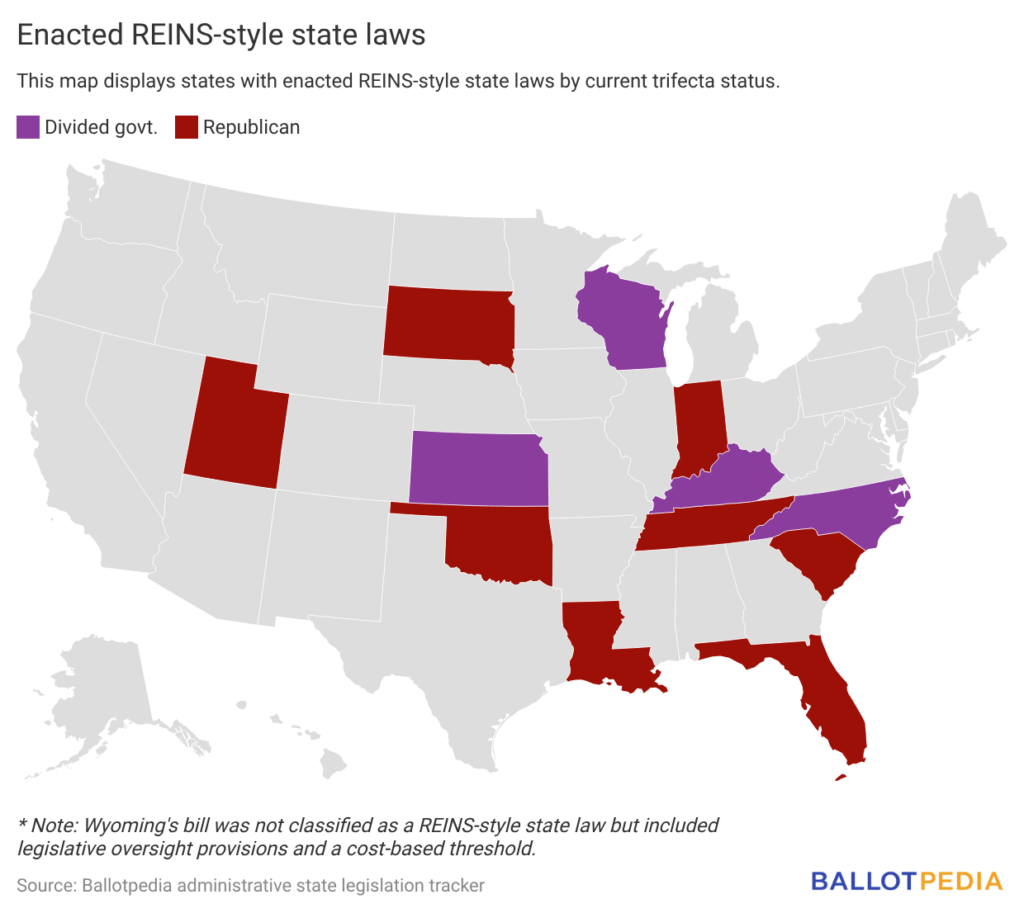
South Carolina is the 12th state to adopt a REINS-style state law since 2010, and the third this year, behind South Dakota and Tennessee. Indiana amended its REINS-style state law in the 2026 legislative session. Five states enacted REINS-style bills in 2025.
Eight of the 12 states had Republican trifectas when they enacted the laws, and the other four had divided governments.
Ballotpedia defines a REINS-style state law as one that requires legislative approval of a proposed rule exceeding a certain cost threshold before the regulation can take effect. These laws are modeled after a federal legislative proposal called the Regulations from the Executive in Need of Scrutiny Act (REINS Act).
REINS-style state laws are one of several other types of policy proposals designed to increase legislative oversight of agency regulations. REINS-style state laws provide state legislatures with more direct control over major agency regulations with significant economic impacts by granting lawmakers the preemptive authority to review and halt the enactment of certain regulations. They address the separation of powers between state legislatures and state executive branches in administrative rulemaking by undelegating executive branch authority.
Judicial deference
South Carolina is the fifth state to limit or prohibit judicial deference this year. Four of the states — Georgia, Alabama, South Carolina, and South Dakota — had a Republican trifecta, and one — Kansas — had a divided government. In 2025, seven states – six with a Republican trifecta and one with a divided government — limited or prohibited judicial deference through legislation or court decisions.
In 2024, the U.S. Supreme Court overturned Chevron deference in its Loper Bright Enterprises v. Raimondo decision, and three states ended deference at the state level through legislation.
Judicial deference is an administrative law principle under which courts yield to an executive agency’s interpretation of a statute, regulation, or policy when certain conditions are met. There are different types of judicial deference doctrines at both the federal and state levels. When courts do not apply a deference doctrine, they read the statute, regulation, or policy de novo, deciding the meaning without deferring to any other authority. Judicial deference is central to many debates about the administrative state and the balance of power between executive branch agencies and the courts.
Click here for more information on REINS-style state laws, and here to check out Ballotpedia's Administrative State Legislation Tracker for more state and federal legislation regarding the executive branch agencies.
President Donald Trump issued six executive orders in June, the fourth-lowest monthly total in his second term
President Donald Trump (R) issued six executive orders in June, the fourth-fewest of any month in his second term. As of July 1, Trump has signed 269 executive orders in his second term.
The June executive orders addressed artificial intelligence, the administrative state, customs enforcement, quantum computing, and agriculture. Click here to read more about each order.
Trump issued 46 executive orders in January 2025, more than in any other month of his second term. October 2025 was the month when Trump issued the fewest executive orders of his second term, with only one.
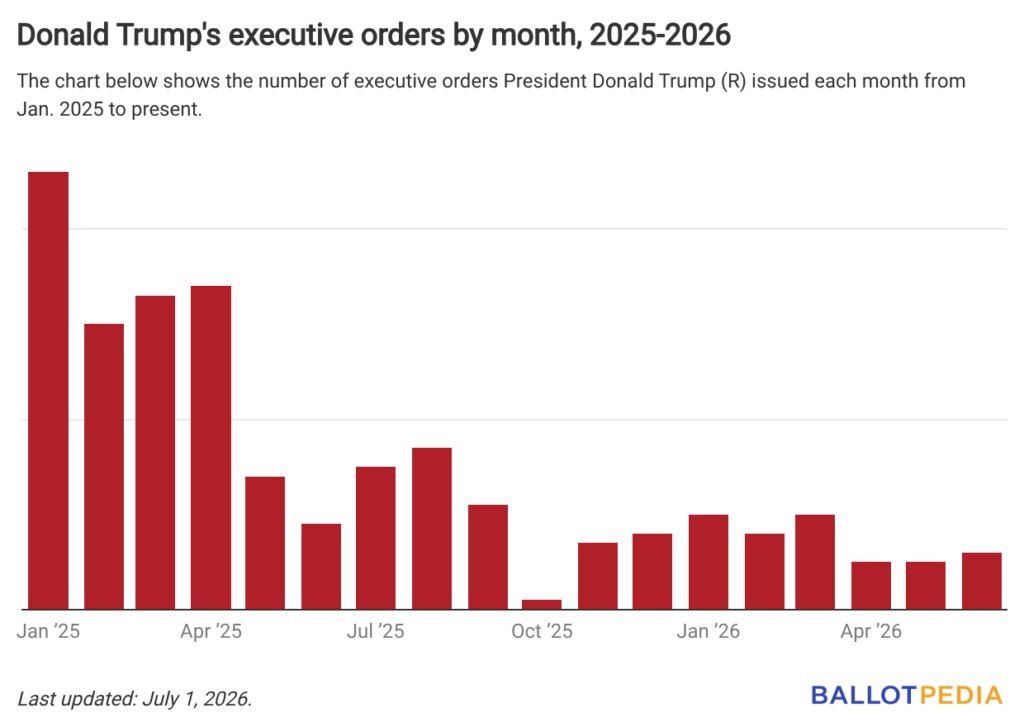
Among all U.S. presidents, Trump has issued the 9th-most executive orders, with 489 orders across his two terms in office as of July 1. Franklin D. Roosevelt (D) issued the most executive orders of any U.S. president, with a total of 3,721 during his time in office. William Henry Harrison (Whig) issued the fewest, having issued none during his one month in office. Three presidents issued only one executive order each: James Madison (Democratic-Republican), James Monroe (Democratic-Republican), and John Adams (Federalist).
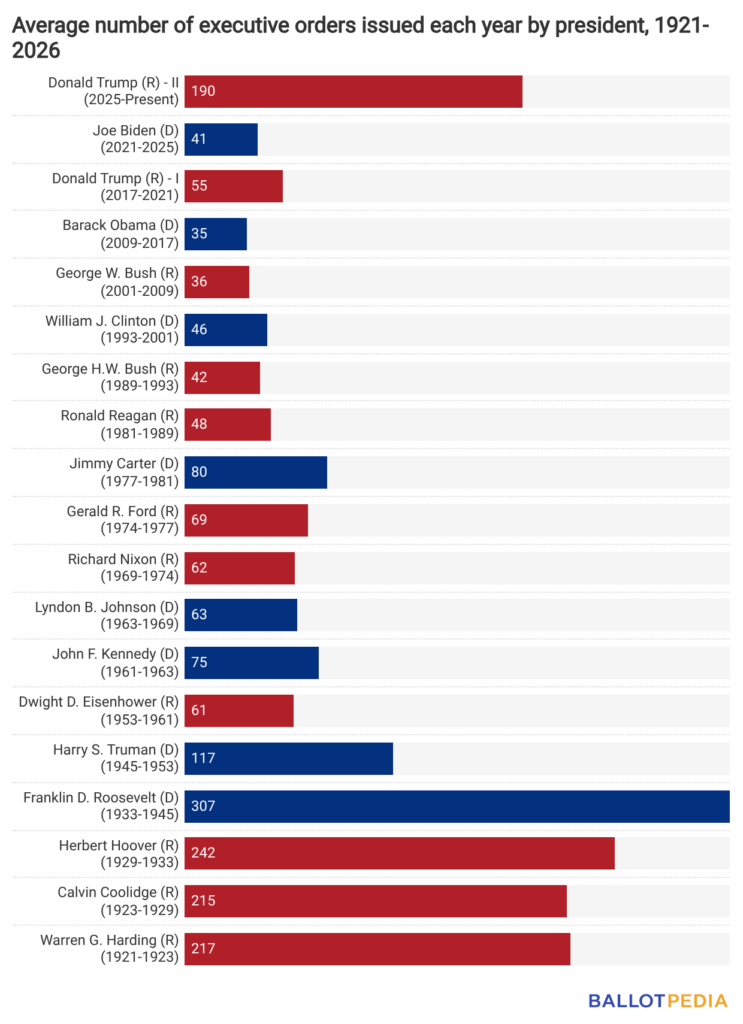
Trump has issued an average of 190 executive orders per year in office in his second term, the highest average among the seven presidents who have held office since 1981. In his first term, Trump averaged 55 executive orders per year, the second-highest in that time. Joe Biden (D) averaged 41 per year, the third-fewest in that time. Franklin D. Roosevelt (D) issued an average of 307 executive orders per year, the most of any U.S. president.
Click here for a full list of Trump’s executive orders and actions in his second term.