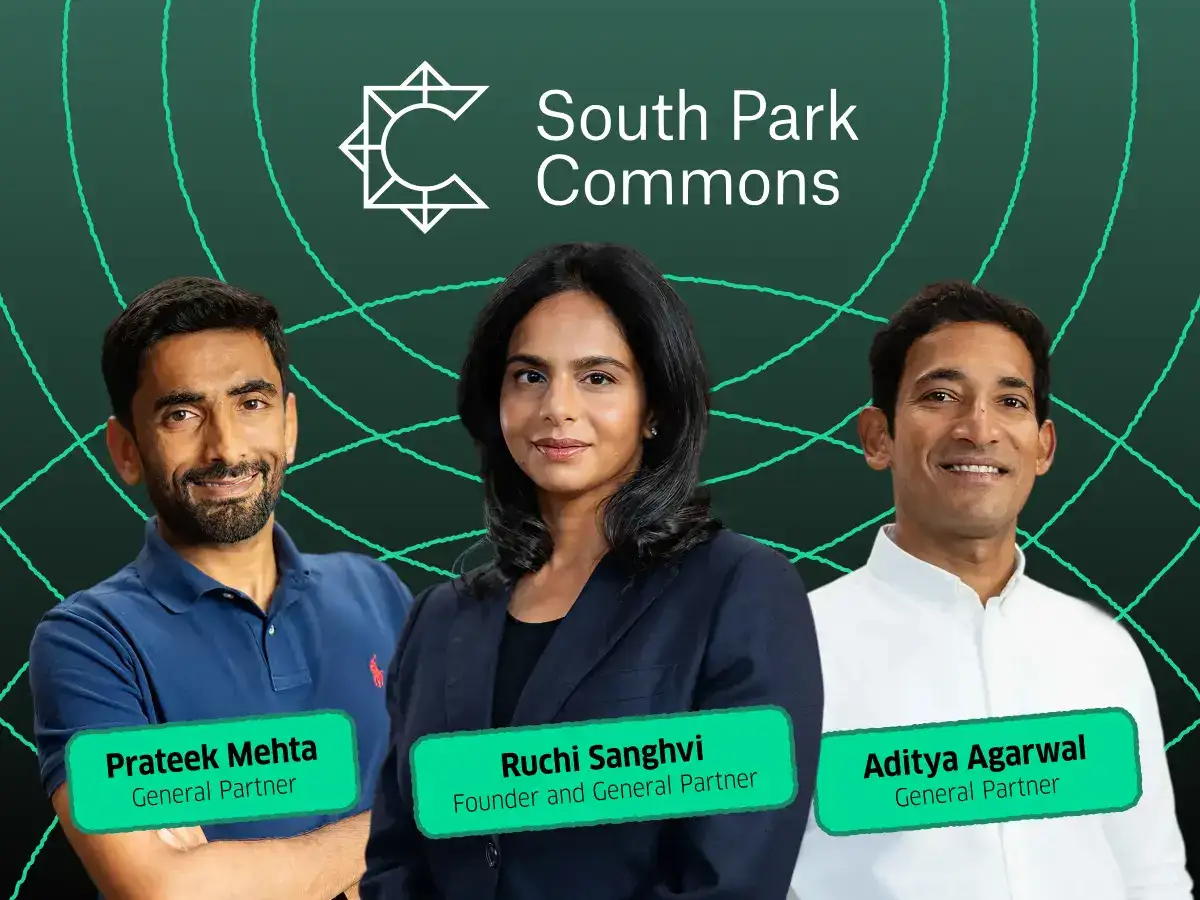
Investors are increasingly hunting for “alpha” in deeptech as software economics evolve, says South Park Commons (SPC) general partner Aditya Agarwal. The San Francisco-based collective for founders that's also an early-stage investor is looking to double down on India's deeptech opportunity.
Agarwal believes venture capital (VC) firms, both globally and in India, are looking beyond traditional software bets to semiconductors, robotics, and spacetech.
“Software has been the biggest growth industry for a long time,” Agarwal told ET during an interaction in Bengaluru. “But investors are now asking where the true alpha lies, where the defensibility is. That is why many are moving towards semiconductors, energy infrastructure, drones, robots, humanoids, and spacetech.”
ET had earlier reported on India’s sector-agnostic VCs launching deeptech funds. Agarwal added that nearly half of SPC’s recent investment activity is tied to deeptech-related themes.
In 2026, deeptech startups have so far raised 1.1 million as of June compared to $1.55 billion across 264 deals in 2025, per data from Tracxn. Venture capitalists said the growing investor appetite for deeptech is being driven by policy support, launch of the Research Development Incentive (RDI) fund, and a strong pipeline of startups beginning to reach maturity.
SPC on Thursday announced two new visiting partners, Harshit Madan and Rohan Choudhary for its India office. Madan used to work at Meesho, where he led product and later operations and supply chain. Choudhary helped build InMobi from the ground up and later co-created Glance.
“With hardtech and deeptech, people will need to learn to get uncomfortable and truly bet on technical risk and the team,” Agarwal explained. “It takes longer to know if something is good. It takes longer to get revenues. There’s an element of patience required.”
SPC, named after a San Francisco neighbourhood, was founded in Silicon Valley by Agarwal and his wife Ruchi Sanghvi in 2016. They have both held top jobs at some of Valley’s biggest tech firms. While Sanghvi is known for being the first woman engineer at Facebook, Agarwal was chief technology officer at file-sharing company Dropbox and also served on the board of Flipkart.
Known for backing founders in the “-1 to 0” stage before ideas fully take shape, SPC entered India in 2024 through a collaboration with Flipkart cofounder Binny Bansal. The firm’s Bengaluru office was its first outside the US.
The company plans to write cheques ranging from roughly $500,000 to $10 million, while continuing to invest across both software and deeptech sectors.
“We are not saying no to software,” Agarwal said. “We still believe consumer software, healthcare software, B2B SaaS, and fintech will continue to account for roughly 40-50% of investments. But my expectation and hope is that at least 50% of our investments will eventually be in deeptech.”
In India, SPC’s portfolio includes about eight startups, including Meesho, Cure.fit, Arctus Aerospace, voice AI company Maya Research, and healthcare startup Cent AI. While SPC has not officially disclosed details of its India-focussed investment vehicle, Agarwal said the capital allocated for the country is larger than figures that have surfaced publicly. Earlier reports had said that the fund is looking to deploy $40 million in early stage startups here.
Globally, the SPC community has included entrepreneurs and researchers who went on to build companies in frontier AI and deeptech. Some of its global investments include Luma Labs, Replit, Gamma, and more.
Also Read: Silicon Valley’s South Park Commons launches Bengaluru outpost in collaboration with Binny Bansal
Deeptech needs a unique mindset
Agarwal said deeptech requires a very different mindset compared to traditional software investing, particularly in India where the venture ecosystem has historically focussed on internet and SaaS businesses.
“Software has been the defining growth industry for venture capital for a long time because the economics were incredibly attractive — low cost of production, low cost of reproduction, and the ability to scale digitally,” he said.
However, Agarwal believes AI is changing the nature of software businesses. “I wouldn’t say software is becoming commoditised, but its properties are clearly evolving, and that could eventually mean lower gross margins than what the industry has historically enjoyed.”
Indian founders solving hard problems
SPC’s India office is led by Bengaluru-based general partner Prateek Mehta, who said the country is beginning to see the emergence of founders tackling globally relevant engineering and scientific problems.
“That is why you are seeing a move into spacetech, semiconductors, and related ecosystems. We are currently spending time with a founder building something in the silicon stack from India — earlier, people would not have imagined that startups could do this. Such ambitions were associated with large groups like the Tatas,” he said.
Agarwal added that the categories emerging in India increasingly resemble frontier deeptech trends visible in the US. “One of the most interesting things about SPC’s ecosystem is that we often get a glimpse of the future 18-24 months in advance because we bring in smart people and encourage them to work on future-facing problems,” he said.
“If these early signals are any indication, I think you are going to see a lot more interesting hardtech innovation emerge across multiple categories in India.”