Thank you to our all our panel guests (see full list). As a final comment, I’d like to highlight a couple of interesting points from Andy Rowell and Eliot Whittington.
Andy Rowell says: Can business leaders be expected to commit to legitimate, realistic pledges or could pledges turn into a publicity campaign in getting a positive reputation in an increasingly aware community of consumers? I am afraid the oil industry has a history of greenwashing on pledges to tackle climate change - BP’s pledge and multi-million campaign to go “beyond Petroleum” just after the Millenium being the most obvious one. Fifteen years later, the company is more dependent on oil and gas than ever.. So I think you have to be very careful of spin..
And in response, Eliot Whittington says: While that’s true, I think you’re missing out part of the picture. Under one CEO (Lord Browne) BP did have a commitment to renewables and make some investments - they then dismantled that when the leadership changed. You can critique the pledge, but I think it’s important to recognise there was a change in strategy away from it.
A nod to the importance of business leadership then...
Updated
What advice would you give business leaders?
Now for some closing comments from our panel guests. What advice would they give business leaders?
Edward Cameron: I would tell them the world is changing. Climate change is already impacting their supply chains, operations, workers, and markets and if they fail to act they will exacerbate their risk. I would tell them that we have an unprecedented opportunity to create a better economy and that governments and other businesses are rising to the challenge. I would tell them that they cannot stand apart from this movement towards a new climate economy without running the risk of damage to their brand and ceding growth opportunities to others who are more innovative. but most importantly I would listen to them. Understand their business. Try to design a strategy tailored for them. And stop preaching.... as I do that far too much already.
Clare Hieron: I would say: be brave but be honest - pledges are fine but the long term viability of your business relies on your ability to deliver on a low carbon business plan so don’t be tempted by green-wash!
Andrew Crane: Business likes a level playing field, so it is imperative that business leaders are united in calling for tough, international climate change rules that affect everyone.
Ben Kellard: Clarify your strategic, longer term material issues (and how you can contribute to a sustainable future) and develop bold goals around them. Then distinguish between what you can act on directly and what you can do (creatively) to influence and shape the wider market/system to create a more sustainable future.
Andy Rowell: The climate science is telling us that the time to act is now, not tomorrow. Fine words and pledges are no longer enough.. its time for radical action.
Eliot Whittington: If I was speaking to a business leader now I’d steal Edward & Veronica’s refrain that this change is inevitable and you are either with it or against it, but I’d also add that if you don’t play a visible constructive role in making the change happen - working to bring about a new, low-carbon, low-climate risk, sustainable economy, then sooner or later you will find that despite your best efforts policies to support the change will be introduced and you will have missed your chance to shape them and develop them to be efficient, cost effective and effective in helping you change as quickly as possible. You won’t make this agenda go away but instead you will just store up problems for the future.
Veronica Lie: ...Remind them that the most important ingredient in engagement is actually not speaking but listening: ‘We have two ears and one mouth so that we can listen twice as much as we speak.’
Updated
And another answer in response to the carbon tax question (see 13:55)
Andrew Crane: If even oil sands companies are asking for a higher price for carbon, you know it has reached a pretty major threshold of acceptability: http://www.huffingtonpost.ca/2015/05/22/boss-of-biggest-oilsands-_n_7423096.html
Updated
Another response to Heather Kilgour’s external costs question (See: 13:55) and specifically on the issue of a carbon tax.
Edward Cameron says: I would say the two things I hear most often from business on this issue is that they would like to have policy certainty and a price on carbon. So personally, I believe it is both a powerful incentive to climate ambition but also one that could get support politically and from the business community. If set up correctly it could also help us to address regressive taxes elsewhere in the system. We would likely need to be agnostic about the method as one jurisdiction might be more disposed towards emissions trading and another might lean towards a tax. We would also have to do a far better job of setting them up than has been the experience to date (i.e. lets not give permits away for free when government revenue can grow by selling them!!!) but overall I think the future lies in carbon pricing.
Updated
Is the system at fault, rather than business?
Julian Spindler has asked: How can business leaders promote climate change solutions when their businesses are based on a free market “growth”model, the very antithesis of what is needed? Fundamentally, climate change is the result of massive, unsustainable over consumption.
In response...
Ben Kellard says: That’s right that our current consumer model of ‘take- make- waste’ based on (relatively) cheap oil has fuelled CC, however it raises the question over what kind of ‘growth’ we need. We are expecting another 2bn people by 2050 and we aren’t able to currently meet the needs of 7bn with our current resources, so I think we need a step change in our political economy that incentivises and delivers solutions that are low carbon and resource efficient products and services that meet real human needs.
Eliot Whittington says: We absolutely do need a fundamental rewiring of the economy if we are to tackle climate change and other sustainability challenges. And I think there are business leaders who get that - they know that their business and the economy they operate in looks fundamentally different in the future. What I think they, and the rest of us, are feeling towards is how do we get there? Ideas like that about the circular economy are starting to answer this, but there’s a way to go.
Updated
In response to Veronica Lie’s answer to whether business leaders should speak out or not (see 14:03), Andrew Crane says: I think you are right Veronica, but two things stand out for me: 1. Your comment in parenthesis that it depends if leaders are on the right side of the argument. This is really important but often with public issues there is no clear right side, except of perhaps whether the majority of their stakeholders agree. Climate change is a little different because there is such a huge scientific consensus, but that is not the case for lots of other issues that business leaders have spoken out on, such as same-sex marriage, immigration, health care and others. 2. The risks you mention (e.g. bad publicity) tend to be short term, while the rewards (e.g. addressing climate change) are often more long term. So business leaders often value the risks higher, even if the rewards are, in principle, much greater.
Updated
Andy Rowell draws attention to Edward Cameron’s point about fossil fuel subsidies.
We are talking about billions and billions of consumer and production subsidies. As Damian Carrington pointed out yesterday in the Guardian, according to the IMF: “Subsidies for fossil fuels amount to $1,000 (£640) a year for every citizen living in the G20 group of the world’s leading economies, despite the group’s pledge in 2009 to phase out support for coal, oil and gas.”
It goes without saying that this is total economic and ecological madness which Governments seem incapable of fixing, despite numerous pledges to the contrary..
And one more response (see 14:03 below) from Gabrielle Walker... Yes indeed, spot on Veronica and Edward. As Richard Sandor (founder of the Chicago Climate Exchange) memorably put it: “If you’re not at the table, you’re on the menu!”
Updated
Should business leaders speak out or not?
Should business leaders speak out or not?
Veronica Lie: It’s risky, I think, for business leaders to stay silent and inactive on issues that matter to their stakeholders. The silent will not escape judgment; they’ll be dismissed as irrelevant.
Ben Kellard: I agree and I think we have reached the point where the risks of businesses staying silent are greater than speaking out.
Edward Cameron: We often use the old adage that “you can lead the parade or get run over by it”. A new low-GHG economy is being created all around us. This summer alone more than 40 countries have come forward with climate action plans representing almost 60% of global emissions. In addition we have seen more than 140 companies with a combined market value of in excess of $2tn commit to climate action through the We Mean Business Campaign. They are all helping to create a new economy. The resilient business of the future will seize this as an opportunity and help shape it. The businesses who fail to act will be left behind.
Updated
Another response to Heather Kilgour below from Andy Rowell: Heather Kilgour asks a great question: Maybe if companies were responsible for all the externalities including pollution then this would not even be an issue? I think if companies did pay the full external cost then certainly people would not fly so much and we would radicaly rethink how and why we travel - It is cheaper to fly to Iceland and back from Bristol than get a single train to London - and that’s not even a peak ticket. It makes no climate sense at all.
And if airlines and airports had to pay the full cost of their carbon dioxide emissions, their noise pollution as well as other more localised pollution, many would argue there would not be any need for a 3rd runway at Heathrow, for example..
Updated
Business must face true costs of actions
Heather Kilgour is asks: Maybe if companies were responsible for all the externalities including pollution then this would not even be an issue?
In response...
Ben Kellard says: The challenge is that, unless a price is costed in globally, it risks becoming marginalised (and capital may move to another region) or an exercise in wooden dollars, as opposed to something real on the balance sheet.
Edward Cameron says: Consider China for a second. China says that up to 28% of its emissions are embedded in goods that are consumed overseas. As a result it claims that the consuming countries - mostly the EU and US - should be responsible essentially for the externalities of those emissions. They manufacture the goods but someone else demands and uses them. Many companies make the same argument - either by saying their emissions are coming from their suppliers or from their consumers. So it actually becomes difficult to determine responsibility.
Elliot Whittington says: This is the logic that leads to a lot of support for mechanisms like a carbon price - which would internalise climate impacts into companies’ business model. However the political reality is that we’re unlikely to get very high carbon prices that could deliver the kinds of change required and the economic reality is that a single price signal is not necessarily the right, efficient policy framework to really unlock the potential of innovation. So in practice a carbon price is a necessary but not sufficient response to climate change, and I suspect that’s true for other issues too.
Updated
NoMoreMrNice then asks: Given the doubts over greenwash, and the difficulties of comparing companies, how can more be done to help those really showing leadership to stand out? Without this their public statements will always be undermined by a public scepticism (whether justified or not).
In response, Clare Hierons says: I think this is where the NGO community can help by putting forward initiatives that leaders can champion and put their name to without the risk of backlash. Rather than compete with each other they can back campaigns that drive a whole agenda forward and provide consistent commentary. RE100 is mentioned in the earlier discussion - this is a straightforward commitment for companies to switch to renewable energy sources. http://there100.org/
Updated
So good points made by NoMoreMrNice: ...speaking out alone is not enough; as somebody working for an organisation that shows more vocal than practical leadership, I know that often what our suppliers hear is “X want to be seen as green, so they’ve put out a press release - that’s nice. Means nothing to us though”. I’m sure many politicians hear this as well; they know that a firm saying ‘we want a sustainable future’ does not necessarily mean they’re saying ‘we’ll back a party promising aggressive carbon cuts’.
Part of the problem is the difficulty over understanding how green a company is - or even what green means - without which we can’t really evaluate whether their actions match the rhetoric. When even a simple product like paper can be FSC, recycled, or (in a particularly egregious example of greenwash packaging I saw ‘suitable for recycling’ shown against a recycling logo on green background) assessing the full impacts of a multinational is nigh on impossible.
But it’s still essential; what’s needed is greater focus on some of the accreditations designed to promote sustainable practice and transparency. We need to move away from ‘x is a sustainable company; they have a wind turbine at their head office’ to a proper narrative that engages with business responsibilities. That cannot be done, in my view, without much stronger, simpler, more transparent certification.
Andy Rowell picking up on the politics issue (13:58). In response to Dr. Neil Cutland I think it is clear that the Conservatives - having gotten rid of the Lib Dem hand-brake - are now showing their true anti-green credentials. They are clearly anti-renewables and pro-fracking, and will do a mimimum on climate, but will spin that differently in the run up to Paris. We cannot forget that many Tory backbenchers and some Ministers are climate sceptics.
Where, you ask, are the powerful business voices, criticising the Government’s environmental record since May?
There have been some Andy...
Updated
Follow the money says Edward Cameron in response to Andy Rowell and Ben Kellard: I think Andy makes a great point about following the money. The climate negotiations are focused on moving $100bn per year in support of climate action. But that amount of money is not enough to change the direction of the global economy - worth in excess of $90tn. So we need to persuade mainstream investors to finance the transition to a low-carbon future and that means putting in place the right incentives. This means creating new financial vehicles (i.e. green bonds) and crucially eliminating the perverse subsidies that make fossil fuels artificially competitive.
Another response to politics question (see 13:38), Andrew Crane says politics do matter...There was a nice study published a couple of years ago demonstrating that the political beliefs of CEOs (measured by their political donations to republican or democrat parties in the US) had a significant correlation with how well their firms performed on social responsibility, irrespective of whether the CEOs spoke up. Basically firms led by democrat CEOs invested more in CSR than those led by Republicans. So political affiliations do matter:http://asq.sagepub.com/content/58/2/197
Updated
In response to politics question (see 13:38), Clare Heirons says: Politics and policy need to be separated – if businesses are genuinely trying to act in the right way and find themselves constrained by legislation then speaking out is helpful. The picture gets skewed when businesses lobby to lock in business models that protect short term gain at the expense of long-term global viability.
Updated
In response to below (see 13:38), Edward Cameron says: I think a broad array of interests prevent companies from speaking out. If you consider the United States for a moment, a company wishing to speak out on climate change faces a Congress controlled by climate skeptics. They need to work with that Congress on trade issues, intellectual property issues, corporate tax, and every other issue under the sun. Many of them are fearful of alienating potential allies on one issue by speaking publically on climate. The net affect is that many companies are working on climate behind the scenes but reluctant to be too vocal. This has got to change but its not easy. If you were to ask me right now what is the one new element that I would like to see in this debate to help us advance the climate agenda it would be a coalition of conservative Americans - from companies, the faith based community, and ideally from State-administration in red States to come out in favor of climate action. The danger right now is that this does seem to be turning into a Liberal - Conservative split and that is very damaging.
Updated
Dr Neil Cutland has sent in the following question: Given that the Conservative government has scrapped, reversed or diluted at least six significant environmental policies since it took power in May, business leaders increasingly have to be the ones who lead on the agenda. But are business leaders really likely to do so, given the Government’s clearly indicated direction of travel?
Veronica Lie warns of the dangers of backlash at those business leaders speaking out: Obviously political activism can backfire (eg when Brendan Eich of Mozilla advocated against gay rights), and this can negatively affect the company. What’s important here is that business leaders are on the right side of the argument, ‘the right side of the future’ (as Nick Butler wrote yesterday in the FT). I think the public respects business leaders who speak up when they feel that the speaker is on their side, supporting society’s progress rather than preserving the status quo for personal gain.
In answer to Anna’s tweet, Andrew Crane states: The question of how we monitor corporate commitments is an important one, and I think here obviously the role played by NGOs, the media and academia is critical. With declining donations for NGOs, a newspaper industry in decline and restricted funding for universities, the potential for serious investigation of these commitments is at risk, despite the rise in social media
Business not the only ones with responsibility
Speaking out in sympathy towards business leaders, Matthew2012 makes a fair point: “It might be the easy part but it could make a real difference politically. If you look at the statistics businesses have been lowering their GHG output far more than the residential sector. Yes, this may have been from a very dubious base but nonetheless they have been doing things. Is it enough? No. But this mainly fallls at the doorstep of government and the available energy sources available to the business. There are a large number of barriers to even aiming to bypass the government all together. Businesses need to make it very clear what they believe the government needs to do to help them lower their emissions further.”
Updated
To what extent can the vision of one CEO be implemented effectively across all aspects of a global supply chain? #askGSB
— Anna Watson (@AnnaHolliday) August 5, 2015
Edward Cameron is raging against conflicting positions taken by both government and business: How many governments advance policy objectives under the heading of “climate action” but then contradict their stated objective under for example “agricultural policy”. Unfortunately the EU is a prime example of this with the CAP. Or how many development agencies sign up to climate action only to fund coal projects. I think we need to take a holistic approach to this problem and eliminate inconsistencies - or even hypocrisies - but again this is not just a problem for the business community.
In a nod of approval to the Guardian’s Keep it in the Ground debate, Andy Rowell says: Everyone could do more to hold the industry to account. The City and pension funds for example still invest billions on oil and gas. Most local authorities invest too. They should be putting their money where their mouth is and disinvesting if they think these companies are acting irresponsibly.
Another response to Andy Rowell’s point (see 13:15), this time from Andrew Crane : Great point Andy. And this just shows how tough it is to “discern when a business is environmentally concerned” as Anne asks. Too many companies simultaneously make major investments in sustainability with one part of their business while systematically undermining regulation through their lobbying efforts in Washington or Brussels
Updated
Edward Cameron says: Let’s be clear there is a long history of everyone looking after their own interests. The diplomatic negotiations have been bogged down for more than two decades because of the exercise of national self-interest. I personally believe this is changing on all fronts. through the We Mean Business Campaign (www.wemeanbusinesscoalition.org) (external link) we are seeing more and more companies coming forward with very ambitious plans for GHG reductions
Eliot Whittington says: Just to pick up on the last phrase (13:23), while I think this can be evidenced, I don’t think this can be proved. There are lots of guidelines out there - commitments for companies to take, projects like the Science Based Targets group or the UN guidelines for responsible lobbying. There are lots of ways that you can investigate what a company is doing and what it says, (although there’s also often big transparency gaps). But in the end judgement is called for. You have to make a call on what you think is the right bar for companies to hit given their context and role.
Updated
In response to the question around guidelines and monitoring businesses (see 13:20), Ben Kellard says: There has been a lot of good work that sets out the expectations of businesses to contribute towards sustainability trends. There are the WBCSD Action 2020, there is also http://futurefitbusiness.org/ work done by the Natural Step and Bob Doppelt, all useful contributions and frameworks that organisations can use to identify their materials issues and set goals.
Updated
Just before we come to everyone’s answers on this second question, Clare Heirons from ShareAction has picked up on Andy Rowell’s earlier point (see 13:15): Companies need to be called up when their actions clearly don’t match their rhetoric! A concerning trend here is the use of convincing-sounding arguments such as the recent adoption of carbon pricing as a solution by the oil majors. Transparency is key - leaders need to make commitments in language that anyone can understand (especially if they want to be believed!)
Updated
How do we monitor business promises?
Moving onto a second question. Anne White has asked: How does one discern when a business is environmentally concerned? What guidelines would be crafted? What evidentiary proof could be established?
Updated
And Eliot Whittington, deputy director of policy, Prince of Wales’s Corporate Leaders Group on Climate Change (CLG) adds his thoughts: Speaking out is not a panacea or a substitute for recognising the real impact and importance of environmental issues like climate change within their core business, but, like it or not, businesses play a key role in developing and delivering policy, and if there aren’t positive voices, the negative ones will dominate.
Veronica Lie from Xynteo suggests that by having this debate we are perhaps indicating that business has become disconnected from society: I also think that the question shows how we’ve tended to sever business from society - it should take an interest in public issues because it is a part of society. This compartmentalisation is part of what’s got us into the mess we’re in now.
Investigative journalist and director at Spinwatch Andy Rowell calls for a little more action: I think business leaders not only have to speak up much more on climate, but their words need to be backed up by radical and concerted action. The next few months leading up to the crucial UN climate talks in Paris are critical. There is no substantial leadership on this issue from the big oil companies.
For example, Europe’s two largest oil and gas companies Shell and BP – which recently urged action on climate change – are still basing their projections for fossil fuel use on scenarios which would see catastrophic levels of global warming. On the one hand they talk about the need for action - on the other they just carry on drilling regardless.
Shell’s ill-judged attempt to drill in the Arctic is systematic of this. The company is exposing itself to huge financial and ecological risk by drilling for oil in the Arctic. It is oil we can never afford to burn if we are going to try and keep to 2 degrees warming.
Although in response, Andrew crane says: Well I think we have to be careful in saying they are stakeholders “like everyone else”. No one else really has their power and influence, so they need to really engage in a way that doesn’t seek to dominate or derail the debate
Edward Cameron, from BSR, says: They should speak out on issues as they are stakeholders in society like everyone else. they are exposed to climate risk like everyone else. And they are agents of change like everyone else. Many businesses have greater reach than governments. Unilever for example are present in 8/10 homes around the world every day. They can therefore use their brand, their investments and their credibility for enormous good. And does it help? It does indeed because suppliers listen to their buyers, and politicians take heed of what they hear from the private sector.
Good point from Andrew Crane, Professor of Business Ethics, Schulich School of Business too: I think that if done right, it certainly can help. When business leaders speak, people (especially governments) listen. The risk is that they tend to talk from a self-interested position, rather than one considering the broader public interest
Ben Kellard from Forum for the Future says: The business community in general aren’t being anything like clear enough with governments and other stakeholders that climate change poses massive risk for businesses, especially those with agricultural supply chains. This challenges the misplaced conception that responding to climate change is bad for business. So I would like to see them being much clearer and more vocal that its in the private sector’s interests for all stakeholder to tackle these issues.
Opening question and answers
To kick-off, I have asked the panel to give their perspective on the title question of this debate: Should business leaders speak out on public issues, such as climate change? Does it help?
Updated
This live debate will start very shortly. Thank you to all our panel guests, who are now ready and waiting to take your questions.
We’ve got a pile of questions ready and waiting - sent in over the past week. Il bring both these questions and any other that we get sent in as we go through the debate.
If you want to send a question in please use the comments section below or tweet us @GuardianSustBiz using #askGSB.
Another one of our panel guests Edward Cameron from BSR, has been busy giving his perspective on Obama’s climate announcement.
“Whether you look at the political scene, or whether you look at the movement within the business community, I think you see an irreversible and irresistible movement toward decarbonization,” Cameron concluded.
Ahead of today’s discussion, one of our panel guests Andrew Crane, professor of Business Ethics at Schulich School of Business has written a blogpost outlining his thoughts.
While warning business leaders against hypocrisy and making grandoise plans that cannot be delivered, he argues that aspirational talk isn’t all bad...
For all the problems of greenwashing, business leaders making aspirational statements about social issues shouldn’t automatically be criticized. For one thing, in the context of challenging, complex problems, it is often imperative that business leaders do go outside their comfort zones and articulate “stretch” goals that they can not necessarily know if or how they can achieve. Consider Interface Carpet’s mission to reduce their waste to zero by 2020. When they started their ‘mission zero’ journey in 1994, former CEO Ray Anderson did not have a plan for how this would be realized only that he needed to set a vision that was inspiring enough to galvanize the entire company. Since then, Interface has cut waste to landfill by more than 90% and GHG emissions per unit of production are down almost 75%. The company is rightly lauded as a sustainability leader that others should follow. The lesson is that there is scope for business leaders to be aspirational but sooner or later they need to back up their words with sustained action.
The panel guests
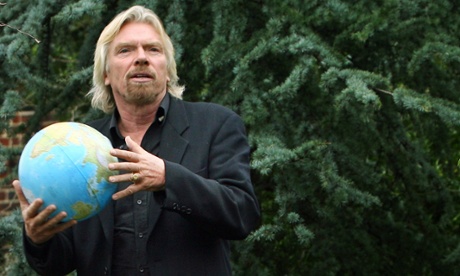
When Richard Branson speaks out on tackling climate change does it help?
With a growing number of CEOs publicly committing their companies to taking action on climate change, what difference can their pronouncements make? Can they persuade others to follow suit, or encourage governments to legislate?
Or is society not yet ready to believe commitments made by the business community. Branson, for example, has been criticised for failing to deliver on a $3bn climate pledge made back in 2006.
Join the following panel on Wednesday 5 August 1-2:30pm BST to discuss the topic:
Andy Rowell, freelance journalist and director at Spinwatch
Clare Hierons, director, ShareAction
Andrew Crane, Professor of Business Ethics, Schulich School of Business
Edward Cameron, managing director for partnership development and research, BSR
Veronica Lie, head of communications and strategy, Xynteo
Ben Kellard, head of sustainable business, Forum for the Future
Eliot Whittington, deputy director of policy, Prince of Wales’s Corporate Leaders Group on Climate Change (CLG)
You can submit your questions in the comments section at the bottom of the page, or send them to us on Twitter at @GuardianSustBiz using #askGSB.
Updated