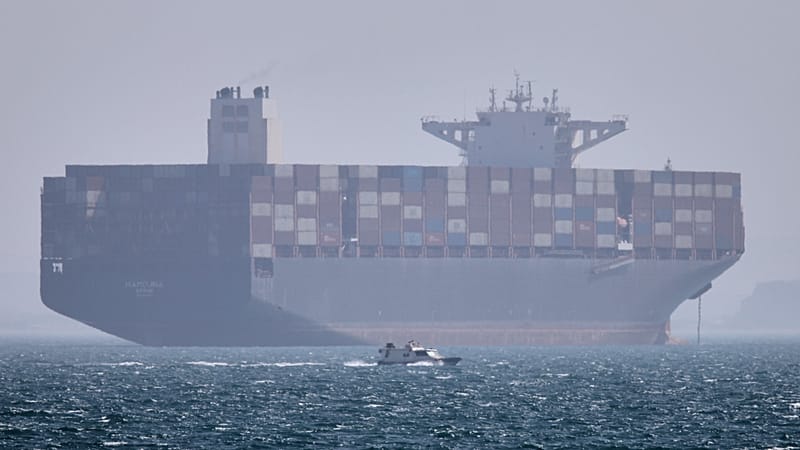
A ship off the UAE coast near the Strait of Hormuz has been taken by unknown people and is now headed towards Iranian waters, a UK maritime agency said on Thursday.
The vessel was "taken by unauthorised personnel whilst at anchor" 38 nautical miles or 70 kilometres northeast of Fujairah, and "is now bound for Iranian territorial waters", according to the United Kingdom Maritime Trade Operations (UKMTO) centre.
The UKMTO did not identify the vessel or who was behind its capture and said it was investigating. It also advised ships in the area to report any suspicious activity.
Several ships have been seized or attacked in or near the key waterway as Iran and the US push on with rival blockades.
India's foreign ministry condemned an attack on an Indian-flagged ship off Oman as "unacceptable" on Thursday, with maritime security monitors reporting the cargo vessel had sunk.
New Delhi did not provide further details on the attack on Wednesday, the fate of the unnamed ship, or who it believes was responsible.
"The attack on an Indian-flagged ship off the coast of Oman yesterday is unacceptable, and we deplore the fact that commercial shipping and civilian mariners continue to be targeted," India's foreign ministry said in a statement.
"All Indian crew on board are safe, and we thank the Omani authorities for rescuing them," it added, without giving further details.
On Sunday, South Korea said a cargo ship had been struck by unidentified aircraft in Hormuz, while Qatar said a freighter arriving in the country's waters from Abu Dhabi was hit by a drone.
Iran has also captured a number of vessels, including a tanker identified as the Ocean Koi last week, saying it was attempting to disrupt oil exports and Iranian interests, according to the official IRNA news agency.
It said the tanker was seized in the Gulf of Oman and was carrying Iranian oil when it was boarded and taken to Iran’s southern coast.
The US sanctioned the Ocean Koi in February as part of a “shadow fleet” that has been transporting Iranian oil.
'Open for all' — if they 'cooperate'
Speaking at a BRICS bloc meeting in New Delhi, Iran's Foreign Minister Abbas Araghchi made no mention of the seizure or the attack on the Indian vessel, but insisted that the Strait of Hormuz "is open for all" commercial vessels that "cooperate" with its navy.
Meanwhile, Iranian judiciary spokesperson Asghar Jahangir said on Thursday that the seizure of what he described as “violating” US vessels is carried out under court orders and in accordance with domestic and international law.
“The seizure of violating American oil tankers is an action grounded in domestic and international laws," Jahangir said, invoking the 1982 UN Convention on the Law of the Sea.
"The detention of these violating tankers is based on firm and final rulings issued by competent Iranian courts after legal procedures have been completed.”
Iranian state-run media reported Thursday that naval forces had allowed a group of Chinese ships to pass through the strategic Strait of Hormuz since the night before.
Iran has largely blocked shipping through the strait since the outbreak of war with the United States and Israel on 28 February.
Washington has imposed its own naval blockade on Iranian ports despite a fragile ceasefire in place since 8 April.
Hormuz crucial to Tehran's future strategy
According to experts, attacking and capturing cargo vessels in the strait has become a key tool for Tehran in its strategy, regardless of whether the internationally-mediated peace talks — which have stalled and are reportedly on the brink of collapse — fail or succeed.
"There is an emergent consensus in Tehran that the Strait of Hormuz is an increasingly potent lever of power and must be central to Iranian strategy moving forward," the Washington-based think tank Institute for the Study of War (ISW) said on Thursday.
According to the ISW, a spokesperson of Iran’s regular armed forces, Artesh, said on Wednesday that Tehran would no longer allow US "weapons" to pass through Hormuz and to bases in the region, "which presumably includes US warships bound for Manama, Bahrain—the headquarters of the US 5th Fleet."
The Iranian army spokesperson further stated that "'strategic control' of the strait would provide Iran with new revenues and strengthen its power."
All of these actions — blocking select ships, extracting tolls, and using the strait as a political tool to ensure compliance with Iranian actions — would be extremely detrimental to US interests," the ISW concluded.
According to international law, territorial waters extend 12 nautical miles or a little more than 22 kilometres from a country's shoreline.
The Strait of Hormuz is some 22 kilometres at its narrowest, meaning both Iran and Oman operate the waterway, which normally carries one-fifth of the world's oil and LNG shipments.
Tehran has previously stated it would also introduce tolls on passing ships, implying it would collect transit fees during the two-week ceasefire with Oman, a claim Muscat quickly rejected, stating that because Hormuz is a natural and not man-made passage no fees can be legally imposed.