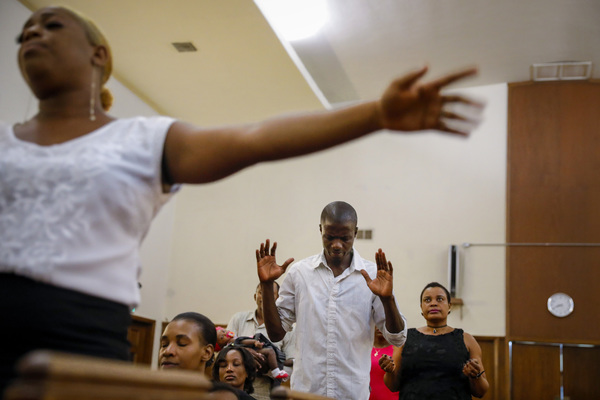
MIAMI _ After years of being shielded from deportation from the United States while their disaster-prone country continues to recover from its devastating 2010 earthquake, tens of thousands of Haitians will now lose that safeguard.
The special deportation protection known as Temporary Protected Status, or TPS, will be revoked for at least 50,000 Haitians living and working across the U.S.
The protection will expire July 22, 2019, giving Haitians living in the U.S. under TPS an 18-month window to go back to their struggling homeland or legalize their status in the United States. At the end of the period, Haitians will return to the immigration status they previously held, leaving them facing possible detention and deportation.
The decision comes 14 days after the Department of Homeland Security announced it was terminating TPS for 2,500 Nicaraguans and delaying a decision for 57,000 Hondurans, which automatically gave them a six-month extension after their current status expires in January.
The announcement Monday, while pleasing to immigration hardliners who argue that the provision was never meant to be permanent, deals a hard blow to longtime Haitian and immigration advocates. For months they have lobbied the Trump administration to extend the status for at least 18 months. It had been set to expire Jan. 22.
"Haiti is not ready to absorb 58,000," said Marleine Bastien, a South Florida Haitian activist who has pushed for at least an 18-month extension of TPS. "It's going to be a disaster for the 58,000 families in the U.S. and a disaster for Haiti. Clearly they are not making decisions based on facts on the ground, but rather politics. This is purely unacceptable."
Enacted in 1990, TPS allows nationals from countries facing civil strife or major natural disasters who are already in the United States to temporarily remain and work here. But President Donald Trump has repeatedly pledged to impose tighter immigration controls, with many of his supporters saying the program has been abused. Congress, critics of the program say, needs to provide a permanent fix for the more than 300,000 Haitians and Central Americans who currently are protected from deportation under TPS.
In May, then Homeland Security Secretary John Kelly _ now Trump's chief of staff _ announced a limited extension of six months for Haitians. It took effect July 22.
But the decision came with a strong signal from Kelly that it could be Haiti's last reprieve. In response, an unprecedented wave of Haitian TPS-holders illegally crossed into French-speaking Quebec out of fear that they would be detained and deported back to Haiti. Quebec has a large community of Haitians, most of whom speak French.
Fearful of a similar surge, this time involving not only Haitians but TPS-holders from Nicaragua, Honduras and El Salvador, Canada recently sent a Spanish-speaking member of parliament, Randy Boissonnault, to Miami. His task: to persuade the Haitian and Central American communities to discourage migrants from crossing into Canada because they falsely believe it's a safe haven.
According to a recent study by the Center for Migration Studies, most Haitians on TPS have been living in the United States for 13 years and have 27,000 U.S.-citizen children among them. More than 80 percent are employed, while 6,200 have mortgages.
TPS advocates have maintained that terminating the program would be cruel and families would be torn apart. And Haiti, they say, still hasn't been sufficiently rebuilt after the 2010 earthquake to accept the influx.
"Some disasters take a long time to recover from," said Randolph McGrorty, an attorney and director of Catholic Legal Services in Miami, which provides legal advice to the Haitian community. "What happened in Haiti is a good example ... It takes time."
But DHS has slowly been narrowing the number of TPS holders. In September, it announced that it was canceling the protection for Sudan as of 2018 but would allow South Sudan, a country in the throes of an armed conflict, to remain until mid-2019.
The lack of a decision on Honduran TPS holders had some advocates hoping that nearly 200,000 Salvadorans may also be spared. Their status expires in March 2018.
"I cannot recall a time when a decision was not reached triggering this automatic extension," said Royce Murray, policy director of the American Immigration Council.
Murray and others said the non-decision on Honduras underscored tensions in the Trump administration over TPS, which a source familiar with the proceedings noted were centered on a recent State Department report on country conditions. The source, who was not authorized to speak to the media, said U.S. foreign service officers were put under considerable pressure by DHS, with policy hawks and politicians at State disagreeing over whether conditions had improved.
"It seems to us as outsiders, the folks who are most familiar with country conditions in these foreign countries are most inclined toward an extension. Those who are removed from country conditions and focused more on the politics of it have leaned the other way," Murray said after the Nicaragua and Honduras announcements were made. "I think the tensions have been very real."
In Haiti's case, advocates say the country is in no condition to handle the influx, seven years after the 7.0-magnitude quake created billions of dollars in damages, left 300,000 dead, 1.5 million injured and an equal number internally displaced.
And the country remains vulnerable. Hurricane Matthew hit the southern region and created $2.8 billion in damages last year, followed by brushes from hurricanes Irma and Maria, and the country continues to suffer from a deadly cholera epidemic, a disease introduced by U.N. peacekeepers. Last week, the Office of Civil Protection confirmed that at least five people had died and 10,000 homes were flooded after days of rain.
Haiti advocates spent months lobbying for support to continue TPS, including a campaign of newspaper editorials and letters of support from faith leaders, governors, city councils and congressional lawmakers on both sides of the aisles.
"Haiti is a textbook case for an 18-month extension due to Hurricane Matthew, the cholera epidemic and incomplete earthquake recovery," Steven Forester, immigration policy coordinator for the Boston-based Institute for Justice & Democracy in Haiti, argued.
Haiti's U.S. Ambassador Paul Altidor, who requested an 18-month extension in an October letter to Department of Homeland Security Acting Secretary Elaine Duke, noted that the country's crippling economy relies heavily on the diaspora working in the U.S. and islands near Haiti that were also hit by hurricanes in 2017. They contribute more than $2.4 billion annually in remittances to the Haitian economy.
"As many of these countries struggle to rebound from these hurricanes, Haitian expatriates working there have found themselves unable to support their families back home, further complicating Haiti's recovery process and delaying the ability of the country to place itself back in the position that it was in prior to the 2010 earthquake," Altidor wrote.
Despite Altidor's advocacy, and that of Haitian Foreign Minister Antonio Rodrigue, the White House hadn't seemed inclined to extend the protection for Haitians' _ despite Trump's promise during his presidential bid to be Haiti's biggest "champion."
Relations between the two nations have been at best tense, with Haiti's ambassador to the Organization of American States in April publicly snubbing the U.S. over Venezuela as he accused diplomats of meddling in the South American nation's internal affairs.
Still, to arrive at her decision, Duke carried out her own investigation, which Murray described as "a candid appraisal" of conditions on the ground in Haiti because she understood the impact of the decision on families. She spoke to Altidor and Rodrigue, and met with members of the Florida congressional delegation, including Democratic Sen. Bill Nelson.
Duke also contacted Gov. Rick Scott, who is among several state governors who supported an 18-month extension on behalf of Haitians _ 32,500 of whom, according to the Center for Migration Studies' analysis, call Florida home. The same day Scott and Duke spoke, a coalition of human rights groups in Haiti, led by the Support Group for Refugees and Returnees, delivered a petition with 3,000 signatures supporting TPS renewal to the U.S. Embassy in Port-au-Prince.
Haiti had received four 18-month extensions on TPS after its initial 2010 designation. But Kelly, who repeatedly emphasized the "temporary" in TPS, was not keen on granting another renewal or re-designation. After traveling to Haiti in late May to meet with Haitian President Jovenel Moise, Kelly told the Miami Herald that he believed that conditions in Haiti had improved. He cited as proof Moise's plans to rebuild the country's quake-damaged presidential palace, and that the United Nations was pulling out its peacekeeping mission.
While the U.N. did withdraw its blue-helmeted soldiers from Haiti under pressure from Washington to reduce its peacekeeping missions around the globe, it still considers an impoverished Haiti a threat to regional security. It replaced the $346 million-a-year peacekeeping mission with a smaller, less costly one focused on justice, human rights and police reform.
Meanwhile, the budget recently passed by Haiti's parliament doesn't have any money allocated for the palace's reconstruction.
"Even if the question is strictly whether conditions today continue to warrant an extension, we have a guidepost," said Tom Jawetz, vice president for immigration policy at the Center for American Progress in Washington, D.C., referring to the justification that was laid down in the federal register for DHS' six-month extension.
That justification reads: "Although Haiti has made significant progress in recovering from the January 2010 earthquake that prompted its initial designation, conditions in Haiti supporting its designation for TPS continue to be met at this time."
"This administration has already spoken as to conditions on the ground," Jawetz said. "In the intervening months, we had hurricanes Irma and Maria and a worsening food insecurity crisis ... . The collection of factors on the ground between May 2017 and November 2017 can't possibly be cited as justification for coming to a different decision than what they made six months ago."