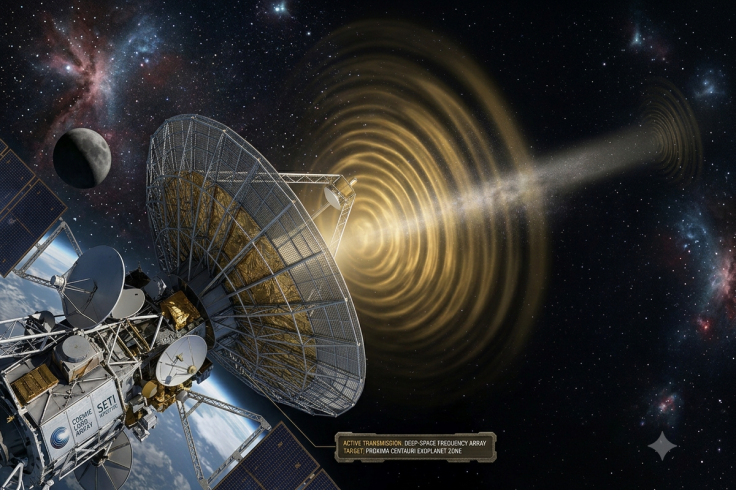
Louisa Mason, a PhD researcher at the University of Manchester, has used archived data from the Atacama Large Millimetre/submillimetre Array (ALMA) in Chile to look for alien signals at radio frequencies that have barely been searched before.
Analysing observations, Mason executed the first-ever ALMA telescope technosignature survey to explore uncharted cosmic bands.
The study, presented at the Royal Astronomical Society's National Astronomy Meeting in Birmingham, found no technosignatures, but it does widen the map for SETI in a way that feels overdue.
Most radio searches for extraterrestrial intelligence have long focused on the so-called 'water hole,' a narrow slice of the spectrum between 1.42 and 1.66 GHz. That band was chosen because hydrogen and hydroxyl, the ingredients of water, emit naturally there, making it a plausible place for a cosmic 'hello' to be sent, or heard.
Mason's team argues that obsession with that one region may have left plenty of other channels effectively untouched.
Although the targeted frequency windows revealed no candidate technosignatures above detection thresholds, the study fundamentally reshapes how scientists calculate stellar search volumes across the Milky Way.
SETI Alien Signal Search Expands Beyond the Water Hole
Mason said the millimetre and submillimetre bands remain 'almost completely unexplored for SETI,' which is the whole point of the exercise.
In a statement from the Royal Astronomical Society, she described the work as opening 'up a new area of parameter space to search.'
Translation for the rest of us, and not the lab-coat crowd, is simple enough, astronomers may have been listening to one quiet corridor while other parts of the radio spectrum were sitting there unused. Wild, really.
The new study did not involve fresh telescope time. Instead, Mason searched archived ALMA observations originally gathered for other astronomical work, looking for narrowband radio signals that might indicate technology rather than a natural astrophysical process.
She focused on two small frequency windows in ALMA's Band 3 data, and found no candidate technosignatures above the survey's detection thresholds. That lack of a detection is not nothing, but it is also not proof that the universe is empty. It only means this limited search, in these limited bands, did not turn up anything that looked like an artificial transmission.
What the ALMA Data Actually Shows
What makes the study interesting is not the absence of a signal, but the method. ALMA is built to observe millimetre and submillimetre wavelengths, so it gives SETI access to a part of the spectrum that has largely been left out of the conversation for decades. If there is a technologically advanced civilisation broadcasting on a different frequency, then the old playbook may simply have missed it.
The research also pushes back against a surprisingly basic problem in SETI, how many stars are you actually covering when you point a telescope at the sky? Mason and her colleagues looked again at an earlier survey of 1,327 telescope pointings, this time using the Besançon Galactic Model rather than relying only on the Gaia star catalogue.
The difference was stark. The estimated number of stars covered rose from around 288,000 to more than 6.1 million. That is not a small correction. It suggests that previous searches may have reached far more of the galaxy than astronomers had counted at first glance, including stars too faint, too distant or too crowded to appear cleanly in catalogues.
The model is not perfect, of course, and Mason's own work acknowledges those limits, but the broader point is hard to ignore. SETI may have been talking about a handful of stars when the beam was actually full of them.
Why the Search Matters Now
The news came after the Royal Astronomical Society highlighted the study as part of this year's National Astronomy Meeting, which has turned into a useful stage for ideas that stretch SETI beyond its usual comfort zone. Mason's approach is attractive because it uses data that already exists, instead of asking for expensive new observing time. That matters in astronomy, where telescope access is precious and time is always the stuff of arguments.
It also leaves the field in a slightly awkward position. If no signal is detected, sceptics can shrug. If a wider search is finally able to test more of the spectrum and more of the sky, then at least SETI stops looking a bit too much like a one-frequency habit with a very long history.
Mason said the results should encourage future searches to 'search more widely across the radio spectrum and make better use of existing astronomical observations.' That sounds sensible, almost painfully so.
The bigger question is whether anyone out there is actually transmitting on a band we have been ignoring all this time, or whether the universe is still doing what it usually does, which is refusing to make things easy.
What Happens Next in SETI Alien Signal Search
For now, the study gives SETI a broader hunting ground and a more realistic sense of how much sky has already been examined. It does not deliver a signal, a smoking gun, or even a particularly neat ending.
It does, however, leave researchers with a better shot at asking the right question next time, and in this field, that is no small thing.
Sceptics may shrug at the lack of a positive detection, but proponents argue that widening the frequency spectrum brings rigour to the search.
Researchers now possess a sharper toolset to determine where and how to look next. As science expands its parameters, the quest for extraterrestrial life finally moves beyond a single frequency habit.