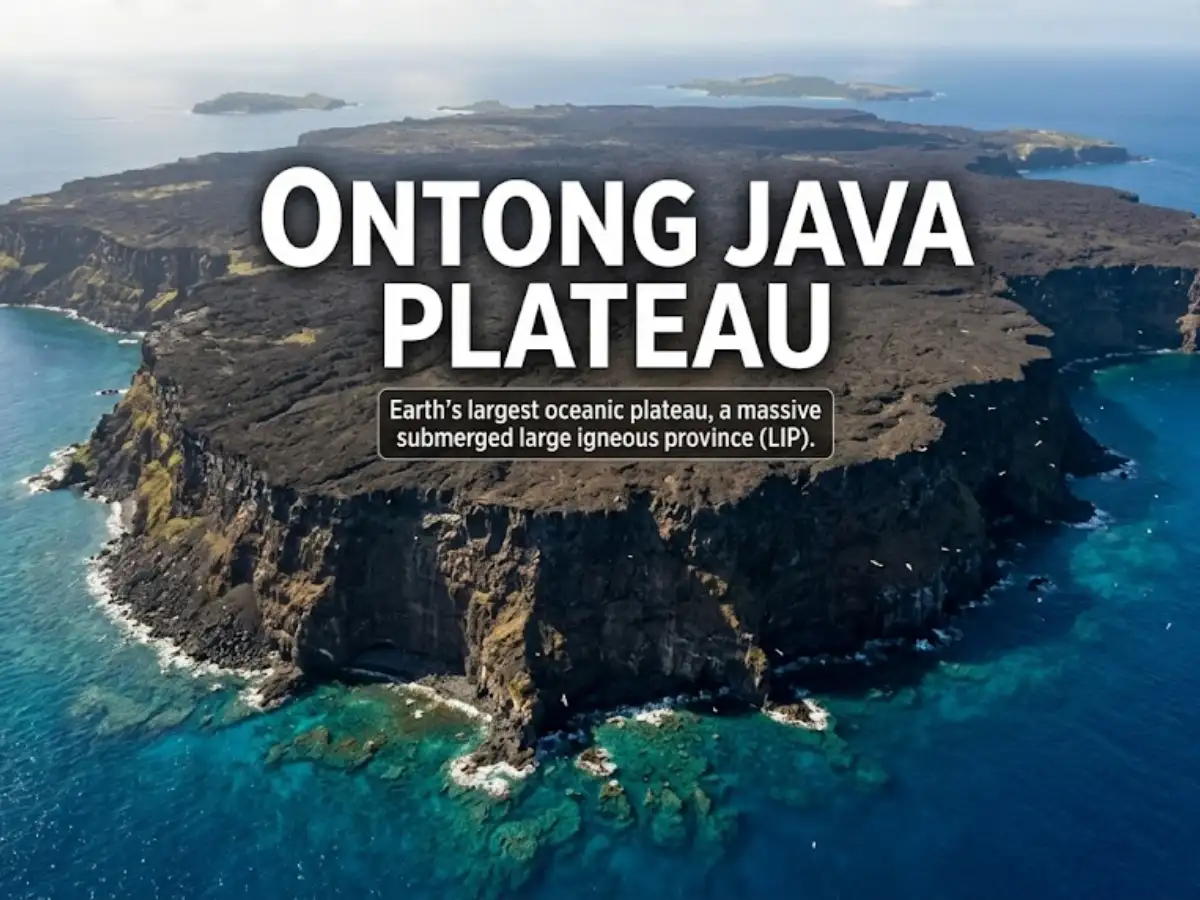
Scientists have uncovered evidence of ancient magma pathways hidden beneath the Ontong Java Plateau, the world's largest oceanic plateau, revealing how massive volcanic activity reshaped Earth's lithosphere more than 100 million years ago.
A study published in Advancing Earth and Space Sciences titled “Dike Swarms in the Oceanic Lithosphere Beneath the Ontong Java Plateau” found that underground structures created during the plateau's formation have remained preserved over geological time. By analysing high-frequency seismic waves, researchers identified signs of ancient magma-filled fractures, known as dike swarms, deep beneath the Pacific Ocean.
The findings provide new insights into how one of Earth's largest volcanic provinces formed and how magma travelled through older oceanic lithosphere during the event.
Seismic waves reveal hidden structures beneath Pacific Ocean
The Ontong Java Plateau, located in the western Pacific Ocean, formed during an intense volcanic episode around 110 to 120 million years ago. While scientists have long known about its volcanic origins, the movement of enormous volumes of magma through the Earth's lithosphere remained unclear.
Researchers studied high-frequency seismic waves generated by distant earthquakes to examine the plateau's internal structure. The waves showed unusual behaviour compared with those travelling through normal oceanic crust, including slower movement and greater weakening.
The study suggested that these signals were caused by a unique underground structure containing both the usual layered rock formations and vertical dike swarms.
Ancient dike swarms preserved magma pathways
According to the research, the dike swarms represent ancient channels through which magma travelled from a deep thermochemical mantle plume before reaching the surface.
Scientists used numerical models to test different underground structures that could explain the seismic observations. Models based only on layered oceanic lithosphere failed to match the recorded signals.
The researchers found that a combination of layered rock and vertically oriented dike-like structures provided a better explanation. The magma repeatedly entered the older lithosphere, creating a network of conduits that remained preserved after volcanic activity ended.
Magma activity permanently altered Earth's lithosphere
The study found that seismic waves moved more slowly beneath the Ontong Java Plateau compared with nearby areas of normal oceanic lithosphere. Researchers said this difference could not be explained only by variations in thickness.
The slower seismic speeds indicate that magma changed the chemical composition of the surrounding mantle. Minerals carried by the molten material may have altered the rocks, leaving behind a long-lasting geological signature.
The findings suggest that the effects of the ancient volcanic activity were not limited to the surface but extended deep into the Earth's interior.
Study sheds light on formation of massive volcanic provinces
Directly studying deep oceanic lithosphere remains difficult due to limited access and the challenges of drilling through large sections of rock. Researchers used seismic imaging as a way to examine these hidden regions.
The study concludes that the Ontong Java Plateau contains a combination of layered lithosphere and preserved magma-filled dike swarms, providing evidence of how a thermochemical mantle plume interacted with existing oceanic crust.
The discovery helps scientists better understand how large volcanic provinces transform the lithosphere and preserve records of geological events that occurred more than 100 million years ago.
(With inputs from TOI)