Human eggs have been "rejuvenated" for the first time, an advance scientists say could revolutionise IVF success rates for older couples.
New research suggests an age-related defect in eggs could be reduced by supplementing eggs with a key protein that results in women being almost half as likely to show the defect compared with untreated eggs.
Although the findings need to be confirmed in more extensive trials, the technique has the potential to improve egg quality, which is the primary cause of IVF failure and miscarriage in older women.
“We have been able to achieve the first rejuvenation of a human egg in vitro, what this means is we could reduce the fraction of eggs with genetic defects, so chromosomal errors, from 71 per cent to as little as 47 per cent,” Dr Agata Zielinska, a co-founder and co-chief executive of Ovo Labs, which is aiming to commercialise the technique, told BBC Radio 4’s Today programme.
“If this could then be translated to the clinic this could potentially be the biggest improvement of IVF success rates of the last decade,” she added. “From a practical perspective it could potentially allow more couples to conceive within just a single IVF attempt.”
The findings, reported in The Guardian, are set to be presented at the British Fertility Conference in Edinburgh on Friday and have been published as a preprint paper on the Biorxiv website.
Professor Melina Schuh, a director at the Max Planck Institute for Multidisciplinary Sciences in Göttingen and a co-founder of Ovo Labs, explained that while most women in their early 40s do have eggs, almost all of them have incorrect chromosome numbers.
IVF success rates drop steeply with age, mostly due to a decline in egg quality. This is why the risk of chromosome disorders such as Down’s syndrome increases with maternal age.
For those under 35, the average birthrate for each embryo transferred in IVF treatment was 35 per cent, compared with just 5 per cent for women aged 43-44, according to figures from Human Fertilisation and Embryology Authority (HFEA). However, the average age of first-time fertility patients is now over 35 years old.
In a process called meiosis, sex cells throw out half of their genetic material in order to join together and make an embryo.
For this to happen, eggs need 23 pairs of X-shaped chromosomes to align in the cell. When it is fertilised, the cell divides, causing the chromosome pairs to be snapped down their centres to create a cell with precisely 23 single chromosomes from the mother, the rest being delivered by the sperm.
But in older eggs, chromosome pairs can detach before fertilisation and the X-shaped structures fail to line up properly. This means that when the cell divides they are not snapped symmetrically, resulting in an embryo with too many or too few chromosomes.
To tackle this problem, scientists used a protein called Shugoshin 1, which appears to act as a glue for the chromosome pairs but declines with age.
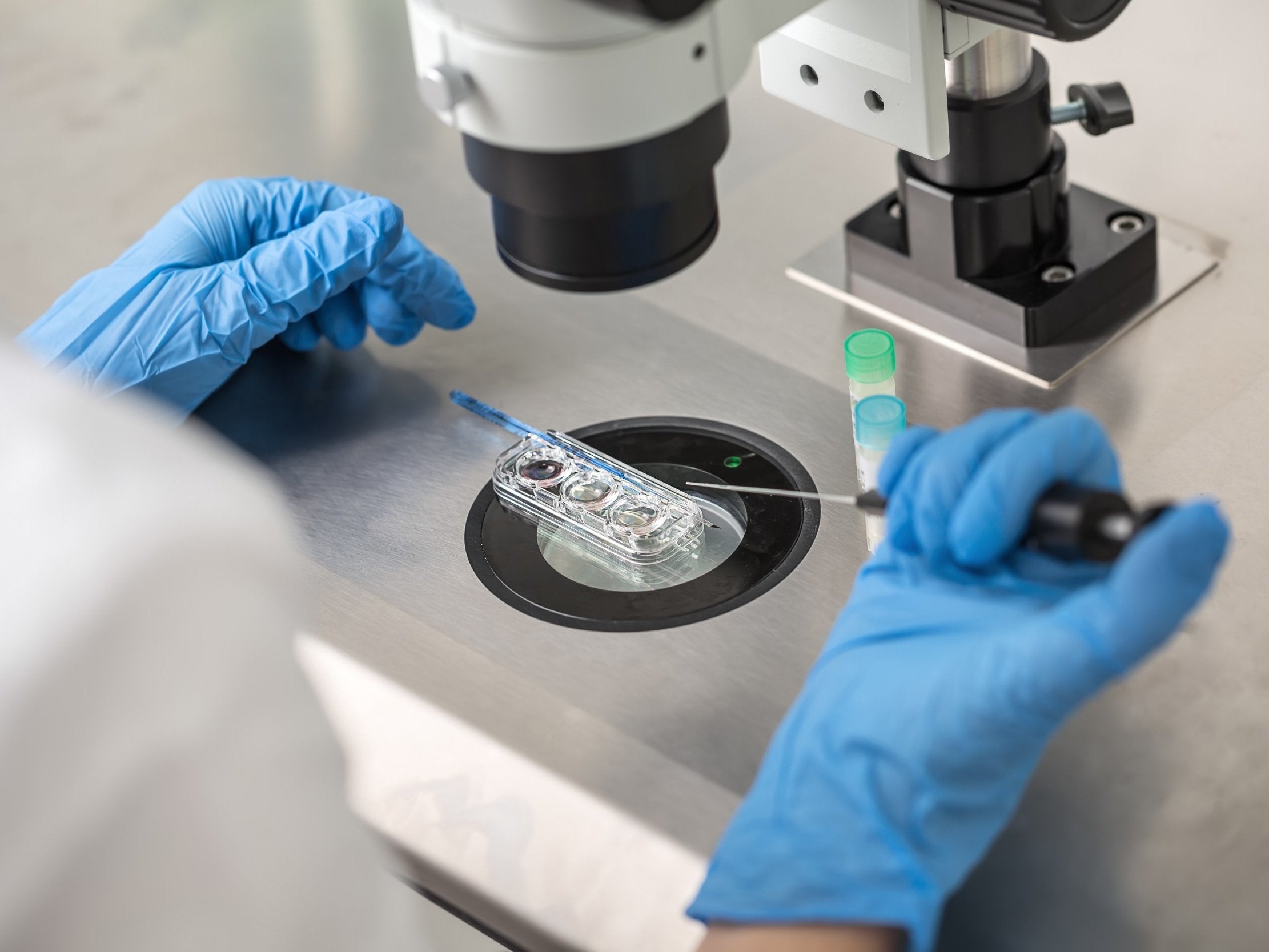
In experiments on mouse and human eggs donated by patients at the Bourn Hall fertility clinic in Cambridge, researchers found that microinjections of Shugoshin 1 appeared to reverse the problem of chromosome pairs separating prematurely.
Using the treatment the number of eggs showing the defect decreased from 53 per cent in control eggs to 29 per cent in treated eggs. Plus, in women over 35, 65 per cent of the control eggs showed the defect in comparison to 44 per cent of the treated ones.
Richard Anderson, lsie Inglis professor of clinical reproductive science at the University of Edinburgh, who was not involved in the study said: “While we await further details and confirmatory clinical trials, including addressing safety issues, these results have great potential for improving IVF success rates.”
Man loses all his hair and stops sweating after getting tattoo
Super flu or a just cold? Here are the key symptoms to look out for
Warning as winter viruses ‘bounce back’ after Christmas and New Year gatherings
Streeting warns NHS ‘not out of the woods yet’ as flu cases spike
Warning over blocked nose spray that can actually worsen symptoms
I’m an infectious disease expert. These are viruses I’ll be watching in 2026