"OK, remember the homework I gave you yesterday?"
I am standing in front of 35 obedient and, at most times, adorable children in Year 6. Upon asking this question, half of them stare back at me blankly. Another quarter appear guilty, and then the saviours -- 25% -- nod and smile. Well, one-quarter is better than nothing.
"Your homework was to memorise the eight feeling words I gave you. So … who did that?"
The proverbial pin begins its downward spiral in slow motion, clanging to the floor in a manner so deafening I feel the need to cover my ears.
I ask the question again. Not a single hand among 70 goes up.
Zero success rate.
The students are not lazy, I don't think, judging from their willingness to participate over the past two days. Nor do I think they have conspired against me to refuse to do the task in hand.
I admire their honesty; in my school days I would have put my hand up and lied to the teacher just to gain brownie points, then pay the price for my dishonesty in the subsequent quiz. They didn't think to do that.
And that is the crux of the problem. It didn't occur to them to do their homework.
Greetings from Kalasin, a province which is baan nok, as they say in the Thai language. Baan nok is the boondocks, or the back of beyond. It is commonly used as a disparaging term in Thai, perceived as an area full of hicks and country bumpkins. This is unfair to the locals, who are no more hick or uneducated than the majority of city folk; only the minority -- more cerebral types -- tend to up and leave rural areas for the big smoke. That is the same in countries and communities all over the world.
Last Sunday, I travelled 567km to this province, though it may as well be a world away, starting in Bangkok and ending on a dusty red-dirt single lane which twists and weaves behind a local temple.
First of all, the good news.
Out here in the boondocks, the air is breathable. I have left the yellowy shroud of Bangkok and entered the crisp, crystal-clear air of the Northeast. Last night was 15C. This brisk change in temperature would perhaps be more of a joy had I thought to bring a jacket along but let's remain positive. There is something uplifting being among majestic trees that border rice fields, with air that is breathable, in temperatures not hitting 30C.
And the bad news?
There is no bad news -- only challenges in the field of education that need to be addressed urgently.
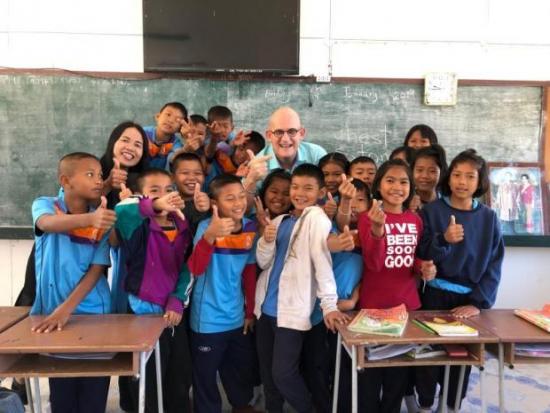
I am in Kalasin to teach English to 35 12-year-olds in a tiny school situated in the heart of sugarcane country. Kalasin is a province of rice crops, sugarcane and rubber. Rubber and sugarcane prices are down, but still, the farmers have mouths to feed, and for two weeks I will spend time with those little mouths.
The road from where I'm staying to the school is just 24km but takes an hour to get there. The roads twist and turn like a rural labyrinth of dirt and asphalt -- you have to memorise the way because Google Maps keeps dropping out. Despite glitzy ad campaigns that claim the contrary, my service provider hasn't made it yet to the sugarcane fields of far-flung Kalasin.
There are only 290 students in the school I am teaching at. They are exclusively the children of farmers surrounding the small village. With 18 teachers, the student-teacher ratio is quite good, thanks to a dwindling child population.
But that's about all it has going for it. It is a testament to human resilience.
Their classrooms send my mind back to Australian schools in the 1960s and 70s with their wooden chairs and desks.
The only technology consists of a blackboard and chalk. The blackboard has thin lines written across it so the teacher can write in straight lines; I don't think I've seen that in decades. There are no TVs.
The floor is linoleum in one room, and concrete in another. The teacher assigned to me, Kru Deaw, is an amazing lady. Perhaps I will write about her next week. I secretly watch her teach one morning as she furiously drills the students on English prepositions.
She is a ball of energy, using an array of teaching resources -- namely her hands, her face, her voice and her chalk.
Watching this school in action, I can't help feeling proud of the effort these teachers make. There has been criticism of a lack of imagination and teaching methods by Thai teachers. Some of that criticism is justified, but we also need to praise these tireless teachers who get little or no backup in the form of technology or resources.
It is a great novelty to have a big bald farang in the school. My students are naughty, fun, polite when required to be, and generally obedient.
What they appear to lack is creative thought, use of the imagination and certainly critical thinking. Creativity and original thought need to be fostered and nourished, and that comes through pushing the boundaries of knowledge, having strong support systems in place and offering students safe challenges. It is partly the responsibility of adults, such as parents, to provide these things for their children.
And that is the crux of the problem these children encounter. More than half of my 35 students don't live with their parents. Don't think they are lucky enough to be the child of a single mother or father. They don't have either.
Their parents are in Bangkok, working on construction sites and factories doing menial labour. It is the norm for young parents to place their babies in the care of their own parents, then leave home to find work in the big smoke away from baan nok.
The task of raising the babies is left with the grandmother, which means this generation of grandparents in Isan must raise two sets of children. Either that, or the raising skips a generation; an Isan woman must wait until her 50s before she experiences raising a child, albeit her grandchild.
(And invariably, these children, when asked, are being raised by grandma. Grandad has either flown the coop or is dead, both statistical rates being extremely high as a man enters his 50s.)
Their children thus don't have the keen gaze of a parent demanding, "Have you done your homework?", let alone sitting down with them to help with the task. Then they attend schools that in 2019 still feature blackboards and chalk, dusters and sticks used to point at things and, one suspects, discipline.
This is the biggest challenge of Thailand 4.0, the era of innovation and technology. In the process of becoming modern and competitive on the world stage, let's not forget those pockets of the country still struggling to hit Thailand 1.0.
Despite all this, it's not gloomy. I can see the spark of wanting to learn in the eyes of some of these kids. And by the way, despite the lack of homework, my classes are going really well. And yesterday, at the end of class, I gave them homework.
"Memorise the eight words again," I said. This time I said it in a more pleading tone. "Why not do it in pairs with your best friend? Or get your brothers or sisters to help you. Can't your parents help you?"
I paused, having forgotten myself.
"I mean, your grandmother?"