The Schengen visa remains one of the most widely used travel permits in the world, giving access to a large part of Europe under a single short-stay system. Every year, millions of applications move through consulates spread across different countries, each handling them in its own way despite shared rules. In 2025, almost 12 million visa applications were processed through EU and Schengen-related embassies and consulates, marking an increase of 1.8% from 2024, when 11.7 million applications were submitted and a growth of 15.5% from 2023, when the number was 10.3 million, as reported by the European Commission. However, despite these demand increases, the number is still far less than the pre-pandemic period of 2019, when it stood at 17 million.
However, over 10 million visas were granted in 2025, which means 3% more visas than in 2024 (9.7 million), but still 50% less than the number of visas issued in 2019 (15 million). No changes in the average rejection rate of the application (it equals 14.8%). Visa refusal trends differed greatly from one country to another. In some countries, the number of approvals increased – for instance, Russia (+6.4%), Algeria (+31%), and Ethiopia (+34%), and in others, it dropped significantly, for example, Senegal (-51.9%), Burundi (-53.4%), and Congo (-40.1%).
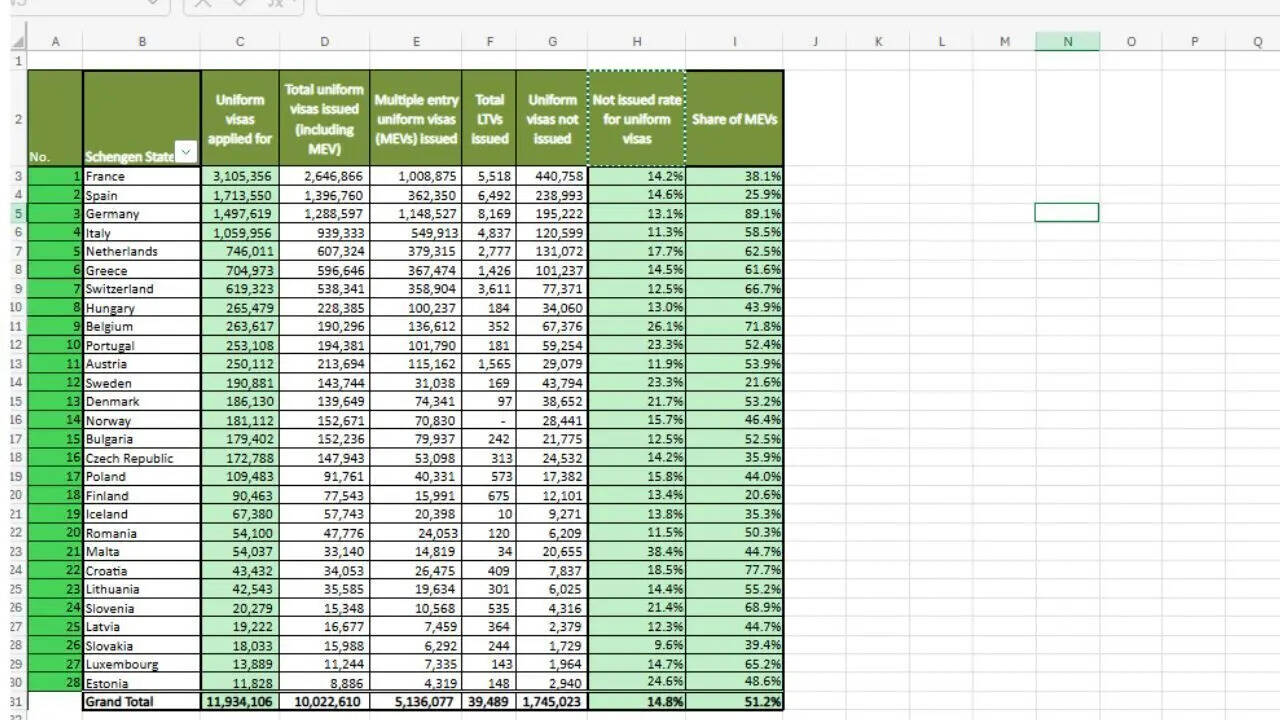
Nevertheless, among the top applicant countries, there were no changes: China, Türkiye, India, Russia, and Morocco. It should be noted that 51.2% of all issued visas were multiple-entry visas (the number was 0.5% higher last year). According to the latest data of the European Commission, please see the list of the top 10 countries that reject visas most often below.
List of 10 Schengen countries that are most likely to reject you
| Rank | Schengen | Not Issued Rate for Uniform Visas |
| 1 | Malta | 38.40% |
| 2 | Belgium | 26.10% |
| 3 | Estonia | 24.60% |
| 4 | Sweden | 23.30% |
| 5 | Portugal | 23.30% |
| 6 | Denmark | 21.70% |
| 7 | Slovenia | 21.40% |
| 8 | Croatia | 18.50% |
| 9 | Netherlands | 17.70% |
| 10 | Norway | 15.70% |
Schengen countries where visa approval is least likely
Malta
Malta sits at the top of the rejection table with a rate of around 38.4%. Part of this is structural. It is a small country, heavily exposed to seasonal tourism, and consulates tend to filter applications more tightly when demand surges. Short stays linked to tourism or temporary work often come under closer review, especially when paperwork feels thin or inconsistent.
Belgium
The rejection rate in Belgium stands at approximately 26.1%, which mostly comes from the evaluation of applicants based on documents. Evaluators usually rely on the clarity of documents provided, financial proof, and consistency of traveling plans.
Estonia
Estonia utilises a very strict filtering process that translates into a rejection rate of about 24.6%. The Estonian visa program is strongly influenced by the process of security evaluation in case of short-term business visits.
Sweden
Sweden’s refusal rate, around 23.3%, often reflects how closely financial stability and travel intent are examined. Applications that lack a clear employment background or stable income record are more likely to be questioned.
Portugal
Portugal records a similar rate, also around 23.3%, though the reasons feel slightly different. Demand spikes heavily during tourist seasons, particularly from Asia and parts of Africa, and this surge often leads to uneven application quality.
Denmark
Denmark has long maintained a cautious stance on immigration and short-stay visas, reflected in a rejection rate of about 21.7%. First-time applicants without strong ties to their home country often face additional questioning.
Slovenia
Slovenia processes fewer applications compared with larger Schengen states, but the rejection rate still sits around 21.4%. The pattern here is less about volume and more about consistency in screening.
Croatia
Croatia’s rejection rate, roughly 18.5%, sits in the middle zone. As a relatively recent addition to the Schengen area, it has seen rising demand and is still adjusting to the broader visa framework.
Applications are generally assessed in a balanced way, though growing tourist interest means tighter checks during peak months. The refusal rate reflects that transition stage more than a fixed policy stance.
Netherlands
The Netherlands handles a large share of Schengen applications and applies a highly structured assessment model. Its rejection rate, around 17.7%, tends to come down to technical issues rather than broader risk profiling.
Norway
Norway records the lowest rejection rate in this group at about 15.7%. Even so, the process remains firm on financial proof and travel purpose.