Although critics have praised the performances in Savage House, the film itself has received a frosty reception.
Tim Robey in the Telegraph described its “putrid stylings” as making it “impossible to enjoy”, dismissing it as a “rancid” and “rotten” period drama. Yet this allegedly “lowbrow” film captures the spirit of 18th-century culture more effectively than many glossy period dramas. Savage House seems outrageous because we have forgotten how outrageous the 18th century could be.
Set during the Jacobite Rising of 1715 and a smallpox outbreak, the film follows Sir Chauncey Savage (Richard E. Grant), a former highwayman whose gambling addiction and taste for luxury have left his Yorkshire estate on the brink of ruin. When the Duke and Duchess of Devonshire announce a visit, the Savages see one final chance to restore their social standing.
What follows is a classic farce, structurally and thematically reminiscent of 18th-century plays like John Gay’s The Beggar’s Opera (1728) or Richard Brinsley Sheridan’s School of Scandal (1777). As the visit approaches, disasters accumulate: disease spreads, affairs threaten exposure, Chauncey’s gout worsens, and panic grows over an impending eclipse. Along the way there is madness, mutilation, vomit, chamber pots and an astonishing amount of human excrement.
Far from being anachronistic, much of this owes a great deal to 18th-century literature and art. However, the modern imagination struggles to see this era as impolite, largely because Jane Austen’s literary vision of Georgian Britain (1714 to 1837) has become so dominant.
Austen’s stories depict a culture shaped by manners and social refinement where sex and dirt are practically non-existent (or buried beneath layers of polite language). Such ideas of the period have more recently been cemented by the Regency-era period drama Bridgerton. How could the early 18th century, then, be so different from Austen’s depictions of the later Georgian period? It can’t, is what many of The Savage’s critics have concluded. However, in reality, earlier 18th-century writers often revelled in something much earthier.
In a poem addressed to the Irish writer and essayist Jonathan Swift, Lady Mary Wortley Montagu joked that Swift’s verses would “furnish paper when I shite”. She was responding to Swift’s notorious satire The Lady’s Dressing Room (1732), in which a servant discovers that the seemingly perfect Celia is, in fact, a human being who uses the toilet. Upon glimpsing the contents of her lavatory, the servant emerges running and shouting “Oh! Celia, Celia, Celia shits!”
Scatology, an interest in bodily waste, runs throughout Swift’s writing, including Gulliver’s Travels (1726). When Gulliver finds himself locked up by the miniature citizens of Lilliput, one of his most urgent concerns is how he is going to discharge his body of its “uneasy load”, since he hasn’t had the opportunity for any toilet time since his ship sunk hours earlier.
Much later in the novel, when he encounters the Yahoos, a species of degenerate humans, he is appalled to discover that they throw excrement at one another. For Swift (who is name checked in Savage House as a potential guest for the Devonshire’s visit) such moments served a satirical purpose. They punctured human vanity by reminding readers that, however refined they imagined themselves to be, they remained creatures of flesh, appetite and bodily functions. Everything else was artifice.
That tension between appearance and reality lies at the heart of Savage House. As literary historian Pat Rogers observed, 18th-century Britain was a “freakish age”, one that celebrated refinement while indulging its basest appetites. Small wonder that bathos (the sudden collapse of the elevated into the ridiculous) became one of the period’s favourite satirical techniques.
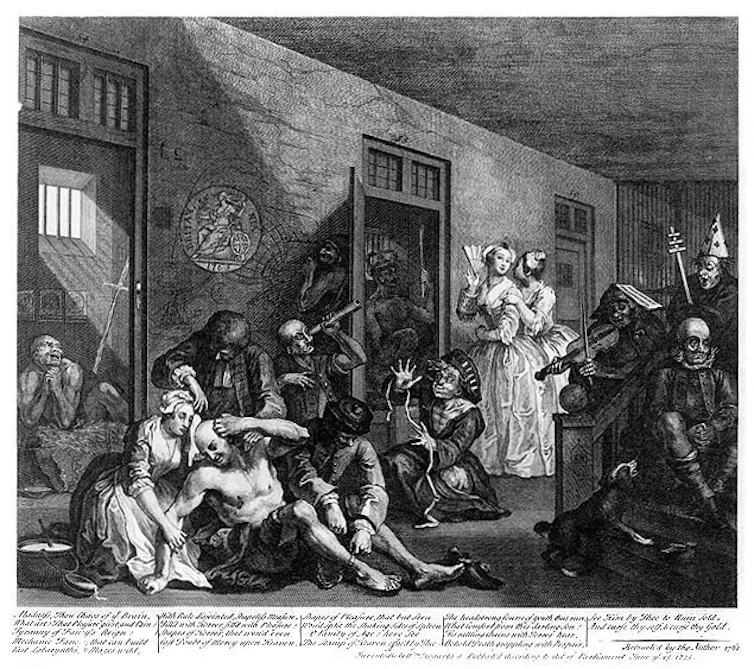
Savage House’s clearest influence is William Hogarth’s A Rake’s Progress (1733 to 1735), a sequence of satirical paintings charting the rise and fall of Thomas Rakewell, a young heir who squanders his fortune on gambling, luxury and vice before ending up in the psychiatric hospital, Bedlam. A “rake” is someone committed to hedonism, whose voracious appetites lead them to live their lives to excess in all matters. Like Rakewell, Chauncey Savage is a classic rake, and the connection becomes explicit in the film’s closing moments, which directly echo Hogarth’s final image.
Unlike Rakewell, however, Chauncey is not born wealthy but cons his way into respectability. In this respect he resembles the ambitious adventurers and social climbers of Henry Fielding’s fiction, especially Tom Jones (1749). Modern readers often forget just how unruly many 18th-century novels were. Laurence Sterne’s Tristram Shandy (1759 to 1767) famously includes a scene in which its hero suffers a catastrophic window-related injury to his genitals, Frances Burney’s Evelina (1778) features a monkey in a suit attacking a man and chewing his ear and Daniel Defoe’s Robinson Crusoe (1719) sees a dancing bear get shot point blank in the face.
None of this means that Savage House is a perfect reconstruction of 18th-century Britain. No historical drama is. But it does draw on aspects of 18th-century culture that have become strangely unfamiliar. There is more to the 18th century than elegant ballrooms and carefully managed courtships. It was also an age fascinated by vice, bodily functions, social climbing, scandal and satirical humiliation.
The film’s chamber pots, rotting bodies and collapsing pretensions are more than a “low-brow” attempt to shock modern audiences. They belong to a long literary and artistic tradition stretching from Swift and Fielding to Hogarth and the 18th-century stage. Bridgerton’s world of romance and refinement has historical foundations. But so too does Savage House’s world of filth, farce and excess. The difference is that we have become much more accustomed to seeing one than the other.
This article features references to books that have been included for editorial reasons, and may contain links to bookshop.org. If you click on one of the links and go on to buy something, The Conversation UK may earn a commission.
This article was originally published on The Conversation. Read the original article.