Quote of the week
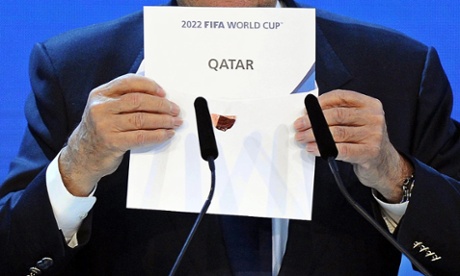
Fifa.com: relaxing in the “closure” brought by last week’s ethics report summary. “Fifa notes the comments of the adjudicatory chamber regarding the bidding process for the 2018/2022 Fifa World Cups as: ‘well-thought, robust and professional’.”
• Among the key Fifa figures who made the process so tight in 2010, as Sepp set about shaping the decade (“I’m working to make football a school of life, bringing hope, bringing emotions!”):
1) Michel Zen-Ruffinen, Fifa’s secretary general until 2002, filmed before the process began setting out what it would cost to buy the votes of key executives. “The biggest gangster on earth” wanted £350,000; another was “a guy you can [get] with ladies, not money”.
2) Nigeria’s Exco member Amos Adamu, caught naming his price in a Sunday Times sting, months after telling colleagues: “The public sees every football administrator as corrupt, and I cannot explain why it is so. We must always be transparent to prove them wrong!”
3) Botswana’s Ismail Bhamjee, caught in the same sting offering to work as a fixer, four years after being caught in his first sting – touting 2006 World Cup tickets at three times face value to supplement his £270 daily expenses. “I got myself in a mess. It was out of character.”
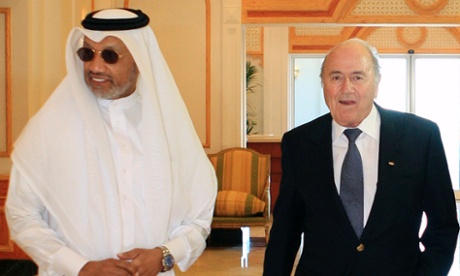
4) Qatar’s Mohamed bin Hammam, who stayed transparent, revealing the scale of vote-trading should “not surprise anybody”, confirming he was “looking to the interests of Qatar”, and paying the legal fees for Tahiti’s Qatar-supporting Reynald Temarii, another sting victim. Last week’s report found Bin Hammam had no impact on the process, and no direct links to the Qatar bid team – whose head described him four years ago as “definitely our biggest asset”.
5) Thailand’s Worawi Makudi, who denied allegations over Qatari business deals; Cyprus executive Marios Lefkaritis, who entered into a £27m oil and land deal with Qatari interests, denied wrongdoing, and voted Qatar; and France’s Michel Platini, who voted Qatar for “football reasons”.
6) Brazil’s Ricardo Teixeira, who said press interest in his ethics record was “shit”, denied multiple fraud allegations, resigned for “health reasons” and last year failed in a residency application to Andorra, a tax haven with no extradition treaty.
7) Cameroon’s Issa Hayatou and Ivory Coast’s Jacques Anouma, who both denied receiving £916,000 to vote for Qatar. Sepp said a later International Olympic Committee inquiry into Hayatou was pure hypocrisy. “The IOC? They have no transparency! They manage their money like a housewife.”
8) The USA’s Chuck Blazer, who denied fraud then turned FBI informant after facing a multi-million dollar tax bill; and Argentina’s late Fifa vice-president Julio Grondona, who denied voting for Qatar in return for $78.4m plus the proceeds of a Brazil v Argentina friendly in Doha on the eve of the vote to ease his FA’s debt crisis. “Enough with all this. The belittling of my good name must end.”
9) Russia’s Vitaly Mutko, who attacked the English press ahead of the vote for “portraying Russia as a hotbed of corruption”, days before a Russian federal audit chamber report found he had claimed expenses for 97 breakfasts eaten during a 20-day trip to Vancouver.
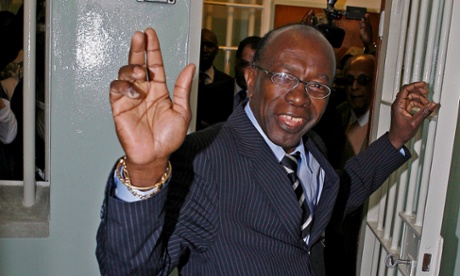
10) And Trinidad’s Jack Warner – who kept his nose clean and told the press: “Fifa preach equity. We live by our principle of fair play!”
After the vote
Sepp’s immediate priority in 2011 after the results were in - setting out what was needed to restore Fifa’s image: a) More transparency - “I’m fighting to clean Fifa, and zero tolerance is my battle horse”, and b) Less press scrutiny. “The British press have always been very critical. It didn’t start with me - it’s been like this a long time. They have a sort of stubbornness.”
Also spotting the problem:
1) Julio Grondona, June 2011: “We always have attacks from England which are mostly lies, with journalism which is more busy lying than telling the truth. This upsets and disturbs the Fifa family.”
2) Jack Warner: railing against new press “foolishness” this year, a repeat of 2010’s “BBC foolishness”, 2011’s “astounding nonsense”, and 2012’s “damn foolish” reports. His overall view: “Allegations are made every day, every week, every year. I’m not interested in that.”
3) Nicolás Leoz, Paraguay’s Fifa executive, unhappy last year after the German press alleged he voted Qatar after also soliciting a bribe. “A while ago the press in England were at it, now the German press do it. I don’t know, what is it that drives these people?”
Other process highlights
• Best unguarded moment: Sepp, February 2011, letting loose after the dust settled: “I’ll be honest. There was a bundle of votes between Spain and Qatar. It was there. But it didn’t work.” Last week’s report found “no conclusive evidence” of collusion.
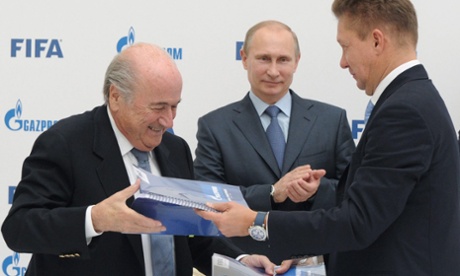
• Best endorsement: Sep 2013, Vladimir Putin weighing up what he had learnt since 2010, while unveiling Russian gas giant Gazprom as an official Fifa partner. “The work Fifa do is noble. Unlike many other associations that proclaim nice, well-intentioned goals, they actually work to realise them. This has no precedent.”
• Tidiest investment: £4.4m - Qatar’s reported spend on “bid ambassadors” during the process, plus a £250k gifts budget for “VIPs and VVIPs” visiting Qatar, where 4,000 migrant workers are expected to die before 2022.
• And the best media campaign: The Sun, writing an open letter to Sepp on the eve of the vote in 2010, attacking the BBC’s Panorama for “sabotaging” England’s bid. “Today the Sun makes this plea to Mr Blatter and Fifa: don’t be put off by the BBC rehashing ancient history. Despite BBC muckraking, the Sun trusts Fifa to put football first.” (Nov 2014, the Sun: “Fifa is a festering boil on the face of football.”)
Plus: What comes next …
Testing Fifa’s sense of closure: investigator Michael Garcia’s appeal against the summary of his inquiry, which he called “incomplete and erroneous”. The case will be heard by Fifa’s 14-man appeals panel, including Madagascar’s Ahmad Darw, who received $10,000 from Bin Hammam in 2008, and asked for more in 2010 via email: “As regards to what I discuss with the President Bin Hammam in Qatar … He promise to give me a help … Two possibility to send it … by bank swift or I can take it in Paris.” Darw denies wrongdoing.
… and thought for the week
Sepp, reflecting on his lot in a speech to the Oxford Union in October last year: “There are not many names the media haven’t thrown at me in the last few years. I would be lying to you if I said it didn’t hurt. You ask yourself: ‘What have I done?’”