
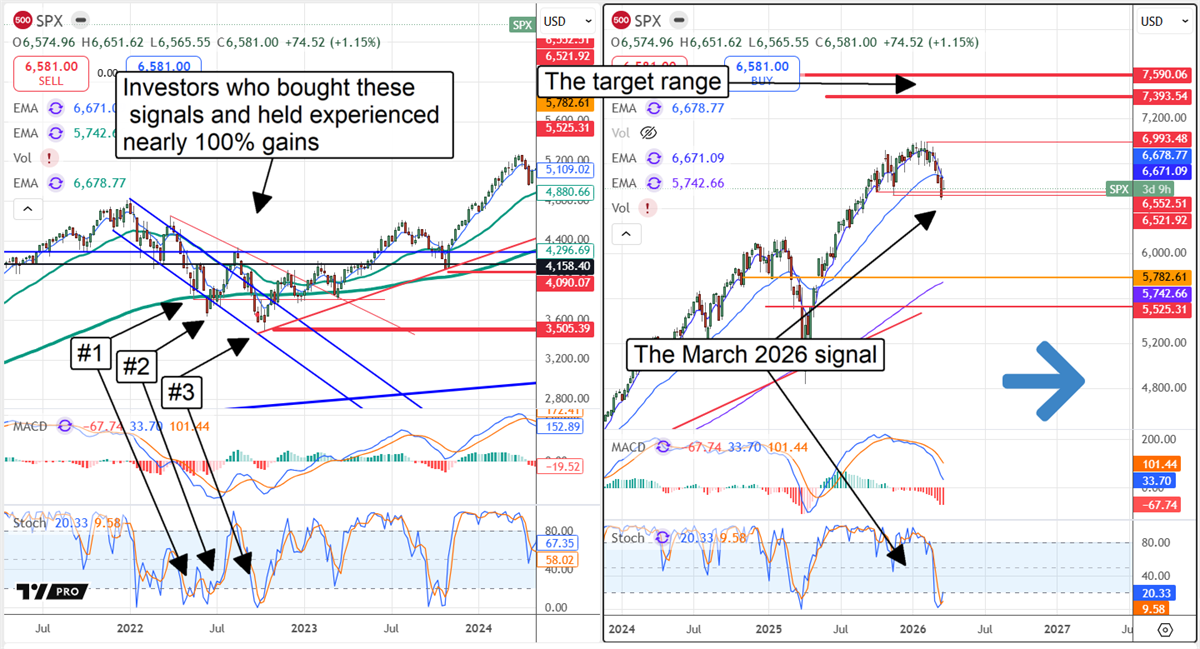
The S&P 500 entered oversold territory on its weekly candle charts late in March, triggering a buying signal with a 100% accuracy rate over the trailing 15-year period. Oversold, as indicated by stochastic, reveals a market sold to levels below its true value, a situation in which anyone with a need, reason, or excuse to sell probably has, leaving nothing but buyers (or at least a buying bias) in the market. In this scenario, the index has just about nowhere to go but up, and that preponderance has already been confirmed.
Technical, Analysts, and Valuation Trends Converge: Upside Potential Offsets Risks
Chart watchers will be quick to point out that there were three such signals in 2023, with the first resulting in only a tepid rebound. However, that signal was followed by two stronger signals, resulting in much stronger rebounds and a complete market reversal. The 2023 market reversal, coincidentally, was grounded in AI and has so far produced a 50% increase in the index.
The takeaway for investors today is that the index is signaling similarly, with near-term headwinds impairing the action while fundamentals and long-term forecasts provide support. The likely outcome is that this market will consolidate within its current range and eventually move up to set new highs later this year.
Analyst trends align and underpin this outlook. Barclays is only the latest to increase its target level for the S&P 500 Index, continuing the trend, citing stronger-than-expected earnings and forecasts to offset macro headwinds. It raised its index target to 7,650, a 250-point increase that puts the index at the high-end of its expected range by year’s end.
And the value is there, if not universally present across sectors. The S&P 500 trades near 20X earnings as of late March, in line with long term trends, but market leaders are trading at deep discounts. NVIDIA (NASDAQ: NVDA), the single most important stock in the market, commanding approximately 7% of the S&P 500's value, trades at only 20X its current-year earnings, which assigns no premium to the world’s leading AI company.
NVIDIA, along with the other blue-chip tech stocks, tends to trade in the 30X to 35X range when fully valued, suggesting that it could rise by 50% to 75% on valuation expansion alone. Add forward earnings forecasts that put this stock near 5X its 2035 earnings, and the upside potential for this market leader extends to 400% to 600%.
S&P Set Up to Hit 7,500 This Year
The critical support and resistance targets for the S&P 500 Index are 6521.92 and 6993.48. (For the S&P 500 Index Tracking Stock (NYSEARCA: SPY), the price equivalents are $64.72 and $69.78).
Support is likely to be strong but could be broken; in that scenario, the next support target would be near 6,400 and $64. Resistance could also remain strong until headwinds ease, keeping upside potential capped at 471 points, or about $4.75, in the near-term. Longer-term, the 471 range suggests a move to the 7464 level (resistance target plus the range magnitude) for the index, $74.65 on the SPY ETF, as a minimum target, and to 7,500 at the higher end.
The catalyst for this move is likely to be multifaceted, including easing headwinds, but it will be centered on the earnings outlook. As it stands, the forecast is for sequential earnings growth acceleration in Q1 2026 extending into Q2 and Q3, with high-teens growth sustained through year’s end.
The trends suggest leaders such as NVIDIA will continue outperforming, pointing to a much stronger finish, with average companies outperforming by approximately 3% to 5%. Earnings season kicks off in mid-April when JPMorgan Chase & Company (NYSE: JPM) reports, but the big market-moving events may not occur until later in the cycle, when NVIDIA and other AI powerhouses release their results.
Among the risks is oil. The war in Iran has oil prices trending near long-term highs, underpinning cost increases and inflationary pressure throughout the system. At these levels, oil will have a negative impact on earnings and the outlook, potentially leading to underperformance and weakened guidance as the year progresses. Additionally, high oil and hot inflation will keep the Fed from cutting rates, another hurdle for the market to cross.
Where Should You Invest $1,000 Right Now?
Before you make your next trade, you'll want to hear this.
MarketBeat keeps track of Wall Street's top-rated and best performing research analysts and the stocks they recommend to their clients on a daily basis.
Our team has identified the five stocks that top analysts are quietly whispering to their clients to buy now before the broader market catches on... and none of the big name stocks were on the list.
They believe these five stocks are the five best companies for investors to buy now...
The article "S&P 500 Fires Buy Signal With 100% Accuracy Rate: What Comes Next" first appeared on MarketBeat.