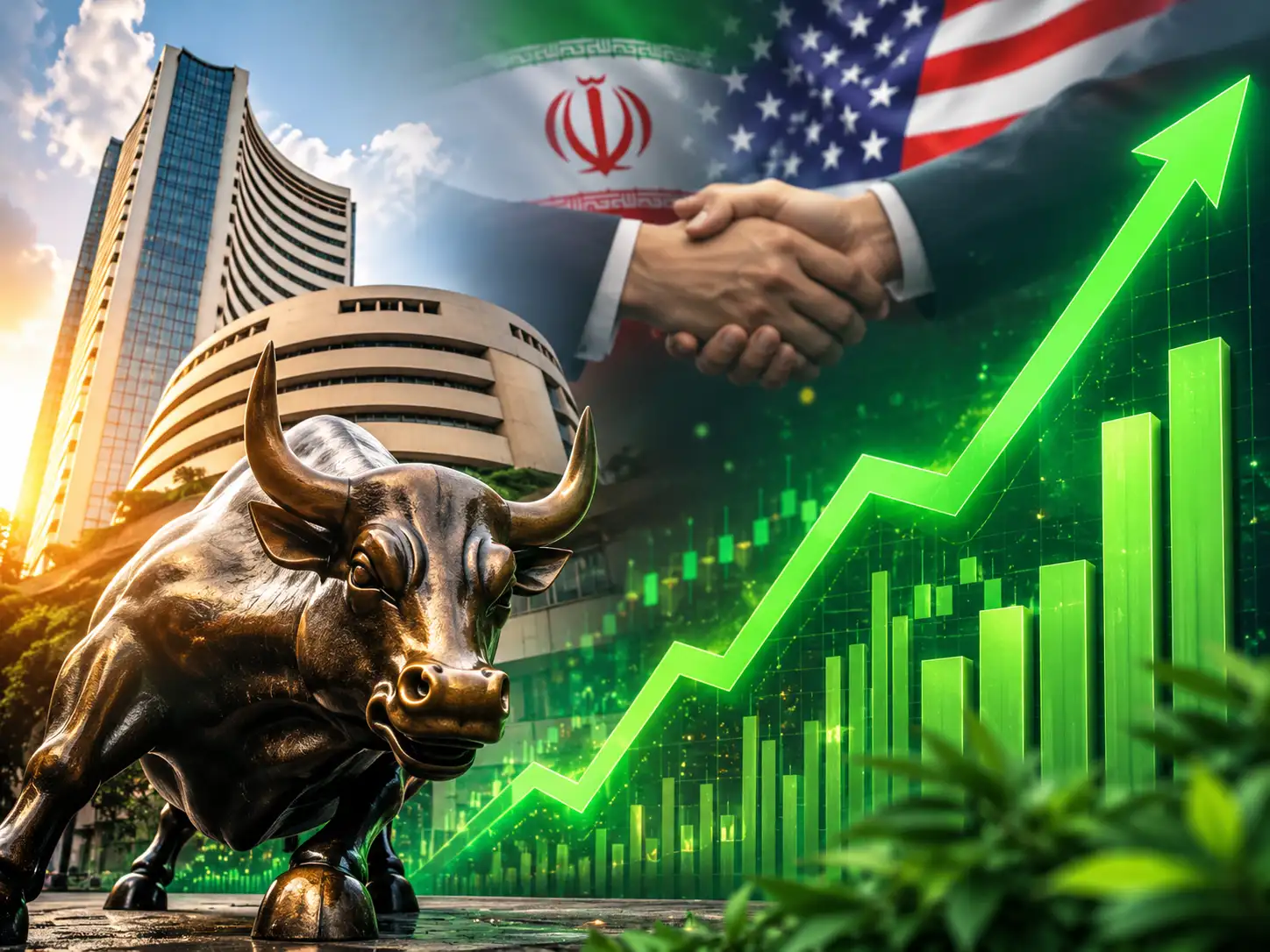
Indian equities kicked off the week on a strong note, with bulls charging through Dalal Street as an Iran-US peace framework, sliding oil prices and other factors lifted the Sensex and Nifty nearly 1% each, mirroring gains across global markets.
Sensex surged over 736 points to close at 76,264, while Nifty jumped over 231 points to end the session near 23,854, after briefly crossing 24,000 during the session. The sharp gains added more than Rs 8 lakh crore to the total market capitalisation of all companies listed on BSE, pulling it up to cross Rs 470 lakh crore.
Zudio and Westside-parent Trent shares jumped more than 5% to lead gains on the Sensex. IndiGo, Bajaj Finserv, Eternal, UltraTech Cement, Maruti Suzuki and Mahindra & Mahindra (M&M) shares jumped 3-4% to follow. Bucking the trend, NTPC and ICICI Bank shares declined more than 1% each to lead losses on the benchmark index.
Broader markets also gained sharply, with Nifty Midcap 100 and Nifty Smallcap 100 indices gaining more than 1%. This came as India VIX, which measures volatility in markets, dropped over 3% to 14.24. Sectorally, Nifty Realty surged around 4% to lead gains. Nifty Pharma, however, dropped around 1%. The overall market breadth was strongly positive, with 2,510 stocks advancing on the NSE, while 831 declined and 112 remained unchanged.
Here are the key factors that pushed the stock market higher today:
1) Iran-US reach peace deal framework
US President Donald Trump announced on Sunday that the much-awaited agreement has been finalised. "The Deal with the Islamic Republic of Iran is now complete," Trump wrote on his Truth Social platform. He further said that the Strait of Hormuz, a vital route for global oil shipments that Iran has effectively closed for months, would reopen on Friday, while the US would end its blockade of Iranian ports. "Ships of the World, start your engines. Let the oil flow!" Trump wrote.
Iran, meanwhile, said that the newly announced agreement with the United States puts an "immediate end" to the countries' war. "A permanent and immediate end to the war has been declared on all fronts, including Lebanon," Iran's Deputy Foreign Minister Kazem Gharibabadi said in televised comments in the early hours of Monday.
2) Oil prices tumble
The peace deal framework brought much-needed relief to oil prices, which had soared to as high as $120 per barrel earlier this year following the closure of the Strait of Hormuz, a narrow 33-kilometre waterway connecting the Persian Gulf with the Gulf of Oman that handles over 20% of the world’s daily oil and gas shipments.
Brent crude futures declined around 5% to trade below $83 per barrel, while WTI Crude futures tumbled over 5% to $80 per barrel on Monday morning.
3) Bond yields drop
Amid the risk-off sentiment, US Treasury yields dropped. The yield on benchmark US 10-year notes fell sharply to 4.426%, while the 30-year bond yield dropped to 4.924. The 2-year note yield, which typically moves in step with interest rate expectations for the Federal Reserve, fell to 4.024%. Falling bond yields typically make bonds less attractive to investors, which in turn can lead to an uptrend in markets.
4) Global markets rally
As a result of the renewed optimism, global markets rallied, with Dalal Street being no exception. Japan’s Nikkei and South Korea’s Kospi rallied around 5%. Hong Kong’s Hang Seng was up 0.5% while China’s Shanghai Composite jumped nearly 2%. Taiwan Weighted rallied around 3%.
Wall Street had ended the last session with minor gains, with the tech-heavy Nasdaq gaining 0.3% on Friday. European markets also gained, with the UK’s FTSE, France’s CAC and Germany’s DAX rising up to 1%.
Rupee gained 0.4 paise to close at 94.71 against the US dollar. The weekend news flow will be crucial, Jateen Trivedi, VP Research Analyst - Commodity and Currency at LKP Securities, had highlighted. “If there are no adverse developments regarding geopolitical negotiations, the rupee could attempt to break the important 94.80 resistance zone, which remains a key technical level on a closing basis. For the near term, the rupee is expected to trade between 94.80 and 95.50. A sustained move below 94.80 could trigger a stronger recovery towards the 94.00 level in the coming sessions,” he said. Notably, the Indian has now breached the key technical levels suggested by the analyst.
What lies ahead for the Indian stock market?
The announcement of the US-Iran deal finally happening will prop up the market initially, but the focus will be on the normalisation on the ground with supply chain flowing and prices coming back to double digits, said Nilesh Shah, MD of Kotak Mahindra AMC. “The market will watch the spread of the monsoon, AI flows, as well as guidance from the companies. We recommend clients follow asset allocation Dharam and remain neutral weight to equity with an overweight to mid-caps,” he added.
"The easing of geopolitical tensions following the USA-Iran peace agreement is a significant positive for global risk assets, and the immediate correction in crude oil prices is particularly encouraging for an import-dependent economy like India, as it helps alleviate inflationary pressures, improves macroeconomic stability, and provides greater policy flexibility, said Rajesh Palviya, Head of Research at Axis Direct.
“With one major global uncertainty receding, investor sentiment is likely to strengthen further. Going forward, markets will closely monitor the progress of the monsoon season and any potential impact from El Niño conditions, along with the upcoming quarterly earnings season, which will provide clearer direction on corporate profitability and growth trends,” he added.
According to Palviya, a sustained revival of FII inflows could act as a key catalyst for the next leg of the market rally, especially given India's strong macro fundamentals and earnings visibility. What remains particularly encouraging is the resilience displayed by the broader markets despite global uncertainties, he said, adding this underscores the growing confidence of domestic retail investors and reflects the structural strength of India's equity markets.
“Overall, the combination of easing geopolitical risks, softer crude prices, healthy domestic participation, and the potential return of foreign capital creates a constructive backdrop for Indian equities over the coming months,” as per Palviya.
(Disclaimer: Recommendations, suggestions, views, and opinions given by experts are their own. These do not represent the views of the Economic Times.)