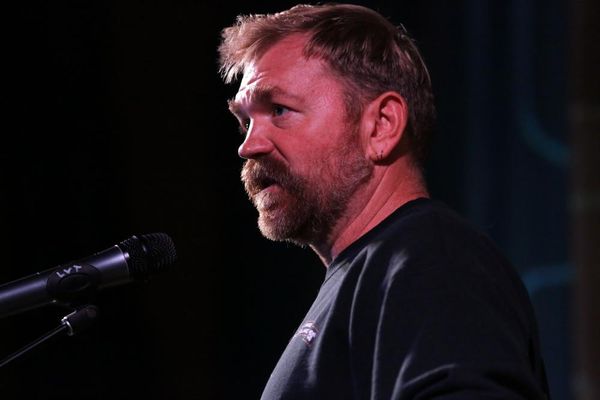
For players of a certain vintage who may once have come up against Roy Barry, it may be difficult for them to wrap their heads around. Particularly those from the European teams who were regularly given a chasing at the hands – or the merciless feet, as the case may have been – of the legendary Dunfermline captain and his partner in enforcement, Bert Paton. But the East End Park class of 2026 are bringing out his emotional side.
Barry, now 83, is still physically as fit as a fiddle, maintaining a disciplined weight-lifting, walking and golfing regime that has served him well since his playing days. The enthusiasm he has for his beloved Pars is positively radiating from him as he bounds through the doors and around the corridors of the famous old ground, being warmly greeted by current players and staff members alike.
It is as though he had never left. And in his heart, you suspect, he never really did.
There is a reason that this is the place he keeps coming back to. It has now been 58 long years since Barry was the last Dunfermline skipper to hold aloft the Scottish Cup, but this remains his spiritual home, and there are priceless memories everywhere you look.
His picture adorns the wall of legends outside the Main Stand. There, you’ll find Barry in his pomp, beaming as he holds aloft the oldest trophy in world football, and he can still regularly be found within that stand, where has been cheering on Neil Lennon and his boys every step of the way as they have shocked everyone - bar themselves, perhaps - by once again reaching the Scottish game’s showpiece occasion.
When Barry is asked what it means to him to see Dunfermline back on such a stage, the welling in his eyes says more than words ever could.
It is the forthcoming cup final, and the desire to hear the stories of his own day climbing the Hampden steps as Dunfermline captain, that brings us together here at his old stomping ground. But Barry also has something significant he wishes to share with his wider Dunfermline family, who revere him to this day.
That can wait though, at least until we have thoroughly mined his treasure trove of stories about his glory days, and the glory years of Dunfermline.
Barry’s story in senior football starts, though, ironically enough, with Hearts, who Dunfermline would of course go on to defeat in that Scottish Cup Final of ‘68. A moment that was made all the sweeter by his status as a former Tynecastle player, and a boyhood Hibee to boot.
“When I was 14 or 15, I chose an apprenticeship at the shipyards, because I wanted to be a welder so I could go into the Navy,” Barry said.
“I was offered the opportunity to become a professional footballer and I turned it down. Imagine.

“A scout approached me after a game I played for Tynecastle Athletic. He came over and introduced himself and asked where my dad was, then he said, 'I want to sign him.'
“I turned to my dad and said, 'I’m not interested; I’m happy.' He smacked me around the back of the head. He clouted me. 'You’ll do what you’re told.' He was a big Jambo."
The conflicting emotions of Barry Snr when his son went on to lead Dunfermline to that famous Hampden triumph over his team were for another day. For Barry Jnr, with some sense quite literally knocked into him, an exciting – if at times, brutal - football education was about to kick off.
“They signed you on a schoolboy contract sort of thing and then they’d send you out to a junior club to toughen you up,” he said.
“I went down to Musselburgh Athletic and played on a Saturday. You can imagine the junior league; it was full of ex-pros who had finished their senior career or hadn’t quite made it. Now I’m amongst all these men in this junior league.
“We used to travel about to Newtongrange Star, Armadale, Dunbar. You’d get kicked up and down the place. It was ferocious.
“Referees were frightened to say anything. I remember players running towards the referee and you would think they were about to headbutt him! They would stop short of actually doing that, but they would intimidate him to such an extent he’d blow his whistle and go the other way for a free kick. The referees at that level were so intimidated by these guys.
“That was an introduction to how people could murder each other on the pitch and as soon as the whistle went, they were walking off the pitch going for a pint together. 'Good game, lads.' That was the nature of the game at the time.
“I came from Stockbridge in Edinburgh, so I wasn’t a shrinking violet. People think that’s posh now, but it wasn’t the posh part then. It was the roughest end. I stayed in the top flat in a tenement. No bathroom, no toilet. The toilet was shared outside with two other families on the top flat.
“The big laugh as well was, you couldn't get to the toilet if somebody was in it, so everybody had a pot under the bed. You’re trying to sleep in the other room and your dad’s splashing away! That was the real world.
“Anyway, at 17, they offered me a full professional contract. I had to decide whether I wanted to continue my apprenticeship until I was 21 or become a professional footballer. It wasn't a hard choice. I became a footballer at that young age.
“Then I was very fortunate I got introduced to the European side of it. One of my early trips was Hearts were in Europe at the time and we went to Milan. "I didn't play, but I was taken for the trip. They took me and my roommate who had come up through the same levels as me, a guy called Bobby Ross, who was a good player too.
“We were taken to these places to experience it, which was a great introduction by Hearts for the young boys.”
This would be the first time that Barry would get a taste of one of the great joys of his career, and what would become a theme of his time at Dunfermline – travelling abroad to represent on foreign soil.
“The next big jump was when Hearts went to represent Scotland on a tour in America,” he said.
“I’d gone from Leith as an apprentice welder in a short time to an apartment - 12 East 86th Street - in Upper Manhattan that I shared with two senior players, David Holt and Willie Polland. John Harvey was the trainer. What an introduction for an apprentice welder.
“The apartment block was straight across the road from Central Park, that was my training ground. I’d go downstairs then go straight across into Central Park to train.
“There was a league of six teams. Bahia from Brazil were there. What they did was we went from New York to play in Chicago. Then we’d fly back to New York and John Harvey would just say, 'Two days off, back here for training in two days.' In New York!
“Then we’d turn up for training, and we would be instructed as to when the next game would be. It could be anywhere. We went to the West Coast to San Francisco and then to Los Angeles. Then we came back across Central America and played in Philadelphia and then back up to New York. In one month! I would have been 19 or 20.”
It wasn’t all galivanting though, with Barry starting to catch the eye as an uncompromising centre-back, despite his tender years. Though, his refusal to take a backwards step almost provoked serious repercussions in the U.S.
“We were introducing ‘soccer’ into the States, and it was just kicking off at university level,” he recalled.

“We were playing on pitches like the public park down the road there from East End. We would get these big crowds who were interested in this ‘soccer’ coming from Europe.
“Of course, our boys were quite rough. The Americans, I would have assumed at the time they’d have the American football and that was rough, but for some reason or other, they didn’t expect soccer to be rough. Of course, we were rough with these university guys, and one guy ran on the pitch and started chasing me with a knife.
“They all jumped on him thankfully, and nothing came of it."
A lucky escape, and one that Barry was determined to make the most of on his return home. His dedication, married to his talent, was about to bring tangible rewards, as he helped the Jambos to lift silverware with a 1-0 win over Kilmarnock in the League Cup Final at Hampden. A feeling he would clearly develop a taste for.
“I was only 19,” he recalled.
“There’s a good photograph of me with Gordon Marshall, the keeper, at the end of a game and I’ve just collapsed into his arms because I was so exhausted.”
It is fair to say though that while Barry enjoyed his time at Tynecastle, it never quite felt entirely like home. In 1966, a £13,000 bid from Dunfermline and a move to Fife would come to be one of the defining moments of his life, a development that shapes it still to this day.
It was here he would meet his doting partner, Jane, for the first time, then just a Dunfermline supporter, but who would many years later become his rock. The decision to choose East End Park though for his next step was, at the time, motivated purely by football reasons.
“I came here for European football,” he said.
“That would have been the attraction. I could always argue that I’d briefly been in Europe with Hearts but not really, not in the same way.
“I got the choice actually of coming here or going to St Johnstone. The manager phoned me up and said I’ve got offers from two clubs for you, Dunfermline and St Johnstone. Perth’s a nice place, I quite like Perth, but because the next game was the European game, that was what swung it. Getting into Europe, I think that was the most important thing."
Barry was immediately struck by the quality of the squad, and he is still irked that there wasn’t more international recognition for that group of players, including himself, but particularly, his great friend Alex Edwards. "We had a team of footballers,” he said.
“The boys at the back did what was required of them. I used to say to the guys, 'Win it, give it to the wingers.' We were fortunate because we had fullbacks who liked to get involved as well.
“We were all encouraging the management that the fullbacks could become wingers as well. The boys at the back - John Lunn left back, Willie Callaghan right back, and myself centre back - we would win it and give it. We used to talk about it. "I was always fortunate too that I played in front of good keepers. I used to get into pre-match talks about what we were going to do. 'You come for this, I’ll go for that.' We had an area that belonged to the keeper. We used to work on it.
“People wouldn’t understand that we were so into it all those years ago. It’s not just got all technical now; it was technical then. We had a Danish keeper, Bent Martin, and we used to do a drawing. 'That area is all yours, Bent; this is mine,' and so on. We used to plan it all. It wasn’t just a case of going out there and just kicking off. There was a lot of thought went into the game, even back in the olden days.
“The only downside I can think of in my career was that I didn’t get capped. Some of the people who were getting capped were quite clearly better than me, and I’m referring to Billy McNeill. Billy and I were big chums.
“I was told offhand once that Billy McNeill had been injured, and I knew I would have been the next in line for a cap. Of course, when the teams came out, Ronnie McKinnon of Rangers was the centre half for Scotland. I didn't get it.
“That was probably one of the biggest disappointments thinking back. I’d been playing so well and was even recognised in the press that this boy was guaranteed a cap instead of Billy McNeill because Billy’s injured. That was a huge shock, and it would have been a big plaudit for the club as well.
“Willie Callaghan was the only one of that team that got a cap, and it wasn't even considered a full cap at the time; it was one of the ones when they played Australia or something."

Barry is in no doubt that the Dunfermline players of that era were a match for many on either side of the Old Firm, but they weren’t given the same consideration by the Scottish FA selectors of the time simply because they played for a so-called ‘provincial’ club. “There's no question,” he said.
“I never used to go for that kind of thing and say it must have been this or that to make an excuse, but when you get older you start to realise what the situation is. They were Celtic and Rangers, we were the bits and pieces. That’s what happened.
“Even now, I’m still bitter, not for myself but for colleagues who I thought should have walked into the Scotland team. Alex Edwards, and Bert Paton was an amazing individual. He was a lovely player, and he was the hardest man I’ve ever come across. He was a fearless person. He would just kill you at a wink. He was just a terrific footballer.
"Alex Edwards was the finest footballer I ever played with or come across though. When I came here, I was in awe of what he could do. He couldn’t get a cap because Jimmy Johnstone used to get the caps. Now, Jimmy was a fine player, but I couldn’t understand how Alex couldn't get a cap. He should have walked into the Scotland team at the time. He was the most skilful. It wasn't fair.
“People have got their favourite choices and there was a time when people used to get caps because they were somebody’s favourite, especially a Celtic or Rangers player. We could never understand it, that he could not get a cap."
While Barry and Edwards remained firm friends until the latter’s passing in late 2024, there was a certain aspect of Edwards’ make-up that his great pal didn’t appreciate quite so much as his wonderful footballing ability, which came to light when they were rooming together.
"The funny thing was, I was forced to share a room with him when we travelled abroad,” he said.
“He was one of these guys that was hyper. He never stopped.
“And then of course, when we travelled away for a Saturday game at Aberdeen or wherever, we would go up on the Friday night. You would get in your room and I'm one of these people who is very disciplined about rest. I'd get tucked in and I'm ready. I'm preparing for the game already on the Friday night. Mickey [Edwards’ nickname] is still zooming.
“My nickname used to be Pugsley after the cartoon character Captain Pugwash because all the teams I played for, I captained. Alex was very young then; he was about four years younger than me.
“I'm getting tucked in and then you hear 'Pugs, Pugs.' Just like that.
“'What do you want?' 'I’ve got something to tell you. I meant to tell you earlier on.' 'Tell me quickly.' He’d proceed to tell me nothing of interest whatsoever. I'd say, 'Leave me now.'
“We’re in bed by 10. One o'clock in the morning and I'm still getting 'Pugs, Pugs, Pugs.' I would turn and by this point, I'd say something really rough. He’d go, 'Pugs, I only want to talk to you. I’m going to play football in the morning.'
“This was one of the finest footballers I’ve ever come across and I cannot get to sleep because he’s talking.
“When I’d eventually get to drop off, in the morning I’d wake up and look at him. The first thing he’d do is open his eyes: 'Pugs, Pugs, do you think I’ll be playing?' 'Of course you'll be playing.'
“He was so insecure. He had no confidence whatsoever until he went on the pitch to show off.
“My game was 'win it, give it.' I used to give it to the little man and he would just go whoosh down the wing. If you’d seen him, what a player.
“The great thing was, when I later went to Hibs, he was also there, so I reconnected with him.
“The first time I got to meet the players, I walked in the door to be introduced by the manager and I just heard, 'Pugsley!' He was just such a terrific lad. It’s a connection I had all my life."
While there may have been the odd issue at the time, the practice of rooming with teammates would be something that would open up wonderful friendships for Barry, as it did earlier in his Pars career, too.
"When I first came to Dunfermline, I was rooming with Alex Ferguson,” he said.
“We were both so feisty. When we played five-a-side at training we used to kick lumps out of each other and try and fight with one another. It bordered on the brutal to such an extent the manager had to take us apart.
“Then, the psychological thing, Willie Cunningham only went and put us in the same room when we travelled. We used to say, 'What? Get lost.' But it worked. As things progressed, we became like brothers.
“He was kind enough many times to invite us down to his place to watch Man United and be his guest after the game. When we first met Bryan Robson, he came up to us, and he started to shake my hand. I said, 'I'm Roy Barry, you won't have heard of me, but I played with Sir Alex when we were all together at Dunfermline.'
“Bryan just went, 'Never heard of you? I got you rammed down my throat for I couldn't tell you how long. I kept on being told, 'You think you're tough, son? Wait until you meet Roy Barry.'

“Bryan was always lovely and really looked after us and thought the world of Sir Alex."
Barry and Ferguson remain close, bonded together by those experiences at East End Park. And of all those glorious occasions and achievements, all those wonderful European nights, it is of course the 1968 Scottish Cup Final that stands above them all.
Barry gives due credit to everyone at the club who was involved in the triumph, but for some, one of their most valuable contributions to the cause was knowing when to stay in their lane. Like manager, George Farm. "George was a clever man because he didn’t really have a clue, but he knew that we did, and he just let us go on with it!” Barry laughed.
“He didn’t do any team talks. Andy Stevenson was the trainer. I was the captain. He would leave it to Andy and myself and the assistant. He would go, 'There you are, boys, do the business,' and he’d walk out to speak to the press. That was his thing.
“He was a great, big, handsome film star kind of guy. He was great because he knew what he was good at. He left what we were good at to us. He didn’t try to be a fancy man and try to tell a man how to do his job.
“When he used to come in and was a bit hot and bothered, that’s when somebody would say, 'That’s from when big George got kicked in the head when he was a keeper!’”
To get to Hampden, the Pars had done it the hard way, navigating an away tie against Celtic as well as games against Aberdeen, Partick Thistle and St Johnstone.
There is a particularly striking image from the game at Celtic Park of Barry and teammate Lunn sliding in to tackle Celtic winger Johnstone, who was unusually attired, which has since been turned into a painting by the artist Paul Town, a print of which has pride of place adorning a wall of the Barry home.
“We were allowed, and I've never been able to find out why, but we were allowed to play at Parkhead in our home strip instead of our away strip, and Jimmy there is in the Celtic away strip,” he said.
“But regardless, we knocked Celtic out at Parkhead and that was the start of it all.”
Working their own way through the rounds, as fate would have it, was Barry’s previous club, Hearts.
"By that time, I was a Par through and through,” he said.
“I’m much more so now, but even then. And Hearts were big rivals for us. George Miller was the captain of Hearts that day and he had been our captain. So, it was a complete vice versa. We were shaking hands at the start, looking at each other. You could actually intimidate somebody just with facial expressions back in the day. Honestly, some of the stuff that went on.
“In the town, the build-up was ridiculous. Everybody was so involved in the football. You couldn't go anywhere that everybody knew you.
“I had become a Fife person. The Fifers appealed to me because they were tough. It’s why I eventually came back to where I was most comfortable, the people suited me. I got on with them well on a social level too. You didn’t want to let them down.”
And he, along with his teammates, certainly didn’t. Two goals from Pat Gardner either side of an Ian Lister penalty rendered an unfortunate Lunn own goal as meaningless.
The rest, as they say, is history, and Barry’s place in Dunfermline’s history, as their inspirational captain that day, was secured.
He may not have known that then, but the rush that accompanied the hoisting of the cup above his head is a feeling that will never leave him.
"That was an absolute burst of everything,” he said.
“You can’t answer the feeling in words because you're either going to cry or you're inside going to explode. It's a feeling really that you can only get of having that achievement, especially when we were never expected to get it.
“When we progressed through the various rounds and then you get to the final and then you win it, it’s just beyond anything you’ll ever experience. What an achievement.
"After the final, the memories I’ve got about it is being on that open-top bus and just thinking you're the king of the castle. I had the cup and everybody used to moan and say, 'Come on Pugs, give us a shot of the cup.' I’m going, 'No, it’s my cup. I’m the captain!' Eventually, I had to share it!
“It’s funny. People would say we were a provincial club. A provincial club? Dunfermline were a big European club. What a time.”
Time though, can also be cruel. Which brings us back to the present day, and a challenge that has presented itself to Barry in these later years of his life. This is what he now wishes to share with his Dunfermline family.
It started with the odd mix-up. Moments of confusion. Forgetting little things here and there. His partner Jane, who had lost her mum to Alzheimer’s, started to recognise familiar, worrying signs. Subsequent tests confirmed her worst fears.
As with any challenge that has presented itself to Barry throughout his life, on or off the pitch, he is facing his own Alzheimer’s diagnosis with courage and positivity. Unlike many of his peers who have sadly been stricken down by the disease, there is nothing to suggest that Barry’s Alzheimer’s was caused by his profession, even accounting for his willingness to frequently put his head in where it hurts.
The toll, for now, thankfully, is relatively minimal. In fact, in well over an hour of conversation, it is only the odd spot of repetition that hints there is anything wrong at all. He attends the Alzheimer Scotland Football Memories Group at East End Park, supporting and benefitting from the brilliant work they do.
But the overt emotion Barry has displayed at times recently, even accounting for Dunfermline’s dramatic cup heroics, has been heightened by his condition. His short-term memory is increasingly failing him.
He still loves to chat with fans at matches about his playing days, whether that be 1968, the win over West Brom, or even just to take a selfie with the Grandkid of someone who was there to witness it all. At times though, the attention can be overwhelming, particularly when someone gets a little too enthusiastic, and touches Barry physically. Polite to a fault, and never wanting to disappoint a fellow Pars fan, he nevertheless can be left exhausted by such experiences.
Respectfully, then, he would ask that in future, such as at the forthcoming cup final, that any Dunfermline fan who wishes to chew the fat – and he would still welcome the opportunity to have a gab – does so while being mindful of his new circumstances.
Nothing, though, and certainly not Alzheimer’s, is going to ruin Barry’s return to Hampden. In his steadfast confidence in his team and current manager Lennon, he can’t even foresee Celtic managing that.
"I think I’m more nervous now than I was back in 1968,” he said.
“I was a wreck at the semi-final against Hibs and Aberdeen. At the Hibs game, I literally burst into tears at the end. It was the drama. We just sat mesmerised.
“I do get more emotional now and a lot of that is probably the Alzheimer's as well. Also the fact that I’m nearly 84 and we’ve waited all this time, and I really want them to win that cup. I really want it for these boys.
“I told Benny [current captain Kyle Benedictus] the other week he had nothing to lose. I cannot for the life of me see us getting beat.
“This Celtic team is not the best Celtic team I’ve ever seen. They’ve got players that are worth a lot of money, but they’re not a team in the same way that these Dunfermline boys are a team.
“It’s my team.”
As true today, as it was in 1968.