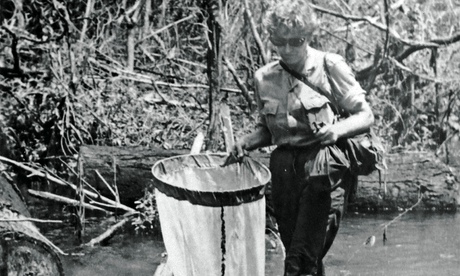
The early fieldwork in Africa and South America of Rosemary Lowe-McConnell, who has died aged 93, made a significant contribution to our understanding of the taxonomy, evolution and ecology of tropical fishes. Ro’s research on tilapia, an important food source for many communities in the developing world, provided a valuable basis for further studies of fish farming in tropical waters. Tilapia is now a major food fish, stocked in lakes and dams, and cultivated in ponds, worldwide.
Ro’s professional achievements are even more remarkable when seen in the light of social attitudes of the day. When she told one of her teachers that she wanted to be an explorer, the response was “perhaps you can teach”. In 1945 the Colonial Service refused to employ female entomologists, so Ro diverted to ichthyology. Later, a female friend of hers was in fact employed as an entomologist by the service, which first consulted Fisheries; they reported that nothing “untoward had happened as a result of appointing a female” (Ro). On getting married in 1953, Ro was obliged to resign due to the marriage bar for women in place at the time.
Born in Liverpool, daughter of Mary and Harold Lowe, Ro grew up in Grassendale, close to the Mersey, and was a boarder at Howell’s school, Denbigh. Her father was Liverpool’s deputy director of education. Ro’s keen interest in her environment manifested itself early on in life. She enjoyed walking down to the shores of the Mersey to watch flocks of wading birds. The family kept a large variety of pets, ranging from stick insects to a donkey, and her father had an aquarium of tropical fish on the telephone table. These fish, Ro observed,“would come up to be fed whenever the phone rang”.
Her childhood dream was to be an explorer in Africa. She was quite intrepid. A neighbour, on seeing Ro perched on the roof of the family home, telephoned her mother, who calmly replied: “It’s nearly teatime, she’ll probably be down soon.” Her great love of adventure, spirit of inquiry, and ability to deal with adverse conditions were to characterise the rest of her life.
After completing a degree in zoology and botany at Liverpool University, Ro joined a team at the Freshwater Biological Association on Lake Windermere in the Lake District. Here she was involved in various projects aimed at producing wartime food from fresh waters.
In 1945, she was sent out to Malawi to set up a laboratory on Lake Nyasa, now Lake Malawi, to continue a fishery survey started there in 1938. The cichlid fishes in the lake were a vital source of protein for the local population and a sustainable fishery programme was needed. Before setting out, she had to learn how to use and repair field gear, to identify the different fish species in the lake, and to tackle the rudiments of the local language. Then began the long journey, accompanying 14 crates of heavy gear by ship, train and, finally, lorry to Malawi.
After a brief period in the UK, Ro returned to Africa in 1948, this time based in Jinja, Uganda, at the East African Fisheries Research Organisation, now the National Fisheries Resources Research Institute. Her main purpose was to study the biology of tilapia in the lakes of east Africa. Ro produced a large number of scientific papers, providing the basis for many later studies assessing the impact of fishing and other human activities on fish populations.
Life in Africa had its challenges, but was fun, too, as described in Ro’s very readable book The Tilapia Trail (2006). On one expedition her car’s reverse gear failed, so a group of local people obligingly picked up the car and turned it in the opposite direction. She also regularly chased hippos out of her garden on the shores of Lake Victoria, so they would eat her neighbours’ cabbages and not her own. Ro also recalled, with great delight, her excitement when, during the building of the Owen Falls dam, the bed of the Nile was exposed briefly, thus enabling Ro and her colleagues to rush down and explore. This unique opportunity resulted in the discovery of a new species of fish.
In 1953 Ro married Richard McConnell, a geologist with the British Geological Survey, in Uganda. Richard was posted to Botswana from 1954 to 1956. There Ro was able to study the fishes of the Okavango Delta. A further posting for Richard, to British Guyana from 1957 to 1962, was described by Ro as a wonderful opportunity for her to take part in a survey of the freshwater fish and fisheries of Guyana. Her personal account of life there is documented in her book Land of Waters (2000).
In 1962 Ro and Richard returned to the UK, to Sussex, their house gradually filling up with books and reprints that were often used by visiting colleagues from around the world.
Ro never actually retired. She participated in many international conferences on ichthyology, limnology and ecology and produced publications bringing together studies on the ecology of freshwater fishes from the tropics of Africa, South America and Asia, culminating in a definitive work on the subject: Ecological Studies in Tropical Fish Communities (1987).
Her clear, concise style and deep understanding of ecology made her publications accessible to readers from diverse cultures and educational backgrounds, and resulted in much research in the tropics. She recognised the huge value and significance of social and scientific networks for stimulating new ideas and supporting researchers. A friend likened her to a spider in the centre of a vast web of information and contacts.
Richard predeceased her, as did her younger brother, Jeffrey. She is survived by her sister-in-law, Sylvia, nephews, Anthony, Simon and David, and niece, Susan.
• Rosemary Helen Lowe-McConnell, biologist, born 24 June 1921; died 22 December 2014