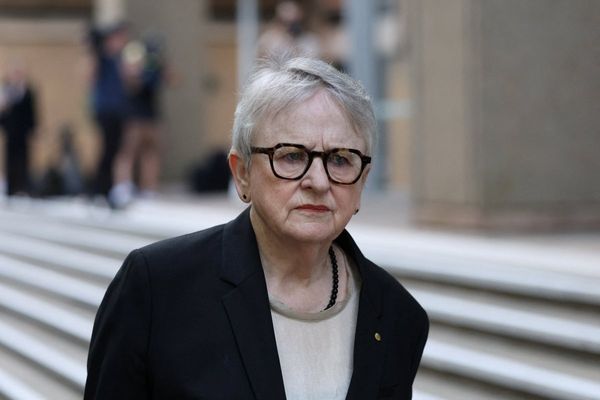
The finest backyard adornment of Professor Ros Croucher’s beautiful Blue Mountains home – from my perspective – is a small cricket oval, complete with pitch and grandstand. Befitting the importance she places on Australian values, it also synthesises her appointment to the role of president of the Australian Human Rights Commission. Just like a good first slip fielder in that idyllic tree-lined setting, she will be a safe pair of hands.
Croucher’s appointment has been universally acclaimed. As it should be.
An eminent lawyer, she successfully served as dean of the law schools of Macquarie and Sydney University. She has effectively led the Australian Law Reform Commission for almost a decade, delivering reports on nine different and complex areas of law reform.
A strong leader who sets clear directions, she always consults first, and works collegiately. She is a skilled lawyer, an excellent researcher, and can find a path through complex law, and the inevitable political issues with which it is enmeshed.
Her seven-year appointment is more than that received by most commission presidents. The government is confident in her. They recognise that, following the turbulence engulfing the commission since the Abbott years, what is required is a long period of stability.
The only opposition to her appointment comes from the rightwing Institute Of Public Affairs – the stable for the most political, and worst, appointment in the commission’s history. They will drink their cup of disappointment with few companions. Margaret Court – recently demonstrating that great achievement in sport is not usually parlayed to achievement in human rights – is probably among them.
Croucher will face numerous challenges. Internally, she will be leading an organisation wounded by the buffeting of the last four years, and drained by the gradual reduction of resources – in real terms – for the last two decades. The insidious government “efficiency dividend” disproportionately damages smaller organisations. But her experience will minimise that impact.
She will also be leading an organisation considered by some to be top heavy. There are seven commissioners who, given their complex advocacy tasks across Australia, are significantly under-resourced. But their resourcing, because of their number and seniority, drains the rest of the organisation. Staff turnover has increased, and morale is not as high as it once was. Team building and resource creation will be significant issues with which Croucher will have to grapple.
Externally, the challenges are multiple and complex. She will need, with the assistance of her commissioners, to build and coalesce the strong community support which the commission retains. She will also need to make human rights more relevant to more Australians to counteract the anti-human rights forces in the parliament and the broader community. They are not so numerous, but they are noisy, and sometimes persuasive.
There are those in government and parliament ideologically keen to further weaken the commission. Pragmatic dog-whistling, in the form of human rights bashing, has sometimes won out. This reduces good policy and compliance with the spirit, as well as the letter, of our laws and international commitments. Croucher will have to, as she has done in law reform, pick her battles carefully.
The Murdoch press have already called for her to walk away from the excellent research and consultation by the sex discrimination commissioner Kate Jenkins into sexual assault and harassment in universities. Female academics and students are well aware of the untold damage this does to academic achievement of young women, and the flow-on damage to our knowledge economy. She will recognise such calls as sensationalism.
The bête noire of the commission, for government and opposition, is asylum seekers. Australia has largely ignored its international obligations for some years, both in our shameful treatment of those seeking asylum, and in the numbers of people we accept. This approach will not change without principled political leadership, and perhaps Croucher will place it in the portfolio of Ed Santow – the human rights commissioner – while she deals with other pressing issues.
The commission president is pulled in multiple directions by commissioners and communities of interest. Calls for a treaty with Aboriginal Australians, lack of movement on same-sex marriage, increasing racism, violence and abuse of people with disabilities in institutions, and disproportionately higher unemployment of older people are just five of many.
Croucher has successfully steered the ship of commonwealth law reform through some choppy waters. She will continue to be a steady hand at the helm of the ship of Australian human rights.
Graeme Innes was, until 2014, a commissioner at the Australian Human Rights Commission for nine years, serving under three commission presidents.