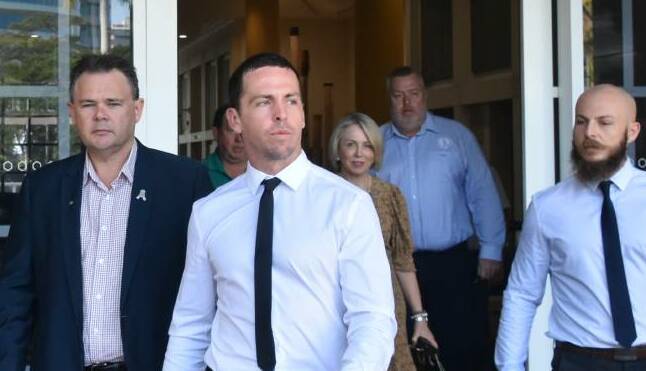
NT Police officer Zachary Rolfe could avoid liability for the alleged murder of Kumanjayi Walker regardless of whether a jury thinks the force was reasonable, prosecutors have argued to the High Court.
Constable Zachary Rolfe stands charged with murder over the death of the 19-year-old Yuendumu man in 2019, with his trial initially set to take place in Darwin earlier this year.
However, the trial has been stalled by a High Court appeal, with prosecutors objecting to a Full Court decision by the NT Supreme Court which would allow Rolfe's defence team to argue that their client is immune from liability because of his role as a police officer.
The argument relates to the interpretation of s148B of the NT's Police Administration Act 1978 which states: "A person is not civilly or criminally liable for an act done or omitted to be done by the person in good faith in the exercise of a power or performance of a function under this act."
The parties will argue whether or not the High Court should grant special leave for the appeal to be heard when the case returns to court next month.
In written submissions tendered to the High Court ahead of the hearing, Crown prosecutor Philip Strickland SC argued the NT Supreme Court decision should be overturned as it "erred in its construction" when it came to interpreting s148B.
He argued Mr Rolfe could be completely immune to liability as long as a jury decides he acted in "good faith".
"On the full court's construction of s148B the respondent police officer could avoid liability for the murder of an Indigenous man without any consideration by the jury as to whether the use of lethal force was reasonable," Mr Strickland said.
"That is, the full court's interpretation would allow a police officer unfettered protection, subject only to the requirement of "good faith", and not bound by any common law or statutory limitation on the exercise of police power.
"Such a construction is not consistent with the language and purpose of the specific provisions in part VII of the act or the common law, which impose express limitations on police powers and functions such as through the use of 'reasonable force'."
In his response, Rolfe's defence barrister Bret Walker SC argued if special leave to hear the appeal is granted, he will argue the NT Supreme Court decision was correct.
"The full court's interpretation of section 148B of the PA act proceeded in orthodox fashion. The full court applied orthodox principles of statutory construction and provided an interpretation that was the only construction reasonably open," Mr Walker said.
He said the "good faith" requirement of s148B protects the defence from being used unfairly.
"The requirement for a police officer to be acting in good faith provides protection against the unwarranted application of this statutory defence and is an answer to the appellant's contention that to permit the construction applied by the full court would eviscerate protections against the alleged unlawful actions of police, or emasculate the careful protection that the law offers citizens against excessive police force."
The case will return to the High Court on November 2.