"Currently, it is a collection of powerful clans, but with no daimyo."
That's how Kohei Nojiri, president of Colowide Co., whose subsidiaries include the Gyu-Kaku barbecue chain and the Kappa Sushi conveyor belt sushi chain, describes the current state of Japan's food service industry.
The food service industry serves a market worth approximately 26 trillion yen annually, more than double the 11 trillion yen convenience store market.
Yet there is no one restaurant chain operator whose annual sales exceed 1 trillion yen. Even the biggest food service operator, Zensho Holdings Co., which operates such eatery chains as Sukiya and Coco's, has annual sales of about 630 billion yen, and its market share is only around 2.4%.
Due to the spread of the novel coronavirus, however, the landscape on which rival food service business operators vie for supremacy may change markedly.
Kyosuke Eto, an official at Nihon M&A Center Inc. who is knowledgeable about corporate reorganization, said, "The reorganization will advance, mainly centering around mid-sized operators that consider that it would be tough [to continue business] on their own."
--Rising higher
Nojiri of Colowide does not hide his eagerness to make his company the "daimyo" of the industry.
He says he aims to increase his company's annual sales, now about 230 billion yen, "to a range between 700 billion yen and 800 billion yen within a few years, thus overtaking [the No. 1] Zensho." He said his company will make "vigorous use of mergers and acquisitions."
"It is impossible to operate 100,000 outlets domestically within a single business category, but across multiple business categories [operating multiple types of restaurants], it would be possible theoretically," he said.
On July 10, Colowide launched a takeover bid for Ootoya Holdings Co., operator of a Japanese-style set-meal eatery business. Colowide is Ootoya's largest shareholder, with a stake of about 19%. By increasing its stake up to about 51% through its takeover bid, Colowide plans to make Ootoya a subsidiary under its group management.
At the target company, both the management and employees of Ootoya oppose the takeover bid by Colowide.
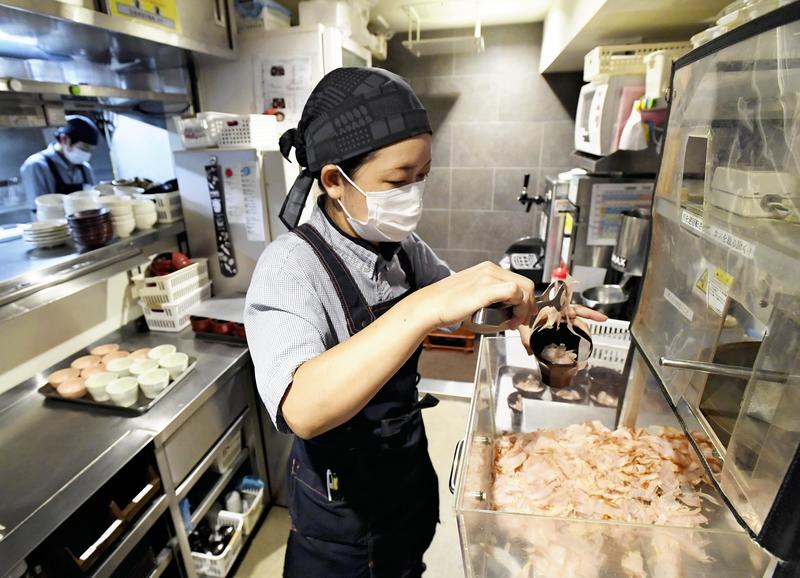
Ootoya prides itself on making its meals fresh at each restaurant. This applies to more than just chopping vegetables; employee shave dried bonito to make bonito flakes, and even make their own tofu from soy milk at each outlet. Ootoya Holdings Co. President Kenichi Kubota argues: "There is no future in our becoming a subsidiary. The merit of Ootoya will be lost."
A takeover bid happens when the acquiring company offers to buy stock in the target company from a broad range of its shareholders, by making public its purchase conditions, including an offered price and the period of that offer. In takeovers, there are friendly takeovers, in which the management of the target company approves the offer, and hostile takeovers, in which the management rejects it.
In the case of Colowide's offer for Ootoya, an Aug. 25 deadline has been set. Within less than one month, a decision will be made as to which side's assertions will be accepted.
Some companies have been forced to make decisions on prized brands that had supported their foundations.
Pepper Food Service Co., known for its Ikinari! Steak brand, has decided to sell off another of its leading brands, Pepper Lunch, for about 8.5 billion yen.
As a result of the company's having opened a large number of Ikinari! Steak branches, they wound up competing for customers among themselves, thus deteriorating the company's business performance. The impact of the new coronavirus was a further blow. A senior executive of the company said the decision to sell Pepper Lunch "is for our company to survive. To tell the truth, we do not want to sell it."
--Future prospects
Since the outbreak of the new coronavirus, corporate management at most companies in the food service industry has been shaken. Merely combining loss-making companies would not lead to the opening up of new business prospects.
Shigeru Sekinada, managing director at the Japan office of A.T. Kearney, a U.S. management consulting firm, said, "Seizing on the outbreak of the new coronavirus, Japan's food service operators should explore what new form food service chains should take."
Sekinada pointed to such practices as utilizing data analysis and sharing workers. "They can even create a model that would overturn the conventional wisdom that the food service industry is synonymous with low profits," he said.
"We want to eat safe and delicious meals at low prices."
Consumers' expectations of food service businesses are clear. Expanding scale is an effective means to realize such consumer expectations, but it is not a goal in itself.
In what way can the meals sought by consumers be offered? Food service business operators must continue exploring such services, without preconceptions.
Read more from The Japan News at https://japannews.yomiuri.co.jp/