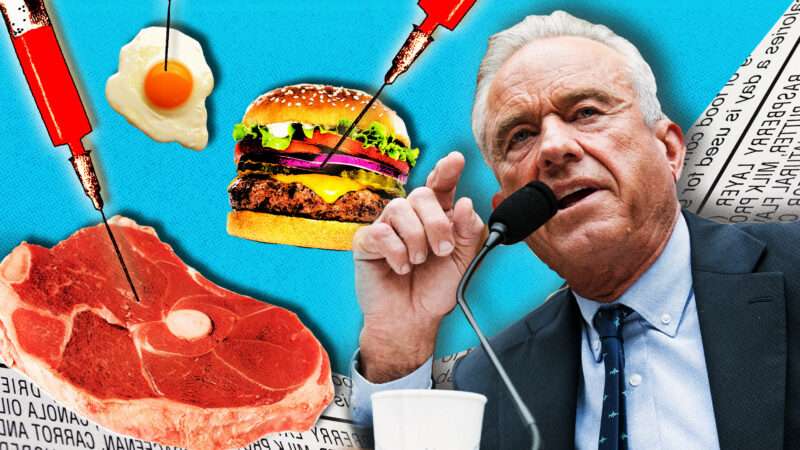
On Monday, Health and Human Services Secretary Robert F. Kennedy Jr. unveiled a new federal rule to crack down on food additives in an attempt to fulfil his promise to "Make America Healthy Again."
The rule would close the "generally recognized as safe" (GRAS) loophole, which allows companies to self-certify that certain food ingredients are safe—and thus can be added to products—without strict government oversight. Under the new rule, companies would be required to notify the Food and Drug Administration (FDA) when they make a GRAS determination and explain why they made that decision.
While manufacturers would not need FDA approval before bringing a product to market, notifying the FDA of new ingredients would be mandatory. According to the proposed rule, failure to submit notices could result in those substances being prioritized for FDA scrutiny.
"The proposal would give the agency greater visibility into the substances that are entering our food supply," said RFK Jr. at an event on Monday morning, standing in front of a banner which read "Eat Real Food," colored with cartoon images of salmon and strawberries, and to his left, a baby held up a sign which read "Real Food in the Military."
This "greater visibility" will come at a cost, according to the FDA, which estimates that the new rule would impose about $90 million in costs over a period of 10 years, though the agency says costs could reach as high as $210 million. The FDA also says the rule will "have a significant economic impact on a substantial number of small entities."
This is not the first expensive rule proposed by RFK Jr. in his quest to "Make America Healthy Again." According to analysis by the Policy Navigation Group, MAHA state nutrition laws are expected to "cost consumers, businesses, and local governments billions of dollars per year in extra grocery costs, in compliance costs, and in greater spending for school meals."
The FDA itself has previously acknowledged how compliance costs can reach consumers. A proposal to require certain nutritional information to appear on food labels is expected to cost the packaged-food industry roughly $3.2 billion over a decade. The FDA concedes that those costs "may, at least partially, be passed through to consumers in the form of price increases."
"I don't think the government should tell any of us what we can and cannot eat, and what additives we can and cannot consume," Jeffrey Singer, a practicing general surgeon and senior fellow at the Cato Institute, tells Reason. "I think we have a right as competent adults to make that decision."
"There are mechanisms in place, and there are incentives," Singer says. "Food manufacturers don't want their reputations destroyed, so nobody buys their product. They don't want to get these huge liability lawsuits. And the civil tort system, of course, is very important here." Private organizations and nonprofits, meanwhile, can evaluate products and provide consumers with information without making government the final arbiter.
His broader point is that private institutions have incentives to discover problems too, and that government approval should not be mistaken for certainty. In the past, the government has approved medications that have proven to be harmful. Vioxx, for example, was an anti-inflammatory drug approved by the FDA in 1999, and for which cardiovascular risks were later identified through research by Kaiser Permanente. The drug was then voluntarily pulled from the market.
"Just because they say it's OK," Singer says, "doesn't mean they're not going to find out later it's not OK."
It's important to note then that RFK Jr.'s proposed rule does not abolish risk or guarantee that every ingredient entering the food supply is "safe." It simply requires manufacturers to tell the FDA how they reached that conclusion. The danger is that, in the name of Making America Healthy Again, Washington makes food more expensive while also encouraging Americans to outsource yet another set of judgments to federal regulators.
The post RFK Jr. Wants More FDA Oversight of Food Ingredients. It Could End Up Costing $210 Million. appeared first on Reason.com.