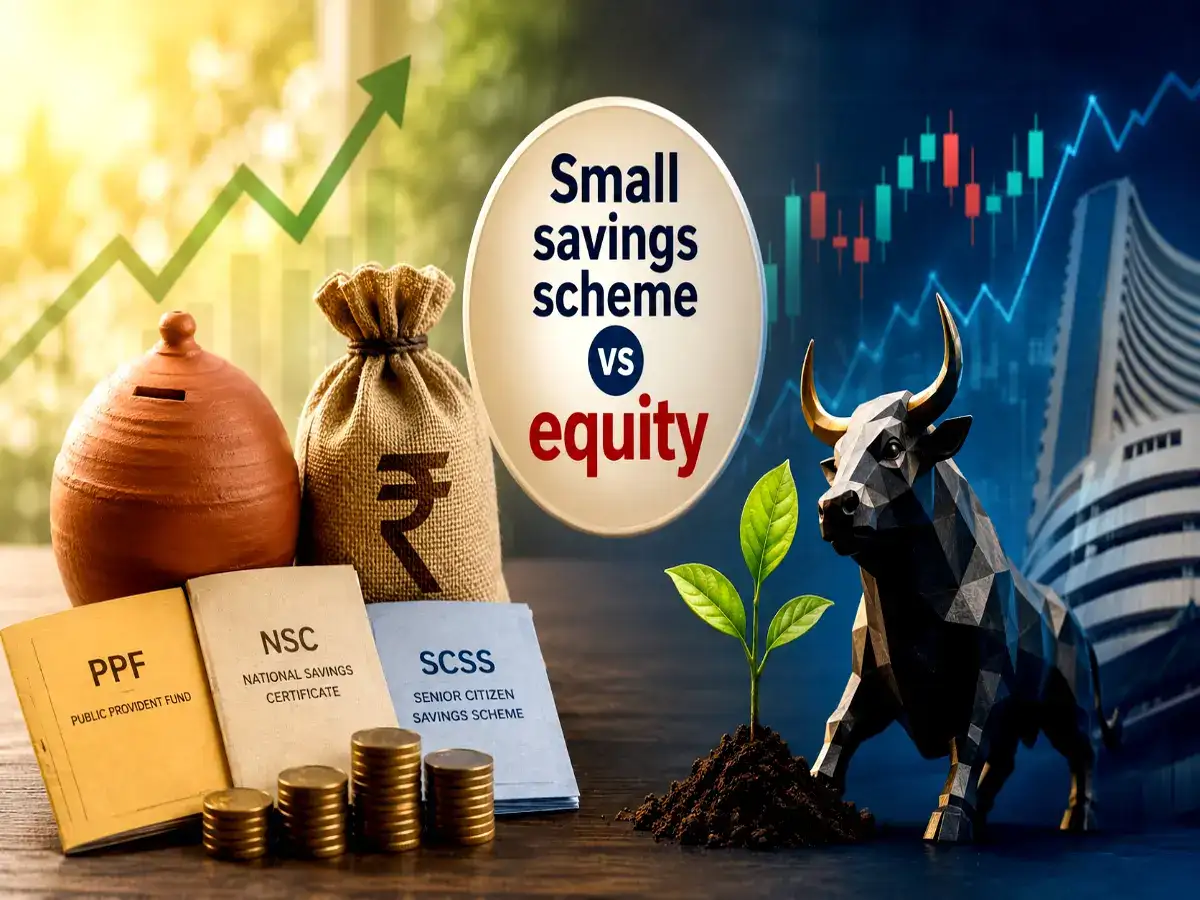
While equity investors have witnessed muted returns in the last two years because of a volatile market, investors in small savings schemes have enjoyed stable returns of up to 8.2% within the same timeframe.
While major indices like the Nifty 100, Nifty Midcap 150 and Nifty Smallcap 250 have seen only modest returns, small savings options like the Senior Citizen Savings Scheme and Sukanya Samriddhi are providing steady return of 8.2% each.
Additionally, other popular small savings schemes like the National Savings Certificate (NSC) and the Public Provident Fund (PPF) are offering interest rates of 7.70% and 7.1% , respectively.
Also Read: FCNR deposit in demand: $1,277 extra interest on $10,000 investment by NRIs after RBI's latest move?
Small savings scheme interest rates
In the table below, you can see that most small savings schemes are offering more than 7% interest rate to investors.
| Small savings schemes | Interest rate |
| Post office savings account | 4% |
| Post office RD | 6.70% |
| Post office MIS | 7.40% |
| SCSS | 8.20% |
| PPF | 7.10% |
| SSA | 8.20% |
| Post office TD (5 years) | 7.50% |
| KVP | 7.50% |
| MSCC | 7.50% |
| NSC | 7.70% |
What is good about small savings scheme interest rates is that the government has not changed them since January 2025 despite many indicators suggesting a possible rate cut.
Equities have given modest returns in last two years
Equities are considered as instruments that help investors beat inflation in the long run. Historically, they have provided better long-term returns compared to small savings schemes. But in the short term, their performance may fluctuate heavily, resulting in low returns compared to small savings schemes. When you check out the two-year performance of top indices like the Nifty 100 Largecap and the Nifty 150 Midcap, it’s clear they have struggled to outperform even low-interest small savings schemes.
Performance of key indices in last two years
According to data available on the Niftyindices website, the Nifty 100 index that represents India’s top 100 companies in terms of market capitalisation, hasn’t given any returns in the last two years. Other indices like Nifty Next 50, Nifty Midcap 100 and Nifty Smallcap 250 have also given modest returns in the same time period.
| Index | 1 Year CAGR | 2 Year CAGR |
| Nifty 100 | -1.52% | -0.15% |
| Nifty Next 50 | 3.99% | -0.38% |
| Nifty Midcap 150 | 5.19% | 4.39% |
| Nifty Smallcap 250 | 9.50% | 1.12% |
Source: Niftyindices
Performance of key mutual fund categories in last 2 years
A lot of people prefer mutual funds to stocks as they want to reduce the risk while benefiting from equity returns. But data of key mutual fund categories picked from Morningstar shows that large, large and midcap, flexicap and multi cap categories haven’t given any returns in the last one year. Looking at the two-year data, no category has delivered a 6% annualised return, while at the same time, some small savings schemes are offering 8%+ interest rates.
| MF category | 1-year CAGR | 2-year CAGR |
| Large cap | -5.37% | 0.68% |
| Large & Midcap | -2.48% | 3.25% |
| Midcap | 1.09% | 5.29% |
| Smallcap | 0.99% | 4.25% |
| Flexicap | -3.45% | 1.77% |
| Multicap | -1.44% | 3.40% |
| ELSS | -4.74% | 1.21% |
Are small savings schemes better than equities then?
After looking at data, many readers may wonder why they should take a risk with equities when small savings schemes are offering 7-8% stable returns? But here is the catch. If you have a short-term investment horizon, equities may not be the best option, especially if you are investing during a market downturn. But in the long-term, there are high chances of equities delivering higher returns than small savings schemes.
For examples, the Nifty 100 largecap index has given 11.99% annualised return in 10 years and 10.64% in 20 years.
It means if someone had invested Rs 1 lakh 20 years ago, its value would have been Rs 9.04 lakh in today’s terms.
The Nifty Midcap 150 index has delivered 17.96% annualised return in 10 years and 13.67% in 20 years, which means Rs 1 lakh invested 20 years ago has grown to nearly Rs 13 lakh.
Now, if you compare these returns with small savings schemes’ returns, equities emerge as hands-down winners.
| Index | 5-year CAGR | 10-year CAGR | 15-year CAGR | 20-year CAGR |
| Nifty 100 | 9.15% | 11.99% | 10.34% | 10.64% |
| Nifty Next 50 | 13.76% | 13.92% | 12.95% | 12.60% |
| Nifty Midcap 150 | 18.05% | 17.96% | 15.79% | 13.67% |
| Nifty Smallcap 250 | 17.52% | 15.28% | 13.14% | 12.02% |
Who should invest in equities and small savings schemes?
Aditya Agarwala, co-founder and chief investment officer at InvestValue, told ET Wealth Online about the timeframe and investor type suitable to invest in small savings schemes and equities.
Who should invest in small savings schemes?
Small savings schemes are suitable for conservative investors seeking safety over high returns, particularly those in retirement or mid-career who prioritise capital protection.
| Small savings scheme investor profile | Recommended Schemes | Why |
| Senior citizens (age 60+) | Senior Citizen Savings Scheme (SCSS) at 8.2% | Highest guaranteed return with tax benefits on principal amount. |
| Parents with girl children | Sukanya Samriddhi Yojana (SSY) at 8.2% | Built for girl child savings till age 21 and interest is completely tax free |
| Tax-conscious investors | PPF (7.1%), NSC (7.7%), 5-year TD (7.5%) | Section 80C deductions under old tax regime |
| Regular income seekers | Monthly Income Scheme (7.4%) | Fixed monthly payouts with government safety |
| Conservative/retired investors | All small savings schemes | Government-backed, minimal risk, predictable returns |
| Short-term savers (1-3 years) | 1-3 year Time Deposits (6.9–7.1%) | Safe medium-term savings |
Who should invest in equities?
Equities suit investors who can tolerate volatility and don't need money for 7–10 years. Equities are the preferred choice for investors seeking wealth creation rather than just wealth preservation.
| Equity investor profile | Why equities fit |
| Young investors (25–40) | Can tolerate volatility and benefit from the longest compounding horizon |
| Long-term wealth builders | Equity SIPs held for 10 years have a strong track record of positive returns |
| Inflation-beating seekers | Over long term, equities delivered high returns that beat inflation |
| Growth-oriented investors | Corporate earnings (EPS) growth is expected to recover to mid-teen levels in 2026 |
| Investors with higher risk tolerance | Can withstand short-term market volatility in pursuit of superior long-term returns |
Thus, you can see that investing in small savings schemes or equities just by looking at data can be misleading. While small savings schemes can be bad weather friend, providing stable returns irrespective of market conditions, equities are best suited for investors with a long-term horizon. It is always advisable to keep your financial goals and timeframe in sight before investing in either of these investments.