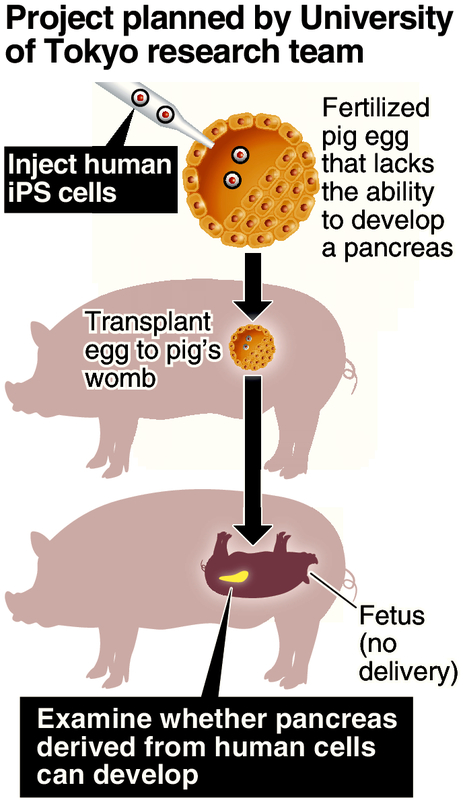
A University of Tokyo research team is aiming to use human induced pluripotent stem (iPS) cells to make a human pancreas inside a pig's body, in a bid to someday transplant such a pancreas into a human body, sources said.
Led by Prof. Hiromitsu Nakauchi, the team has decided to submit its research project to make human pancreases in pigs to the university's ethics screening committee as early as April, according to the sources. There are not enough human pancreases available for transplantation, so the team plans to extract pancreases made with human cells from pigs, and use them in the future for transplantation into a human body.
The government in late March is expected to revise its guidelines to allow research on producing human organs inside animal bodies in Japan. If their project is given the green light, Nakuchi and his fellow researchers' study will be the first of its kind in the nation.
They plan to inject human iPS cells -- which can develop into any kind of cells -- into fertilized eggs that have been genetically modified so they lack the ability to develop pancreases. Then the eggs will be placed back inside the wombs of pigs.
They expect human pancreases to develop as the human iPS cells spread to the part of the pig fetus where the pancreas would be. The fetus will be removed before delivery to examine the amount of pancreatic tissues derived from the human cells and how well the organ functions.
If the project passes the university's ethics screening committee and is approved by the government's expert committee, the team will start work by the end of fiscal 2019 at the earliest.
They chose pigs for the project because they grow quickly and their organs are similar in shape to those of humans.
Regarding the production of pancreases inside pigs for the purposes of transplantation, Nakauchi said, "We'd like to put [the project] into practical use within 10 years."
The guidelines to be revised will apply to basic research, allowing experiments in which fertilized eggs injected with human tissues are returned to animal wombs and eventually delivered.
Read more from The Japan News at https://japannews.yomiuri.co.jp/