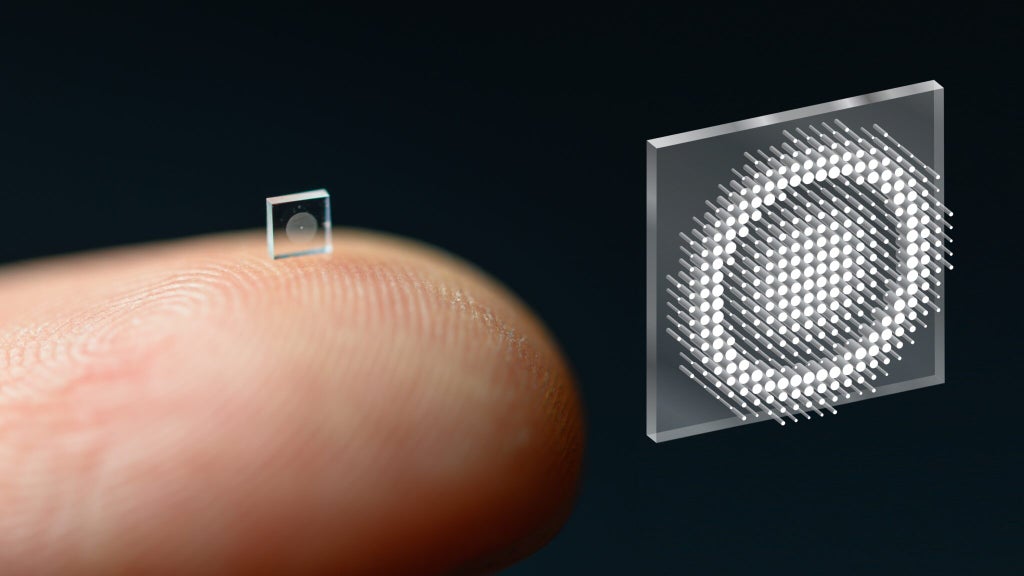
Researchers have created an ultracompact camera the size of a grain of salt capable of producing pictures on par with lenses hundreds of thousands of times larger than it.
Engineers from Princeton University and the University of Washington say that the camera can produce full-colour images that could be used in collaboration with medical robots to diagnose and treat diseases.
Traditional cameras use curved glass or plastic to bend light rays, this new camera uses ‘metasurface’ technology which is produced like a computer chip. The metasurface of this particular camera has 1.6 million cylindrical posts – each approximately the size of a virus – to make up a system just half a millimetre wide.
Each of those posts has its own unique geometry, working like an optical antenna, and machine-learning algorithms can use the posts’ combined interactions with light to create high-quality images. Compared to older versions of these cameras, this camera works better in natural light conditions, has fewer distortions, and larger fields of view too.

“It’s been a challenge to design and configure these little nano-structures to do what you want,” said Ethan Tseng, a computer science PhD student at Princeton who co-led the study.
“For this specific task of capturing large field of view RGB images, it was previously unclear how to co-design the millions of nano-structures together with post-processing algorithms.”
The next step for the researchers will be to add greater computational abilities to the camera – such as object detection and other modalities that would make it more useful in medicine or robotics.
Felix Heide, the study’s senior author and an assistant professor of computer science at Princeton, predicts that ultracompact imagers will be used to create “surfaces as sensors.”
Individual surfaces could be turned into cameras with ultra-high resolution, “so you wouldn’t need three cameras on the back of your phone anymore, but the whole back of your phone would become one giant camera. We can think of completely different ways to build devices in the future,” he said.