For visual learners, concepts have always been easier to understand when one could picture them as something else.
For some, even months have colours. January can be bright blue, July pink and October orange, for instance. Maybe it has something to do with the feeling of each season, or maybe it is simply a way of making something abstract feel more real.
Sexuality has always worked the same way for many. Different kinds of love feel like different genres, not because they can be neatly categorised, but because they carry different textures, emotions and rhythms.
Some are soft, some loud and some difficult to name. Like music, sexuality can shift over time. It can borrow from different influences, resist labels and still feel completely honest.
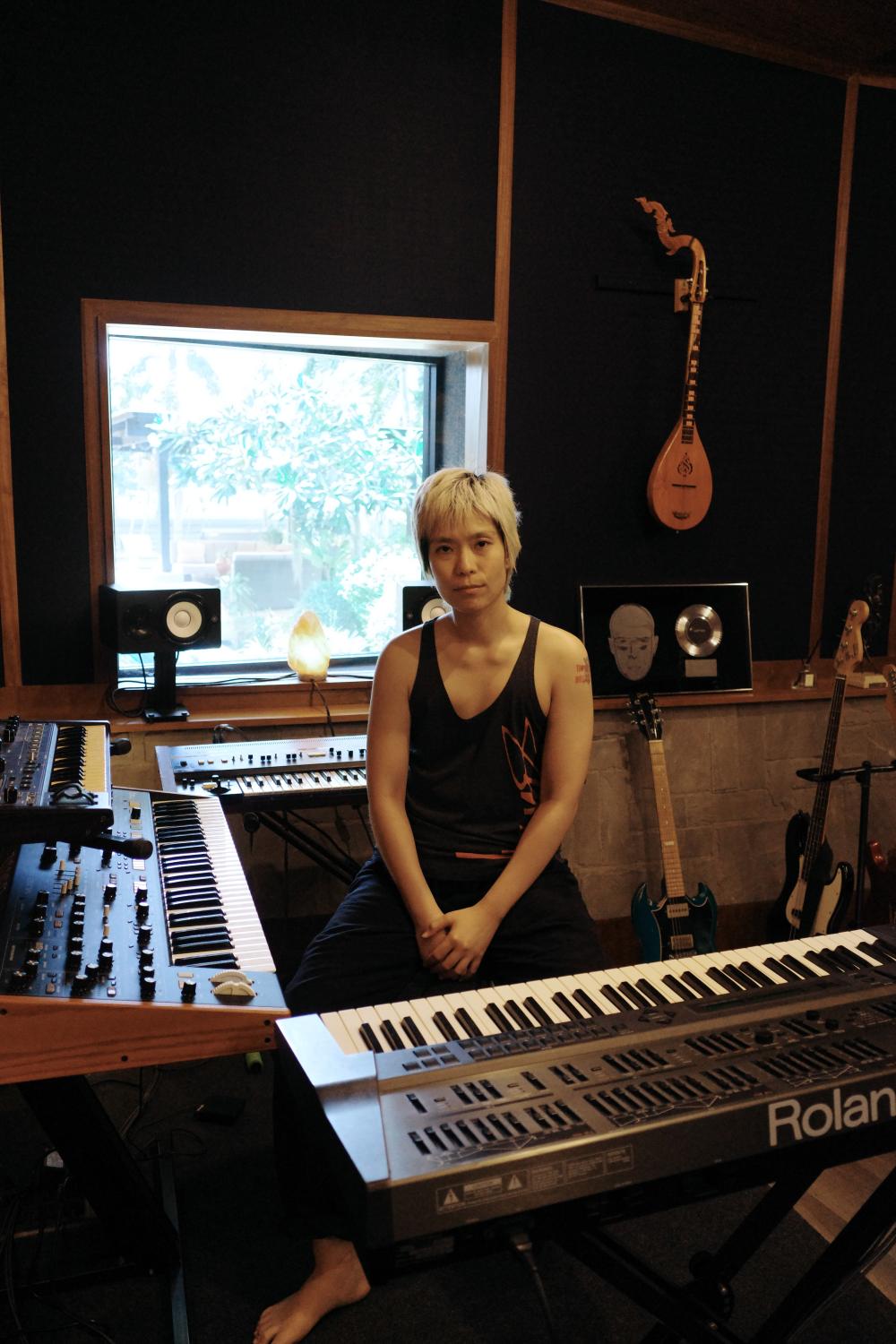
That's also how Sutipat Sutiwanit, also known as MAMIO, conceptualises it.
Known for songs such as The End and her latest release Soulmate, Sutipat is a Thai singer-songwriter known for her striking voice and poetically intimate lyricism. Across a diverse discography, she weaves deeply personal narratives into an ever-evolving soundscape.
As an artist, her sound has moved through many phases and as a person, her understanding of herself has moved too. Her music and sexuality do not feel like two separate stories, but seem to grow from the same place: a desire to search, question and become more honest with herself.
When asked if she sees gender as something fluid and constantly evolving, much like the artistic process, her answer immediately connected the two.
"I believe it is the same," she said. "Both begin as questions, finding their shape through the act of searching."
That sentence became the centre of our conversation. For Sutipat, gender was not something she understood from the beginning. As a child, she did not think much about being a girl or a boy. She simply liked what she liked.
School made gender visible. In Thai, even the way a person refers to themselves can become gendered. When she had to use ka, she realised how others expected her to identify.
"Sutipat is here ka," she recalled. That was the moment she understood people saw her as a girl.
In secondary school, she began hearing the word tom, a Thai term often used for masculine-presenting women who like women. She cut her hair short, wore chest binders, flirted with girls and began using that label for herself.
But even that label came with rules.
"Because I like girls, I have to act like a boy?" she asked. "Society has made it feel that way."
Sutipat's experience connects strongly to the theory of "doing gender", introduced by sociologists Candace West and Don Zimmerman. The theory suggests that gender is not only something we are, but something we repeatedly perform through everyday behaviour.
We "do" gender through the way we speak, dress, move and respond to social expectations. More importantly, people are judged when they do not perform gender in the way society expects.
"Once I grew up, I started seeing that liking girls shouldn't confine us to becoming a boy," she said. "Just because you like girls, you don't necessarily have to be or become a boy."
That realisation was important. It allowed her to separate desire from performance. Liking girls did not mean she had to erase her femininity. Presenting masculinity did not mean she had to deny her softness. Being quiet or having a deadpan face did not mean she was dangerous or emotionally cold.
"I can still be a girl," she said. "I can still have a lot of emotions, be vulnerable. I have evolved."
Her answer made gender feel less like a destination and more like a negotiation. Sutipat was not simply trying to find the "correct" label. She was trying to understand which parts of those labels helped her and which parts trapped her.
When I asked what parts of gender felt liberating and what parts felt limiting, she was direct.
"I feel like all aspects of gender have always been limiting for me," she said. "Whenever we choose to identify with a certain gender, I have to be the societal construct of that gender."
For her, each category already comes with expectations. If she chooses to be seen as a girl, she is expected to be proper and poised. If she speaks too much, people may judge her. If she is seen as tom, she is expected to be masculine in a specific way. The problem is not only the label itself, but the performance attached to it.
That is why music becomes such a useful comparison. Music allows Sutipat to be many things at once.
"I don't feel good when I have to identify which genre I am an artist in," she said. "I can't answer. I like so many musical styles and I mix so many of them. The answer is so similar to when I answer about my sexuality. If I had to answer which sexuality I am, I wouldn't be able to answer that."
When Sutipat became MAMIO as a solo artist, she used that space to experiment with sounds she had never tried before: trip-hop, techno, alternative and eventually a return to folk. She described it almost like a full circle -- moving forward so much that she returned to an earlier version of herself.
That return feels important. Growth is not always about leaving the past behind. Sometimes it means returning to it with more self-knowledge.
Still, Sutipat is honest that not every part of being an artist has felt authentic. There was a period when her work felt disconnected from her identity. She knew she was doing it for money and trying to please others while finding a middle ground where she could still like the work.
"At that moment, I decided to trade my identity to work in the pursuit of money," she said.
This statement removes the romantic idea that artists are always free. The music industry may celebrate authenticity, but it also asks artists to be marketable. For queer artists, that pressure can become even more complicated. They may be praised for representation, but also reduced by it.
Sutipat said that when people call her a "queer artist", it can feel limiting.
"It does make me feel reduced," she said. "Because labelling someone by their sexuality seems like such a bordered wall to me."
"People who listen to music don't think about gender," she said. "They listen to admire the music." But the industry often does think in labels. Once an artist is framed as queer, Sutipat worries that people may assume they are harder to sell, less relatable, or less commercially powerful than male artists. In that sense, gender is not only something individuals perform. The industry performs gender too, through the artists it chooses to push, package and believe in.
Sutipat's story is not about choosing one final label, genre or gender expression. It is about questioning why those categories feel so necessary in the first place. It is about learning that liking girls does not require performing masculinity. It is about realising that softness can exist inside a masculine appearance and it is about making music that does not need to fit one genre in order to be real.
Like her sound, Sutipat's identity is layered, changing and difficult to contain. And maybe that is the clearest way to understand her: not as someone without definition, but as someone who refuses to let definition become a cage.