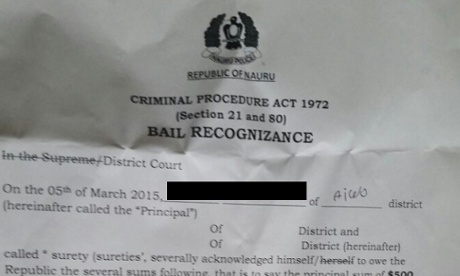
Refugees on Nauru say they were forced to sign bail sureties of $500 – promising not to protest again – in order to be released from prison.
At least 183 refugees, including women and children, were arrested this week for protesting against their temporary resettlement and living conditions on Nauru.
Nauru police say 174 people have been charged and released on bail. They said in a statement that one 13-year-old boy had been arrested, following a court-issued warrant for assaulting a police officer.
It is alleged the boy threw rocks at police, injuring one. Police also revealed a Nauruan national had been arrested and charged with assaulting a refugee.
Tension has been rising on the island after a week of non-cooperation and street demonstrations by refugees.
One refugee from Iran, who Guardian Australia has chosen not to name, said she and dozens of other refugees were released from prison at 11pm on Thursday night after being arrested on Tuesday. But they were freed only after signing a bail form which forbids them from “breaching the peace”, which includes gathering in groups of more than three.
“They gave a paper to us and said ‘this is your freedom paper but first you have to sign that you never go protest [again]’. People were in a bad situation and they said, ‘If you don’t do it, we keep you here and you can’t go home.’ All people sign by force because we didn’t have another choice,” she said.
“Many people [were] sick because they couldn’t took [take] medicine for two days. And many family sign that paper because their children was at home alone.”
Several family groups were arrested on Tuesday. Children were released that night, but in some cases, both of their parents were held in prison until Thursday. The refugees were given an interpreter, but were not given access to lawyers before they were asked to sign the paper.
One refugee told Guardian Australia they were crammed, “more than 20 of us”, into a single prison cell.
“When we asked them for food or water they said ‘if you don’t like this situation you have to [go] back to your country’.”
“They kept us in very bad situation and some of the women were sick … but they just laughing at us.”
The bail form refugees were required to sign commits them to a surety of $500, to be paid if the refugee fails to appear in court when summonsed, or if he or she breaches bail conditions. The handwritten bail conditions are: “to keep peace and not to re-offend”.
The bail form does not say with what offence they have been charged, or if they have been charged at all. Refugees, who are given an allowance of $180 a fortnight, have said any fine would be an impossible to pay. Those who have found jobs earn about between three and four dollars an hour.
According to a directive issued by the Nauru police director, Corey Caleb, breaching the peace includes gathering in groups larger than three. Any protesters who fail to disperse when ordered can be jailed.
Refugees are also restricted in where they can go on the island. They cannot go to schools, the hospital, airport, harbours or parliament.
Nauru’s constitution guarantees “every person in Nauru ... freedom of conscience, of expression and of peaceful assembly and association”.
Guardian Australia called Caleb several times on his mobile phone, but calls were not answered.
Nauru’s president, Baron Waqa, said police had not been violent towards refugee protesters, but that they would not be allowed to demonstrate on the streets. He said “faceless people” in Australia were inciting resistance on Nauru.
“Refugees [are] safe in the country and talk to the contrary is blatant lies spread by Australian advocates and lawyers,” he said in a statement.
Australia’s immigration minister, Peter Dutton, said the protests on Nauru were a matter for local authorities, but that Australia’s offshore resettlement policy would not be influenced by protests.
“If people who have been resettled on Nauru believe that these activities will change Australia’s position – they are wrong ... those who come illegally by boat will never be settled in Australia.”
He said refugees should treat the people and government of Nauru with “gratitude and respect”.