Amnesty International has released images from earlier this month which it says shows how sealing the border crossing from Serbia to Hungary led to a bottleneck of trapped people seeking entry to the European Union.
Amnesty said the images serve as a warning to Croatia, Slovenia and other countries currently considering closing their borders to thousands of people seeking protection.
Tirana Hassan, Amnesty International’s crisis response director, who has just returned from the border, said:
The shocking scenes from the ground this week at the Horgoš-Röszke border crossing have shown the human toll of Hungary’s irresponsible actions. These images give a deeper sense of the speed and scale of Hungary’s operation to seal its borders, which culminated in a dire situation for refugees and asylum-seekers left in limbo.

Dutch prime minister Mark Rutte called for a binding agreement to share out migrants between EU countries to stop what he dubbed “asylum shopping”, AFP reports.
EU commission chief Jean-Claude Juncker has urged members states to take 160,000 refugees from border countries Greece, Hungary and Italy, grappling with Europe’s worst migration crisis since World War II.
Referring to migrants streaming to mainly wealthier western European countries with favourable asylum policies, Rutte said:
We have to end the practice of ‘asylum shopping’
Eastern Europe too must shoulder its responsibility.

The row between Croatia and Hungary over their respective handling of the migration crisis is deepening as Hungary’s foreign minister on Friday accused Croatia of pushing migrants to break the law by “illegally” breaching Hungarian borders.
Peter Szijjarto was speaking in Belgrade after talks with his Serbian counterpart Ivica Dacic and Serbian Interior Minister Nebojsa Stefanovic. He said:
Rather than respecting the laws in place in the EU, they (Croatia), are encouraging the masses to break the law, because illegally crossing a border is breaking the law.
At the moment, the Croatian government is transporting migrants - in contravention of the laws in force in the European Union - towards the Hungarian border instead of giving them a place to stay and looking after their needs.
A joint European response to the migrant crisis as countries cannot cope individually, a spokesman for the United Nations refugee agency said.
Babar Baloch, regional spokesman for central Europe for the UN High Commissioner for Refugees, said his organisation is capable of handling the humanitarian response to the migrant crisis, but “what’s missing is a collective EU action.”
Tovarnik, #Croatia: More families from Syria arrive as dawn breaks. Strong pleas for help & compassion on #Europe pic.twitter.com/ziUqqcG5AP
— Babar Baloch (@BabarBloch) September 18, 2015
Baloch said “within three days we can put in place mechanism for refugee arrivals,” or “empty our warehouses in Dubai, Copenhagen and other places”.
He added: “We know how to do the job, but the responsibility, the moral and legal responsibility here is on the countries in the European Union.”
Here’s a live feed from the Bermend border crossing between Hungary and Croatia. Buses from the Hungarian side have been taking refugees and migrants who were bussed to the crossing by the Croatian authorities.
While some of the 14,000 refugees in Croatia have provocatively been taken to the Hungarian borders, others have been seen arriving in the capital Zagreb.
Croatian TV has been showing footage of 1,200 refugees arriving by train in the outskirts of Zagreb and getting on buses from there. They were being taken to the Zagreb Fair site, a Guardian contributor in Croatia report.
He added that the Croatian media is reporting that a fight at Beli Manastir station took place between Syrians and Afghans refugees.
Updated
Croatia has insisted it won’t become a “collection centre” for refugees and migrants in Europe.
The Croatia government has put out an English language version of forthright comments made by Prime Minister Zoran Milanovic at today’s press conference.
It quotes him saying: “Croatia has shown that it has a heart, both its authorities and its people, but we must remind our neighbours and the EU that we also have a brain and that we know where our interests and our security lie.”
It adds:
Milanovic said that no one can physically close the borders unless they build wire fences, which Croatia will not do. “Those calling for closing the borders should explain what they mean by it. Closing border crossings does not mean closing the borders,” he said, adding that the daily influx of people into the country was incomparably higher than six months ago.”
Croatia has been preparing for this. Croatia is taking them in, but our capacity is small. We can’t do it any more. Over 13,000 people have entered Croatia in two days and a small number of them have left. We can’t control this and we can’t accept them any more because they exceed our capacity,” the PM said.
Updated
Croatia buses refugees to Hungarian border
The Croatia authorities have bused thousands of refugees to a heavily defended border crossing to Hungary, according to Jonathan Miller from Channel 4 News.
They've disembarked then and are preparing to march then across @Channel4News pic.twitter.com/cWkB78ZXvz
— Jonathan Miller (@millerC4) September 18, 2015
Hungarian special forces have lined up on their border. They are all armed and have riot shields @Channel4News pic.twitter.com/KL8W2BCPYS
— Jonathan Miller (@millerC4) September 18, 2015
More people have filmed crossing Croatia’s border with Slovenia.
Some have been turned around but more coming all the time pic.twitter.com/v4VnzsNe7v
— Christian Fraser (@ChristianFraser) September 18, 2015
Croatia’s deputy prime minister, Vesna Pusic, said Slovenia is carrying out its threat of returning a “certain number of people” to Croatia. But she added that others are getting through.
Pusic insisted that Croatia did not have the capacity to register asylum claims, but said it would make an exception for women and children.
“There will be various discussions and difficulties,” she predicted.
She also revealed that Croatia had had offers to take migrants, from New Zealand, Canada, Australia and the United States.
As Hungary threatens to build more razor wire fences, human rights campaigners have urged its leaders to remember history.
Lydia Gall Eastern Europe researcher for Human Rights Watch, says Hungary’s actions are a insult to history. She writes:
It’s also tragically hypocritical that Hungary, from where about 200,000 Hungarians were forced to flee in 1956 to obtain protection from Western countries, is currently closing its borders to those fleeing their countries for similar reasons.
Hungary should honor its human rights obligations and indeed its own history and keep its borders open to allow people to present their claims for asylum in a fair and transparent procedure.
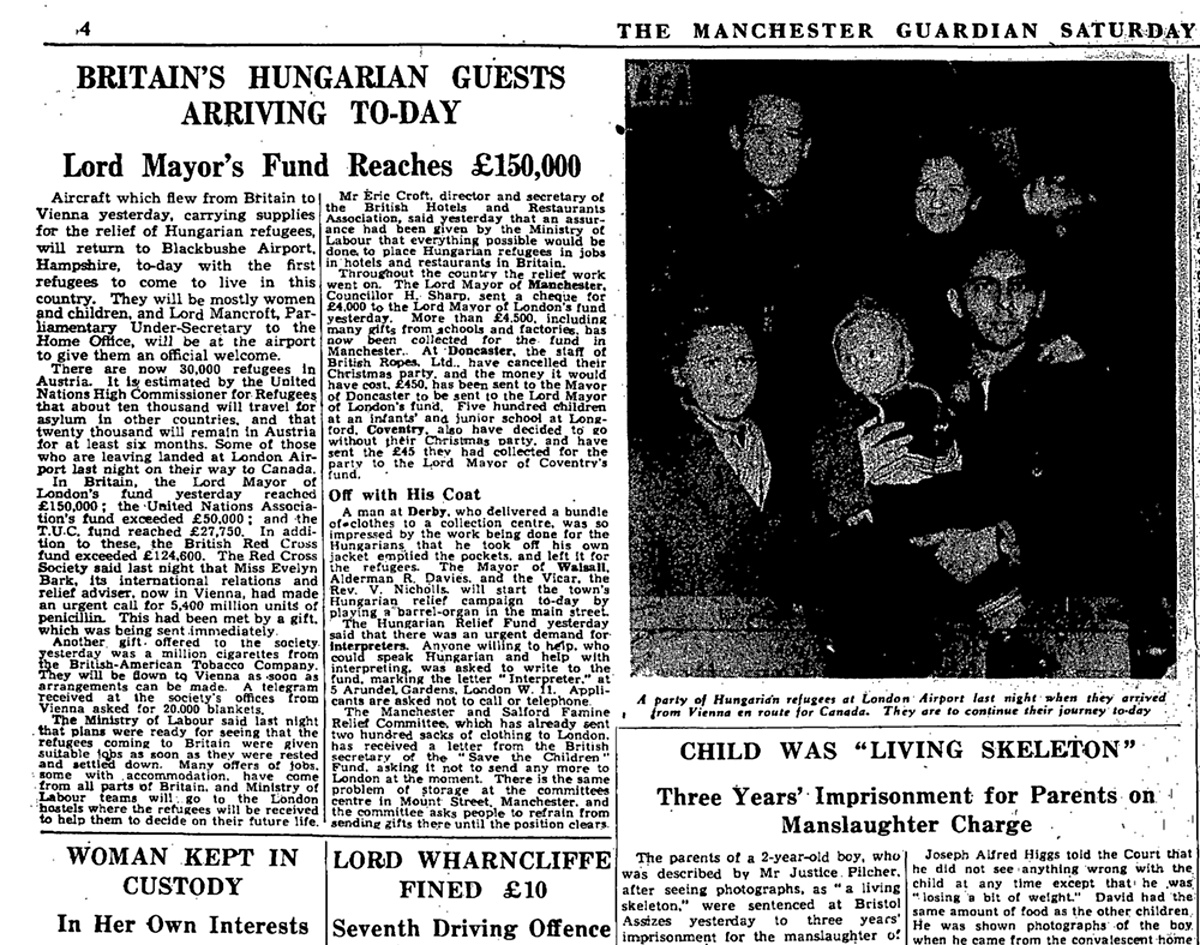
Here’s how the Manchester Guardian covered the first arrival of thousands of Hungarian refugees to Britain in November 1956. It says: “The Ministry of Labour said last night that plans were ready for seeing that the refugees coming to Britain were given suitable jobs as soon as they were rested and settled down. Many offers of jobs, some with accommodation, have come from all parts of Britain, and Ministry of London teams will go to the London hostels where the refugees will be received to help them decide on their future life.”
How things change.

Updated
Summary
Here’s a summary of the latest developments:
- The Croatia government says it cannot cope with thousands of refugees crossing its borders and says it will allow them to pass through to northern Europe without registering asylum claims. Prime Minister Zoran Milanovic said: “We cannot register and accommodate these people any longer. They will get food, water and medical help, and then they can move on.”
- Hungary started building a new fence on its border with Croatia overnight and has already deployed hundreds of soldiers and police on the border. Announcing construction of the 41km fence, Prime Minister Viktor Orban said: “We must implement the same measures as on the Serbian-Hungarian border.”
- Slovenia’s government is to hold a meeting of its security council to decide on its response to the crisis. Refugees and migrants were filmed walking through its unguarded borders but it has imposed border restrictions and vowed to send back migrants to Croatia.
- A man has been electrocuted near the entrance to the Channel tunnel in Calais as he tried to climb on to the roof of a train to reach England. At least 10 refugees or migrants have now died at Calais since the end of June.
- Almost 500,000 people have entered Europe by crossing the Mediterranean this year, according to the latest figures from the International Organization for Migration. It recorded 473,887 arrivals to Europe by sea in 2015. Almost 40% of those making the journey were from Syria.
- Germany has threatened to use a qualified majority vote to force EU states to accept a binding quota plan to resettle 120,000 refugees across Europe. Foreign Minister Frank-Walter Steinmeier said: “It just cannot be that Germany, Austria, Sweden and Italy carry the burden alone ... if there is no other way, then we should seriously consider to use the instrument of a qualified majority.”
- European leaders are to stage an emergency summit next week to wrestle with a refugee emergency that has pitched the union into one of its most bitter political conflicts. Amid ever deepening division and a war of words between eastern and western Europe over how to cope with hundreds of thousands of arrivals, Donald Tusk, president of the European council, called the special summit for next Wednesday after Angela Merkel, Germany’s chancellor, demanded he do so.
Updated
Croatia’s relations with neighbouring Hungary continue to fray over the crisis.
Hungary’s government spokesman, Zoltan Kovacs, says Croatia’s decision to redirect migrants entering the country toward Hungary and Slovenia is “totally unacceptable.”
Croatian Prime Minister Zoran Milanovic said earlier that Croatia could no longer register migrants in accordance with EU rules, and suggested they would be allowed to pass through Croatia to Slovenia and Hungary.
Milanovic also criticised Hungary’s decision to build a new fence on its border with Croatia. “Barbed wire is not the answer,” he said.
Speaking to AP Kovacs said: “It is totally unacceptable for a European country to not respect European rules just because it was unprepared.”
Practicing what the Pope preaches, the Vatican has housed a family of Syrian refugees.
Earlier this month the Pope Francis called on every religious community across Europe to do their part to stem the refugee crisis and offer sanctuary to migrant families.
“May every parish, every religious community, every monastery, every sanctuary of Europe, take in one family,” he said.
The Vatican City has announced is had taken in a family that had fled the war in Syria.
The family – a father, mother and their two children – came from Damascus and are Melkite Greek Catholics, a Christian church with close ties to the Roman Catholic Church.
Refugees and asylum seekers have been filmed strolling through an unguarded border crossing between Croatia and Slovenia.
Crossing into #Slovenia from #Croatia - some relieved refugees. No police. Yet. pic.twitter.com/x7qdJQnLHq
— Piers Scholfield (@inglesi) September 18, 2015
The number of new arrivals in Croatia in the last few days has reached 14,000, according to the country’s interior ministry.
Around 14.000 #refugees entered Croatia by 9 AM http://t.co/iWCb9yk195 #refugeescrisis
— Vlada R. Hrvatske (@VladaRH) September 18, 2015
A thousand of them are stranded at Tovarnik station, according to Patrick Kingsley.
After last night's train that never left, today it's the train that never comes. Perhaps 1000 waiting in hope at the 1st stn inside Croatia.
— Patrick Kingsley (@PatrickKingsley) September 18, 2015
Germany threatens QMV over refugee quotas
Germany has threatened to use a qualified majority vote to force EU states to accept a binding quota plan to resettle 120,000 refugees across Europe.
In an interview with Passauer Neue Presse daily Foreign Minister Frank-Walter Steinmeier said: “It just cannot be that Germany, Austria, Sweden and Italy carry the burden alone. That’s not how European solidarity works. And if there is no other way, then we should seriously consider to use the instrument of a qualified majority,”
A meeting of EU interior ministers last Monday failed to reach a deal on quotas to distribute 120,000 migrants. An extraordinary summit of the European Union has been scheduled for next Wednesday in Brussels, following a request by Berlin and Vienna.
Diplomats have cautioned Germany against using a qualified majority vote.
“The consequences of a qualified majority vote (QMV) would be significant,” said Philippe Lamberts, co-leader of the Greens in the European parliament. “Forcing QMV on such a hot issue won’t produce a result. More people are turning their backs on Europe. This should be avoided.”
Steinmeier is in Turkey today to discuss the crisis.
FM #Steinmeier calls f strengthening of transit+host countries: Hope that this is a common position in #EU. #refugees pic.twitter.com/3jstPt35cY
— GermanForeignOffice (@GermanyDiplo) September 18, 2015
The Croatia government has confirmed it will no longer register asylum seekers, but will allow them to pass through to northern Europe.
Croatian PM Milanović: We can't register people anymore. What else to do but to let them go where they want to go? #refugeescrisis #refugees
— Vlada R. Hrvatske (@VladaRH) September 18, 2015
It is unclear how this work, as the BBC’s Anna Holligan points out.
'Move on' in which direction and how..? #refugees https://t.co/3eH2hb3Fr0
— anna holligan (@annaholligan) September 18, 2015
The queue for buses at Croatia’s Tovarnik station is long and heavily policed, according to this footage from the BBC’s Gavin Lee.
"2 by 2" says riot officer,as 2 thousand #migrants get weary of keeping in bus line after 24 hrs at #tovarnik station pic.twitter.com/4bUggOs7QM
— Gavin Lee (@GavinLeeBBC) September 18, 2015
Croatia cannot and will not accept the burden of thousands of migrants any longer, Prime Minister Zoran Milanovic, told a news conference.
He said: “We cannot register and accommodate these people any longer. They will get food, water and medical help, and then they can move on. The European Union must know that Croatia will not become a migrant ‘hotspot’.”
He also adopted the same kind of language used by David Cameron in the UK’s response to the crisis. “We have hearts, but we also have heads,” Milanovic said.
Earlier this month Cameron said: “Britain will act with our head and our heart, providing refuge for those in need while working on long term solutions to this crisis.”
The Greek island of Lesbos has become inundated as refugees battle to reach Athens, according to this video report.
Croatian PM: country will not become a 'hot spot'
Croatia’s Prime Minister Zoran Milanovic has signalled a tough new approach to the crisis vowing that his country will not become a “hot spot”.
Within 48 hours of promising free passage through Croatia, Milanovic said: “Croatia’s plan B is to no longer register and accommodate migrants.”
He said it was time for Croatia to deal differently with the problem, according to a translation from Reuters. “Croatia cannot and will not accept this burden anymore,” he said.
Milanovic also called for a meeting of Croatia’s national security council.
Updated
Slovenia’s government is to hold a meeting of its security council to decide on its response to the crisis.
Authorities expect thousands of people will attempt to cross into Slovenia on Friday after more than 13,000 entered neighboring Croatia in little over two days.
Most migrants want to move on toward Western Europe.
Slovenia’s Prime Minister Miro Cerar has ruled out creating a north-bound corridor for the migrants.
Slovenia has said it will return migrants coming in from Croatia. Dozens attempting to cross have already been held up by Slovenian police.
Updated
Croatian Prime Minister Zoran Milanovic is giving a press conference. Croatian speakers can follow it here.
Updated
Almost 500,000 people have entered Europe by crossing the Mediterranean this year, according to the latest figures from the International Organization for Migration.
It recorded 473,887 arrivals to Europe by sea in 2015. Almost 40% of those making the journey were from Syria.
On average eight people per day have drowned making the journey this month, the IOM said.
Deaths on sea routes today stand 2812, up from 2661 at the end of August. In other words: an average of just over eight fatalities per day through the current month.
Midway through Sept arrivals in the Mediterranean reach 473,887 for 2015 http://t.co/KiwqJEUZo6 #MissingMigrants pic.twitter.com/GFihtNN7Ca
— IOM (@IOM_news) September 18, 2015
Croatia has reacted sharply to Hungary’s decision to start work on a razor wire fence between the two countries.
In a TV interview Croatia’s interior minister Ranko Ostojic said: “Walls have never prevented anyone, it is absolutely unacceptable. Hungary’s wire won’t stop the wave of people, their crazy ideas are not the solution.”
But Ostojic said Croatia would accept people turned back by Slovenia, according to Index.hr.
Meanwhile there are more chaotic scenes at Tovarnik railway station where thousands of refugees and migrants are waiting for trains and buses to take them to the Croatian capital Zagreb and beyond.
Updated
Now that Hungary is building a new fence with Croatia, the only other way to western Europe from Croatia is through Slovenia.
The Slovenia authorities are reported to be returning people to Croatia and have stopped all rail traffic between the two countries.
Around 150 refugees entered Slovenia by train and were transported to a refugee centre in Postojna in western Slovenia, according to Balkan Insight.
Slovenia has already reintroduce border controls with Hungary.
Announcing the move the Slovenian prime minister, Miro Cerar, said the controls with Hungary “will make it possible to keep the situation under control”.
Overnight, Cerar said refugees will either be registered in Slovenia or sent back to Croatia. Speaking on state television he said Slovenia would implement Schengen rules and that “only those meeting the EU’s requirements can be allowed to cross the border”.


More details have emerged about Hungary’s decision to build a new heavily armed 41km razor-wire fence with Croatia.
In a radio interview Prime Minister Viktor Orban said:
“During the night work already began on building the technical border closure... It seems we can rely on help from no one
“Forces are being redeployed, 600 soldiers are already at the scene, 500 will arrive there in the course of the day, and several hundred at the weekend. Two hundred police have been assigned to the Croatian border.
“There will be no sandhill or molehill to hide behind, we will defend our borders.”
“The western Balkans route is still there. The fact the Hungarian-Serbian border is now closed has not stopped the flow.”
Hungary’s decision to fire teargas and water cannon at refugees trying to cross its border on Wednesday continues to be criticised.
UN High Commissioner for Human Rights Zeid Ra’ad Al Hussein said he was appalled by the scenes.
In a statement he said: “The images of women and young children being assaulted with tear gas and water cannons at Hungary’s border with Serbia were truly shocking. I am appalled at the callous, and in some cases illegal, actions of the Hungarian authorities in recent days, which include denying entry to, arresting, summarily rejecting and returning refugees, using disproportionate force on migrants and refugees, as well as reportedly assaulting journalists and seizing video documentation. Some of these actions amount to clear violations of international law.”
Asylum seeker killed in Channel Tunnel
An asylum seeker, thought to be a Syrian man, was electrocuted last night near the entrance to the Channel Tunnel in France, a spokesman for the local authorities in northern France told AFP.
He tried to climb on to the roof of a train to make his way to England the official said. “The individual died after he was electrocuted trying to climb on to the freight car,” the official said.
The man was found dead shortly before midnight Thursday. Officials said it was the 10th death of a migrant in or near the tunnel since late June.
Eurotunnel reported some disruption to services this morning.
Our Passenger service is currently operating with up to 2 departures per hour but some trains are leaving later than originally planned ^CM
— Eurotunnel LeShuttle (@LeShuttle) September 18, 2015
Croatia’s interior ministry has reported another sharp rise in the number of people crossing its border. The figure for new arrivals this week is now up to 13,300 almost six times the number for the whole of last year.
Interior Minister Ranko Ostojic said he had a message for migrants: “Don’t come here anymore. Stay in refugee centers in Serbia and Macedonia and Greece. This is not the road to Europe. Buses can’t take you there. It’s a lie.”
Patrick Kingsley has the latest from Croatia’s Tovarnik railway station.
More than 2,000 refugees were left stranded overnight in a border town near Croatia’s border with Serbia as Slovenia prevented hundreds of others from leaving north-west Croatia, leading to fears that the latest refugee route into the European Union may turn out to be a dead-end.
Early on Friday morning, Croatia also closed seven of its eight road border crossings with Serbia after complaining of being overwhelmed by the arrival of more than 11,000 migrants and refugees.
At least 2,000 people were stuck in Tovarnik, the first Croatian town after the border with Serbia. While a specially commissioned train arrived to pick many of them up at about midnight, the train was still waiting in the station at 7am, its 10 carriages packed with about 1,000 restless refugees largely from Syria, Afghanistan and Iraq.
More than 1,000 others were left sleeping on the station platforms and in the streets of Tovarnik, a small and sleepy rural town that has no hotels. Small children slept on cold stone slabs, and a baby was placed inside a small suitcase to keep it warm.
A right wing mayor in Hungary has launched a chilling video warning refugees and migrants not to try to reach Germany via Hungary.
In the video Laszlo Toroczkai, the crew cut mayor of Asotthalom on the Serbian border, is shown in a field next to the border fence flanked by burley border guards dressed in shades and camouflage trousers.
“The borders of Hungary are protected by a fence that is continuously being built,” he warns.
The video goes on to depict border guards in helicopters, 4x4 vehicles, on motorbikes and on horse back. The action shots are accompanied by the sound macho music.
Over the image of a map showing migration routes, Toroczkai says: “If you are an illegal immigrant and you want to get to Germany then the shortest journey from Serbia is through Croatia and Slovenia. Do not trust lying human traffickers. Hungary is a bad choice. Asotthalom is the worst.”
Calls for action against Hungary
There are growing calls for the EU to sanction Hungary over its treatment of refugees.
Countries that do not share European values cannot count on receiving money from the bloc, German Economy Minister Sigmar Gabriel warned in an interview with the newspaper Bild.
Gabriel said that while Germany was opening gymnasiums, barracks and homes to refugee families, other countries were “laying barbed wire on their borders and closing the gates”.
The comments came after Hungary was widely condemned for using teargas and water cannon to stop people crossings its border with Serbia. Undeterred Hungary’s anti-immigration prime minister Viktor Orban announced the start of construction of 41km fence with Croatia.
The Washington Post urged Europe to consider suspending Hungary from the EU. In an editorial it said:
Tougher steps may be needed to stop Mr. Orban from imposing his agenda of intolerance. Austrian and German officials have suggested that generous EU subsidies to Hungary should be reconsidered; the union also has the option of suspending Budapest’s voting rights. One way or another, the European Union must make clear its rejection of Mr. Orban’s repellent policies.

Welcome to our continuing live coverage of the increasingly dire refugee crisis as more borders are shut across central Europe. Refugees and migrants continue to arrive at Europe’s door only to be being greeted with more closed border crossings, new fences and extra riot police.
Here’s a roundup of the latest developments:
- Hungary started building a new fence on its border with Croatia overnight and has already deployed hundreds of soldiers and police on the border. Announcing construction of the 41km fence, Prime Minister Viktor Orban said: “We must implement the same measures as on the Serbian-Hungarian border.”
- Croatia has closed seven of eight road border crossings with Serbia after complaining of being overwhelmed by an influx of more than 11,000 migrants. Only the main Bajakovo crossing, on the highway between Belgrade and Zagreb, appeared to be open to traffic on Friday, while neighbouring Slovenia stopped all rail traffic on the main line from Croatia after halting a train carrying migrants on the Slovenian side of the border.
- European leaders are to stage an emergency summit next week to wrestle with a refugee emergency that has pitched the union into one of its most bitter political conflicts. Amid ever deepening division and a war of words between eastern and western Europe over how to cope with hundreds of thousands of arrivals, Donald Tusk, president of the European council, called the special summit for next Wednesday after Angela Merkel, Germany’s chancellor, demanded he do so.
- The flashpoints in the crisis are changing on a daily basis, writes the Guardian’s migration correspondent, Patrick Kingsley.
On Wednesday, the bottleneck was at Horgoš on Serbia’s border with Hungary, where Hungarian police fired teargas at crowds of refugees who tried to rush a border gate when they suddenly found their northward procession blocked. But by Thursday, after Serbian officials bussed thousands of people from its Hungarian border to its Croatian one, the flashpoint had moved 120 miles south west.
At first things seemed to go smoothly. People were dropped off easily enough in Šid. Then they walked through the cauldron of the late Balkans summer, and through a series of pancake-flat corn fields to find waiting trains and coaches, amid an initially warm series of media statements from Croatia’s prime minister.
But in Tovarnik, as the news spread that Croatia was open and more than 5,000 people piled over the border, matters quickly unravelled. The government had not prepared enough transport for such a huge volume of people, nor enough water, and there were too few officials to provide information and direction to newcomers who had little idea of where they were.