Academic research published earlier this year could turn back the clock even further on the origins of Japanese ramen.
Although Tokugawa Mitsukuni, feudal lord of the Mito clan during the Edo period (1603-1867) and hero of the "Mito Komon" TV drama, was long considered the first to eat ramen noodles in Japan, the new research reveals it may have been someone much, much earlier.
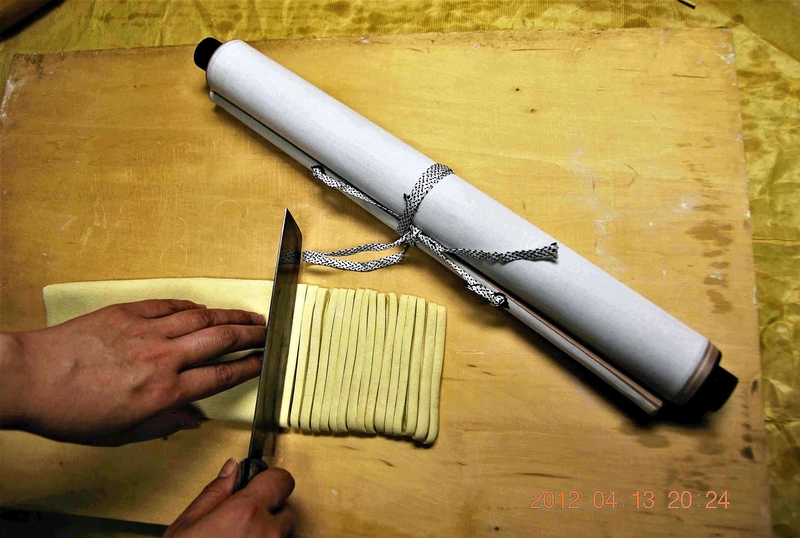
A zen monk believed to be a son of Emperor Godaigo and who was active during the Nanbokucho, or Southern and Northern Dynasties period in the 1300s, penned a description of keitaimen -- regarded as the predecessor of Chinese-style noodles -- in a poem.
The finding is attracting attention as it raises a question about the history of one of the nation's most popular dishes.
According to the Shin-Yokohama Ramen Museum in Yokohama and others, Chinese-style noodles are made by adding brine water, or alkaline salt aqueous solution, to flour to bring out the noodles' suppleness and firmness. The modern form of ramen is said to have become popular sometime after the Meiji period (1868-1912).
Mitsukuni was considered the first to eat ramen noodles in Japan primarily because records show that he learned how to cook them from a Chinese Confucian scholar in 1697 and fed the noodles to his vassals.
In 2017, with the cooperation of Toshiyuki Inasawa, a soba researcher and expert on the history of noodles, the museum confirmed the description of keitaimen noodles in a 1488 diary written by a monk in Kyoto, and publicized it as a record of the first Chinese noodles in Japan.
Later however, Hajime Yoshizawa, a Meisei University associate professor of Japan's medieval history, found a poem titled, "Keitaimen (noodles)," in "Shozanshu," a collection of Chinese poems written by zen monk Ryosen Ryozui during the Nanbokucho (1336-1392).
Yoshizawa published the results of the research earlier this year in the academic journal "History of the performing arts."
The poem says, "Look how it is stretched flat. That is so beautiful." This poem is believed to have been written in return for receiving the noodles.
"More information on how to eat keitaimen, for example, may be found in old literature in the future," Yoshizawa said.
Ryosen Ryozui spent several of his last years at Jotenji temple in the Hakata area of Fukuoka.
According to Koji Ito, a Kyushu University professor of Japan's medieval history, although Japan had tense relations with China, which was ruled by Mongolians who attempted to invade Japan, private trade was intermittently conducted with the port of Hakata as a gateway.
Jotenji also functioned as a venue for personal exchanges among trading merchants and zen monks.
"Jotenji was the place where the latest information and food culture of China were brought in. It is highly likely that Ryosen Ryozui also ate keitaimen while he was at the temple," Ito said.
Read more from The Japan News at https://japannews.yomiuri.co.jp/