Thailand's Consumer Council (TCC) and the Department of Rail Transport (DRT) are pushing for a major overhaul of Bangkok's traffic management system after a deadly train–bus collision exposed critical weaknesses at railway crossings.
The agencies cited problems, including non-integrated traffic signals that police cannot independently control.
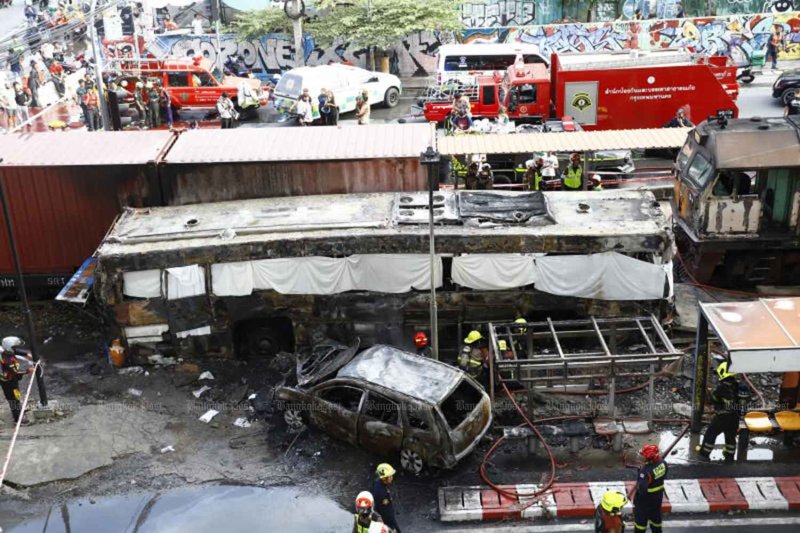
The May 16 crash at the Makkasan–Asok Din Daeng crossing killed eight people and injured more than 30, triggering urgent calls for reform.
Speaking on Tuesday, TCC secretary-general Saree Aongsomwang said agencies must urgently review the traffic system design and adopt intelligent technologies to improve traffic flow and strengthen accident prevention.
She said she visited the site on May 23 with deputy DRT director-general Athibhu Chitranukroh and a working group to inspect the Phaya Thai rail crossing and discuss the use of artificial intelligence.
Discussions with on-site traffic police identified a major limitation: officers stationed at traffic booths cannot directly adjust signals or switch them to automatic mode, but must coordinate with City Hall personnel who are not on-site.
"It raises the question of why Thailand, despite using automated traffic signals for so long, has not introduced AI to help frontline officials manage traffic problems," Ms Saree said.
"AI can immediately analyse traffic volumes and improve flow at intersections and key junctions without requiring massive investment."
She added that traffic management should be handled holistically rather than fragmented by police jurisdictions, warning that reforms in Thailand often take six months to a year -- far too slow given current challenges.
Mr Athibhu said Bangkok's railway crossings are highly complex, often involving overlapping intersections.
Following a May 22 meeting with traffic police, authorities agreed on short-term measures, including deploying more officers to prevent vehicles from stopping in yellow cross-hatched "Keep Clear" zones near railway tracks. The BMA will also be asked to operate traffic lights throughout the day.
For the longer term, the DRT plans to use AI to better coordinate signal timing between adjacent intersections. In collaboration with the Rail Technology Research Institute and Huawei Thailand, the department has piloted AI-enabled smart CCTV systems at several crossings in Nakhon Sawan.
The system detects vehicles trapped within railway barriers and alerts station masters, enabling them to warn train drivers to slow or stop. It had been scheduled for installation at the Asok Din Daeng crossing before the accident.
Separately, the Ministry of Transport has instructed the State Railway of Thailand to accelerate plans for elevated rail tracks from Phaya Thai to Hua Mak to eliminate key level crossings.