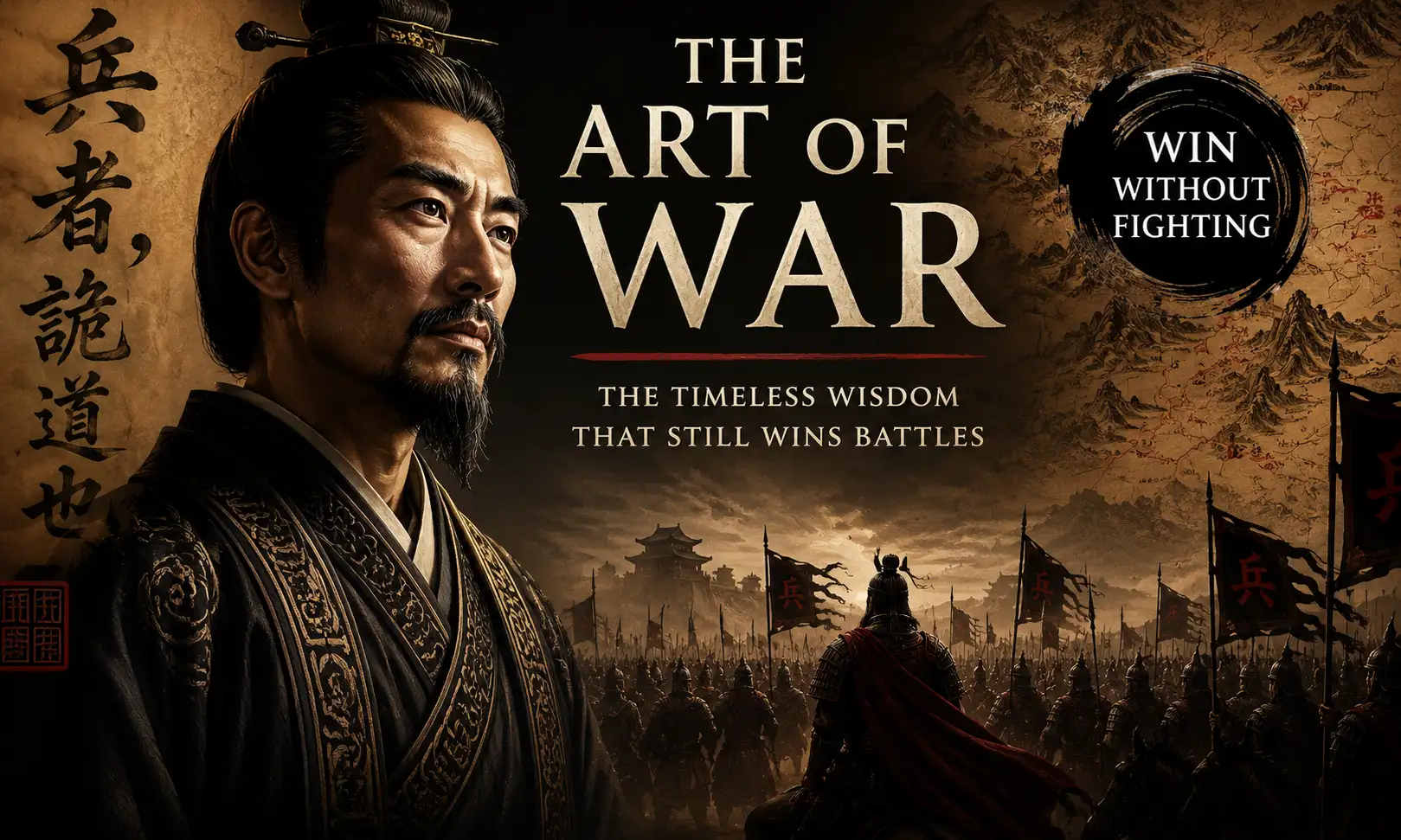
The Quote of the Day by Sun Tzu continues to resonate more than 2,500 years after it was written because it captures a timeless truth about human nature. At first glance, the quotation appears to be about warfare alone. Yet its deeper meaning reaches far beyond battlefields. It explores how people respond when there is no easy escape, no backup plan, and no choice except to move forward.
Modern psychology has repeatedly shown that necessity can transform behavior. People often perform beyond their perceived limits when circumstances demand it. Sun Tzu recognized this centuries before the language of behavioral science existed. In The Art of War , he observed that the greatest courage does not always come from fearless individuals—it often emerges when ordinary people are fully committed to a single course of action.
Meaning of the Quote of the Day by Sun Tzu
The quotation comes from Chapter 11 of The Art of War , titled "The Nine Situations." In this chapter, Sun Tzu explains that different environments require different strategies. Among these situations, the most extreme is Death Ground —a place where an army has no route of retreat, no safe refuge, and no option except survival through action.
Sun Tzu argues that removing the possibility of withdrawal fundamentally changes human psychology. Soldiers who might hesitate under ordinary conditions suddenly become focused, disciplined, and determined because hesitation itself becomes dangerous.
The idea is surprisingly modern. When distractions disappear and commitment becomes absolute, people often stop wasting energy on doubt. Their attention shifts entirely toward solving the problem in front of them.
Importantly, Sun Tzu does not recommend placing people in desperate situations without reason. His point is strategic rather than emotional. A wise leader creates conditions where commitment is stronger than fear, not where panic replaces planning.
The quote therefore teaches that clarity often appears when excuses disappear.
Who Was Sun Tzu and Why Does His Wisdom Still Matter?
Sun Tzu was an ancient Chinese military strategist, philosopher, and writer traditionally believed to have lived during the Eastern Zhou period, around the fifth century BCE. Although historians continue to debate aspects of his biography, his influence is beyond dispute.
His masterpiece, The Art of War , consists of just thirteen concise chapters. Despite its relatively short length, it has become one of history's most influential books on strategy.
What makes Sun Tzu remarkable is that he rarely glorifies conflict. Instead, he emphasizes intelligence over aggression, preparation over impulse, and understanding over force.
One of his best-known principles states that the highest form of victory is winning without fighting. This philosophy has attracted readers far beyond military circles. Business leaders, athletes, diplomats, political thinkers, and psychologists have all drawn lessons from his work because it focuses on decision-making rather than violence.
Centuries after it was written, The Art of War remains required reading in military academies around the world while also influencing management, negotiation, competitive sports, and leadership studies.
Sun Tzu's Main Works and Lasting Ideas
Although Sun Tzu is primarily known for The Art of War , the book itself contains a remarkably broad framework for understanding conflict.
Across its thirteen chapters, he discusses planning, leadership, deception, intelligence gathering, logistics, terrain, adaptability, discipline, and psychological advantage.
Several ideas have become universally recognized.
First, preparation matters more than reaction. Success usually depends on work completed long before a challenge begins.
Second, understanding both yourself and your opponent reduces uncertainty. One of his most famous observations advises that knowing both ensures confidence regardless of how many battles lie ahead.
Third, flexibility consistently defeats rigidity. Sun Tzu believed that effective leaders adjust their methods as circumstances change instead of clinging to fixed plans.
Finally, psychological strength often determines outcomes more than physical power. The "Death Ground" concept perfectly illustrates this belief by showing how mindset changes behavior under pressure.
These principles explain why the book continues to be studied alongside modern leadership and strategic thinking.
Why Do People Often Misunderstand This Famous Quote?
Many readers assume that Sun Tzu is encouraging people to create crises or intentionally eliminate every safety net.
That interpretation misses his larger argument.
The quote is not about seeking danger for its own sake. It is about recognizing how commitment transforms motivation.
Modern life offers countless opportunities to delay decisions, abandon goals, or switch directions whenever progress becomes uncomfortable. Sun Tzu observed that too many escape routes can weaken determination because the mind continues calculating alternatives instead of focusing on execution.
The lesson is psychological rather than literal.
A student preparing seriously for an examination, an entrepreneur launching a company, or an athlete training for competition all understand this principle. Meaningful progress usually begins when distractions shrink and commitment grows.
The quote reminds readers that genuine dedication often produces abilities they never knew they possessed.
What Life Lessons Can We Learn from Sun Tzu's Death Ground Philosophy?
The first lesson is that commitment creates momentum. Once people stop dividing their attention between success and retreat, they often perform with greater confidence.
The second lesson is that preparation makes courage possible. Sun Tzu never separates bravery from planning. Confidence grows from readiness, not wishful thinking.
Another lesson concerns leadership. Great leaders inspire people to believe that shared goals matter enough to deserve complete effort. They do not motivate through fear alone but through purpose and clarity.
The quote also teaches resilience. Difficult moments reveal strengths that comfortable circumstances often hide. Challenges do not automatically make people stronger, but they frequently uncover strengths developed long before the crisis arrived.
Perhaps the most practical lesson is to stop treating uncertainty as proof of failure. Many important achievements begin with situations that feel uncomfortable because growth almost always requires leaving familiar ground behind.
Technology has changed the world dramatically since Sun Tzu wrote The Art of War , yet human psychology remains remarkably familiar.
People still struggle with fear, hesitation, uncertainty, and difficult choices. Leaders still face complex decisions under pressure. Teams still succeed or fail based on preparation, trust, and adaptability.
That is why the Quote of the Day by Sun Tzu continues to feel relevant. It reminds readers that extraordinary determination rarely appears before commitment. Instead, commitment often creates extraordinary determination.
The wisdom of "Death Ground" is ultimately not about war. It is about understanding how human beings respond when purpose becomes stronger than fear. In every generation, those moments reveal a simple but enduring truth: our greatest strength often emerges only after we stop looking for the easiest way out.