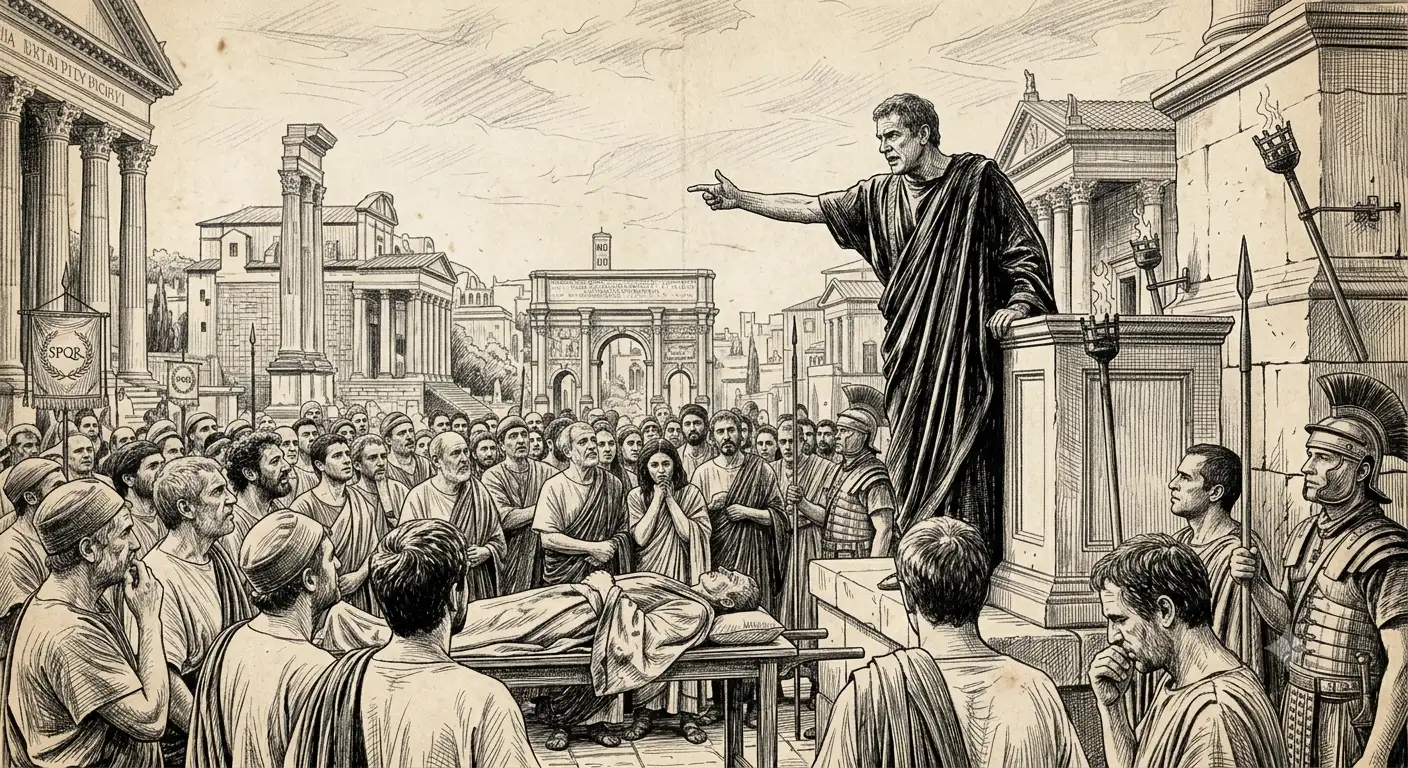
Quote of the day by Marc Antony : Public speeches have the power to influence emotions, challenge assumptions, and even change the course of history. There are many famous speeches that have shaped the way people think, but few are as enduring as Roman politician and general Marc Antony's funeral address in playwright William Shakespeare's Julius Caesar. Delivered in the aftermath of Julius Caesar's assassination, the speech is remembered not only for its emotional impact but also for the way it gradually transforms public opinion. Even centuries after Shakespeare wrote the play, Antony's words continue to demonstrate how carefully chosen language can challenge assumptions and inspire critical thinking.
Quote of the Day by Marc Antony from William Shakespeare's Julius Caesar
Marc Antony said, " Friends, Romans, countrymen, lend me your ears; I come to bury Caesar, not to praise him ."
These iconic opening lines introduce Marc Antony's funeral speech in William Shakespeare's Julius Caesar, one of the most celebrated speeches in English literature.
Marc Antony's Famous "Friends, Romans, Countrymen" Speech in Julius Caesar
Here is the full speech given by Marc Antony in William Shakespeare's play, Julius Caesar.
"Friends, Romans, countrymen, lend me your ears;
I come to bury Caesar, not to praise him.
The evil that men do lives after them;
The good is oft interred with their bones;
So let it be with Caesar. The noble Brutus
Hath told you Caesar was ambitious:
If it were so, it was a grievous fault,
And grievously hath Caesar answer’d it.
Here, under leave of Brutus and the rest–
For Brutus is an honourable man;
So are they all, all honourable men–
Come I to speak in Caesar’s funeral.
He was my friend, faithful and just to me:
But Brutus says he was ambitious;
And Brutus is an honourable man.
He hath brought many captives home to Rome
Whose ransoms did the general coffers fill:
Did this in Caesar seem ambitious?
When that the poor have cried, Caesar hath wept:
Ambition should be made of sterner stuff:
Yet Brutus says he was ambitious;
And Brutus is an honourable man.
You all did see that on the Lupercal
I thrice presented him a kingly crown,
Which he did thrice refuse: was this ambition?
Yet Brutus says he was ambitious;
And, sure, he is an honourable man.
I speak not to disprove what Brutus spoke,
But here I am to speak what I do know.
You all did love him once, not without cause:
What cause withholds you then, to mourn for him?
O judgment! thou art fled to brutish beasts,
And men have lost their reason. Bear with me;
My heart is in the coffin there with Caesar,
And I must pause till it come back to me," as per Poetry Foundation.
What Marc Antony's Quote Means
Although Antony begins by appearing to respect Brutus and the conspirators, his speech slowly encourages the Roman people to reconsider their judgment. By highlighting Caesar's compassion, generosity, and refusal of the crown, he invites the crowd to question whether ambition was truly Caesar's greatest fault.
Rather than arguing openly, Antony relies on facts, emotion, and irony to let his audience reach their own conclusions.
Why the Speech Still Matters Today
Marc Antony's words remain relevant because they illustrate the lasting influence of persuasive communication. They remind people to think independently, question popular opinions, and carefully examine the evidence before accepting widely held beliefs.
Life Lesson from Marc Antony's Speech
The speech teaches that wisdom comes from listening carefully, questioning assumptions, and forming opinions based on thoughtful reflection rather than emotion alone. It also shows that the way a message is delivered can be just as powerful as the message itself.
Who Was Mark Antony
Mark Antony (83–30 BCE) was a Roman general and politician who served under Julius Caesar and later became a member of the Second Triumvirate with Octavian and Lepidus. His alliance with Cleopatra and defeat by Octavian marked the end of the Roman Republic, according to a Britannica report.
Mark Antony's Early Career
Antony gained military experience in Judaea, Egypt, and Gaul while serving alongside Julius Caesar. He later became quaestor, joined the Roman Senate, and rose to become one of Caesar's closest allies.
Mark Antony After Julius Caesar's Death
Following Caesar's assassination in 44 BCE, Antony emerged as a leading political figure. In 43 BCE, he formed the Second Triumvirate with Octavian and Lepidus, and together they defeated Brutus and Cassius at the Battle of Philippi, as per the Britannica report.
Mark Antony and Cleopatra
While governing Rome's eastern territories, Antony formed a political and personal alliance with Cleopatra, queen of Egypt. Their partnership became central to the conflict with Octavian.
Mark Antony's Legacy
After losing the Battle of Actium in 31 BCE, Antony retreated to Alexandria, where he died in 30 BCE, as per the Britannica report. He remains one of the most significant figures of Classical antiquity, remembered for his military leadership, political career, and relationship with Cleopatra.